Understanding symmetry Adding up to 50 Misc Worksheets for Ages 5-7
3 filtered results
-
From - To
Unlock your child's mathematical potential with our "Understanding Symmetry Adding up to 50 Misc Worksheets for Ages 5-7"! These engaging and educational worksheets are specially designed to teach young learners about symmetry and addition in a fun, interactive way. Perfect for kids aged 5 to 7, the colorful printables guide children through the concepts of symmetry while enhancing their skills at adding numbers up to 50. Encourage your child’s curiosity and love for math with activities that blend creativity and logical thinking, providing the perfect foundation for future mathematical success. Enhance learning at home or in the classroom!
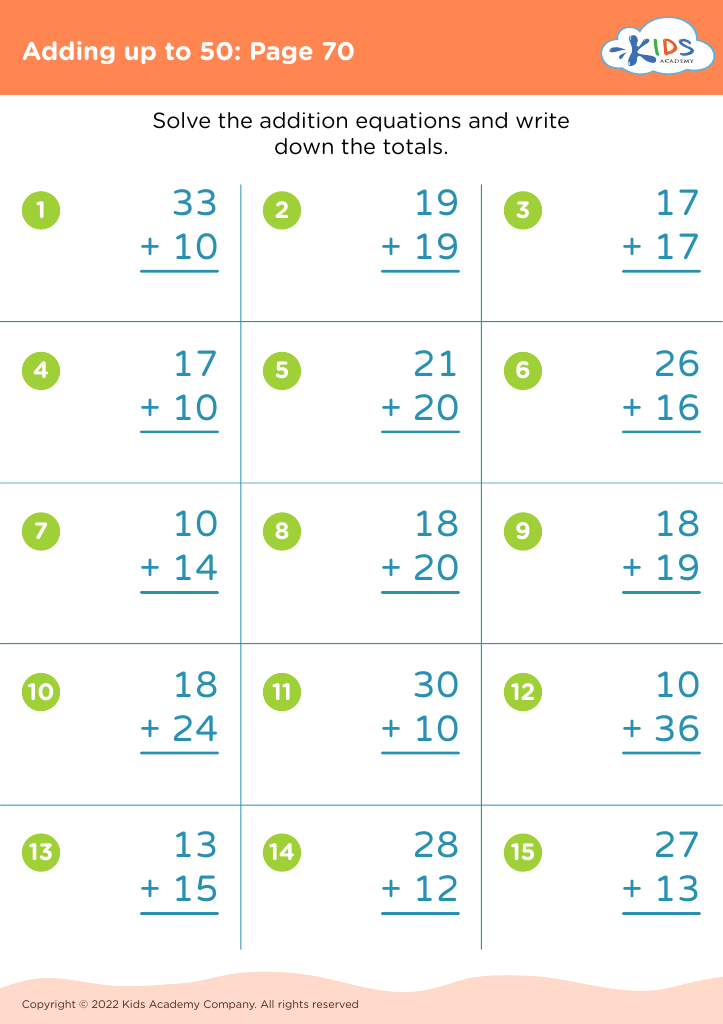


Understanding symmetry, learning to add up to 50, and various additional miscellaneous skills are foundational for children aged 5-7 for several reasons. Symmetry helps young learners grasp basic concepts of geometry, which is essential for spatial sense and visual processing. When children recognize symmetry, they better understand balance and proportion, skills crucial for higher-level math and real-world tasks, like reading maps or creating art.
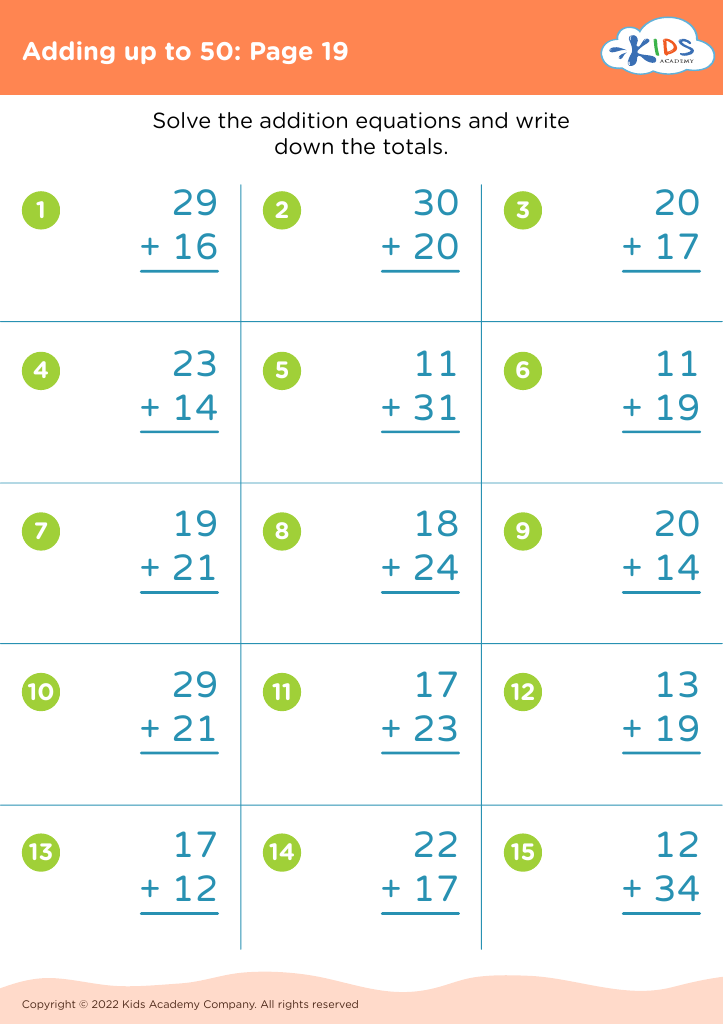
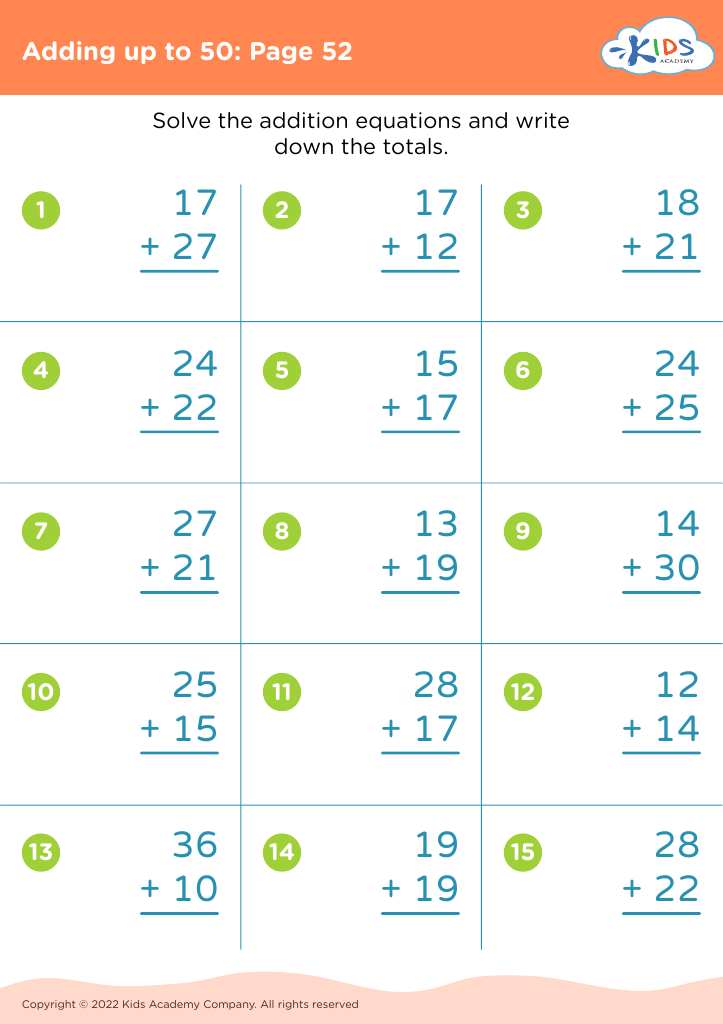
Learning to add up to 50 is critical as it establishes a strong arithmetic foundation. Mastery in basic addition fosters number sense and prepares children for more complex operations like subtraction, multiplication, and division. It also promotes problem-solving skills, logical thinking, and mental computation, which are invaluable in daily life.
Incorporating various miscellaneous skills fosters holistic development. Be it honing fine motor skills through writing, developing emotional intelligence through social interactions, or nurturing creativity through arts and crafts, these activities contribute to a well-rounded education.
Early exposure to these concepts under the guidance of caring teachers and parents creates a positive and enriching learning environment. It boosts confidence, encourages a love for learning, and equips children with the necessary tools to succeed academically and in life. Therefore, their involvement and understanding are paramount to children's growth during these formative years.