Color Identification Addition & Subtraction Worksheets for Ages 5-7 - Page 2
27 filtered results
-
From - To
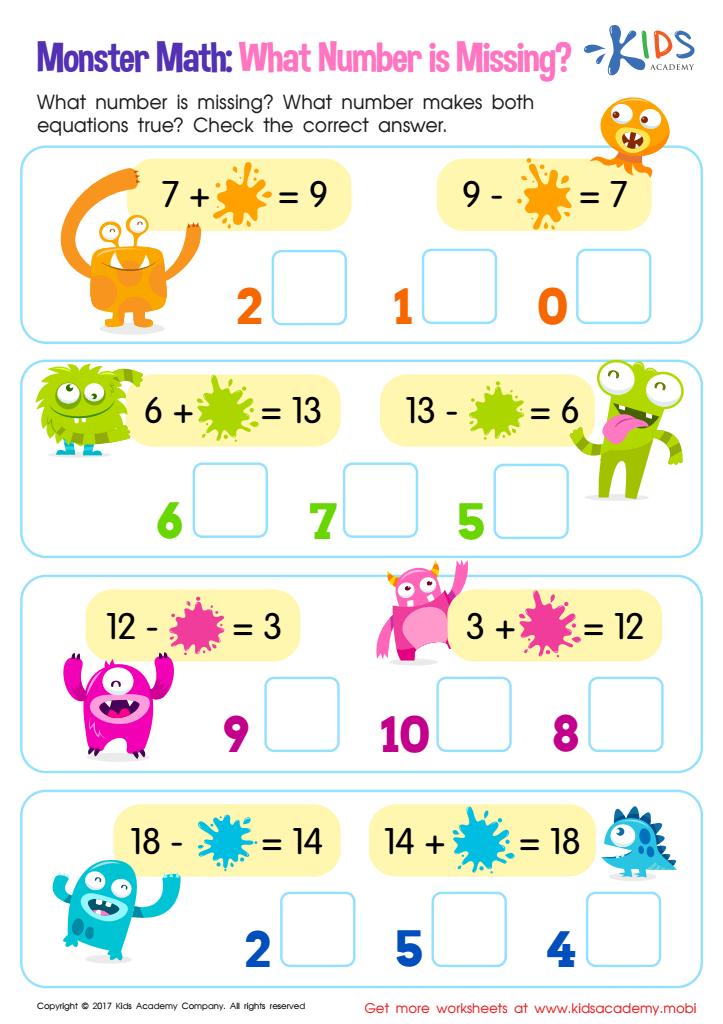
Missing Number: Monster Math Worksheet
 Assign to My Students








Color Identification, along with Addition and Subtraction, plays a crucial role in the early educational development of children aged 5-7. First, understanding colors enhances cognitive development and creative thinking. It allows children to classify objects and add vibrancy to their learning experiences. Furthermore, when colors are integrated into math—especially addition and subtraction—learning becomes more engaging. For example, using colored objects or guided illustrations facilitates a visual learning style, making abstract concepts like math more tangible and memorable.
Teachers and parents should also recognize that children in this age group are developing foundational number sense. When math concepts are intertwined with color identification, it helps reinforce critical thinking and problem-solving skills. It encourages children to group numbers by color while adding or subtracting, promoting not just mathematical skills but also fine motor skills through hands-on play.
Additionally, early mastery of these concepts paves the way for more complex math skills later on. Encouraging color identification in math can ignite a love for learning that helps shape a child's academic journey. Ultimately, utilizing color in addition and subtraction lessons provides a holistic approach to learning that nurtures both cognitive growth and creativity in young learners.








