
Enhancing math skills Addition & Subtraction Worksheets for Ages 5-7
6 filtered results
Difficulty Level
Grade
Age
-
From - To
Subject
Activity
Standards
Unlock your child's mathematical potential with our comprehensive Addition & Subtraction Worksheets for Ages 5-7. Designed to make learning fun and engaging, these worksheets help young learners develop crucial math skills through a variety of interactive activities. Students will practice basic addition and subtraction, solidifying their understanding of fundamental concepts and boosting their confidence in mathematics. Tailored for early grade students, our worksheets foster a love for learning while enhancing problem-solving abilities. Give your child the tools they need for academic success and set the foundation for future mathematical achievements with our expertly crafted resources.
Favorites
With answer key
Interactive
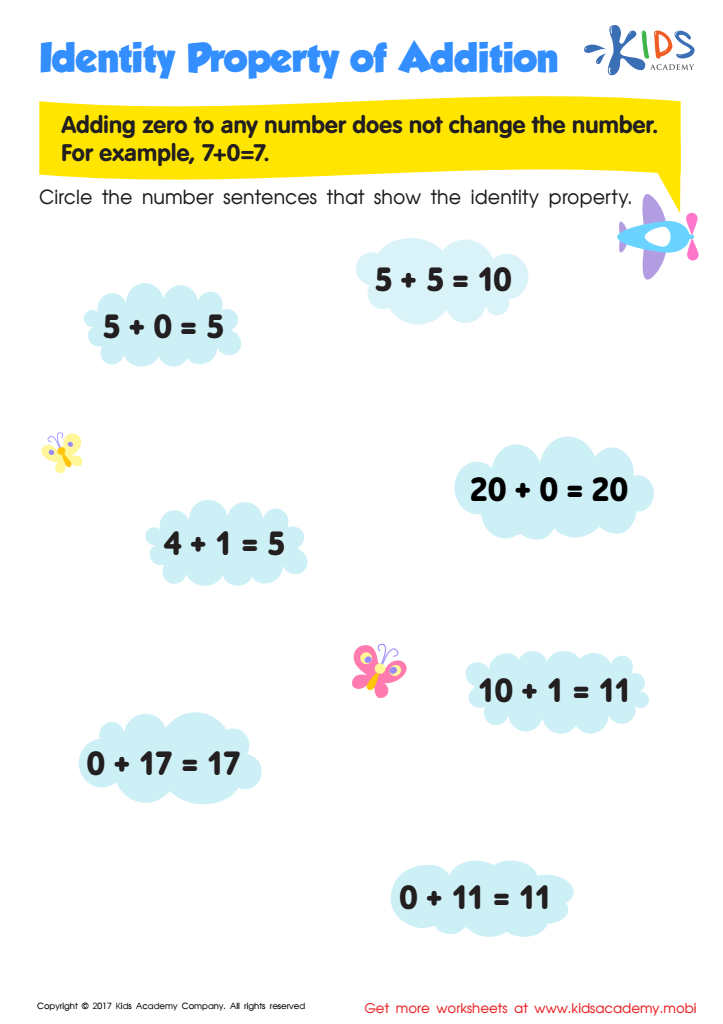
Identity Property of Addition Worksheet
Kids must learn the identity property of addition in math. It states that adding zero to an equation does not change the number. A great way to help kids understand this concept is with a Kids Academy worksheet. It encourages kids to identify which number sentences demonstrate the identity property of addition. Doing so builds vital mental math skills for fast addition.
 Assign to My Students
Identity Property of Addition Worksheet
Worksheet
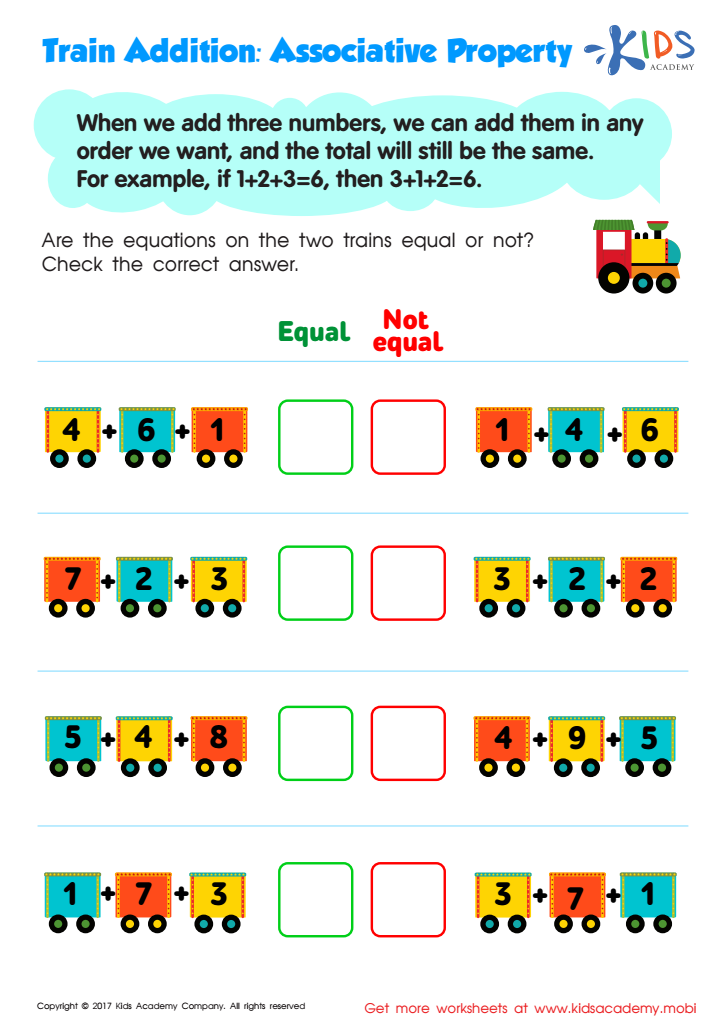
Train Addition: Associative Property Worksheet
The associative property of addition lets us add numbers in any order. Total will remain the same. Help kids practice this pre-algebra skill with a train-themed worksheet. It will help them understand if the equations are equal using this property.
Train Addition: Associative Property Worksheet
Worksheet
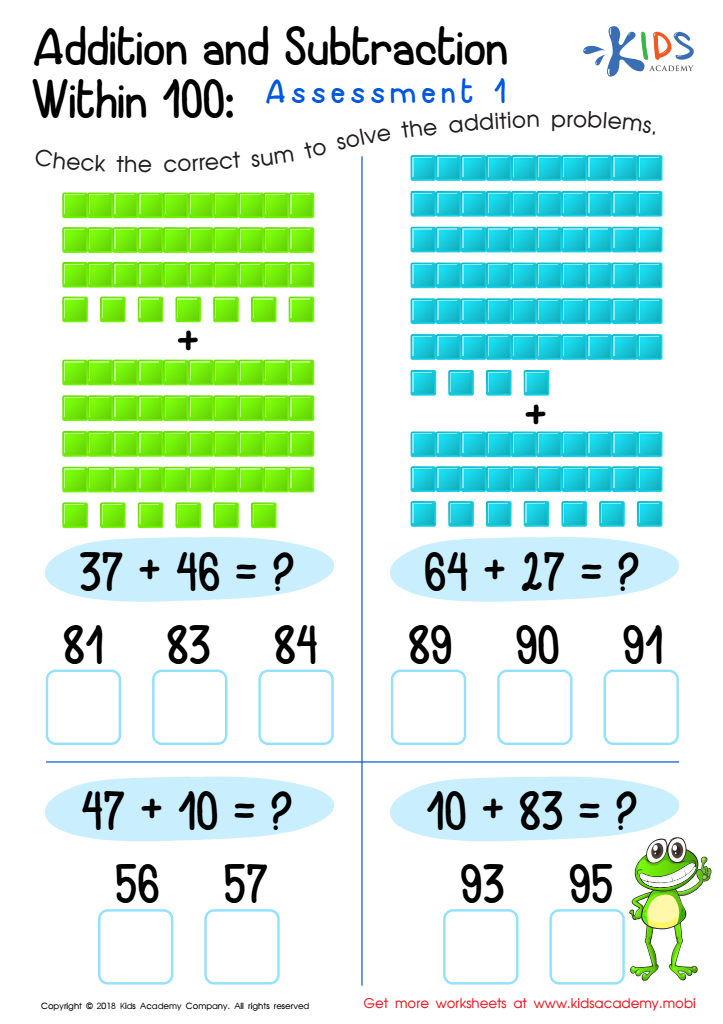
Addition and Subtraction Within 1: Assessment 1 Worksheet
Help your kids develop their math skills with this worksheet! Addition and subtraction can be daunting for young learners, but you can make it easier for them with this pdf. Use it to check the correct sum and help them solve the addition problems. This is a great way to get them ready to be future great mathematicians.
Addition and Subtraction Within 1: Assessment 1 Worksheet
Worksheet
Join Kids Academy for Free
Who is primarily going to use this learning content?








Enhancing math skills, specifically addition and subtraction, for children ages 5-7 is essential for several reasons. At this developmental stage, kids are like sponges; they absorb information rapidly. Establishing a strong foundation in these basic arithmetic skills sets the stage for future mathematical learning and problem-solving abilities. Understanding addition and subtraction is not just about numbers; it's about cognitive development. These operations teach children important concepts such as grouping, sequencing, and number sense.
Poor math skills early on can lead to greater academic difficulties later. Children who struggle with basic math may suffer from math anxiety, which can affect their performance and attitude towards the subject as they grow older. This anxiety can ripple into other subjects and general academic confidence.
On a practical level, basic arithmetic is essential for everyday life. Counting money, telling time, and even basic decision-making often require the use of addition and subtraction. Encouraging proficiency in these areas helps children navigate their environments more independently and confidently.
Moreover, early success in math fosters a positive attitude and builds self-esteem, motivating children to tackle more complex problems. Therefore, parents and teachers should prioritize enhancing math skills at this critical age to promote lifelong learning and development.








