
Enhancing math skills Addition Worksheets for Ages 5-7
4 filtered results
Difficulty Level
Grade
Age
-
From - To
Subject
Activity
Standards
Enhance your child's math skills with our engaging Addition Worksheets, specially designed for孩子 ages 5-7. These worksheets make learning seamless and fun, fostering a deep understanding of basic addition concepts. Each activity contains colorful illustrations to capture kids' attention and interactive problems that challenge their thinking. As they progress through various exercises, students build confidence and master essential math skills necessary for future learning. Parents can easily print the worksheets for use at home or in the classroom. Strengthen your child's foundation in math today with our carefully crafted addition resources that inspire and motivate young learners!
Favorites
With answer key
Interactive
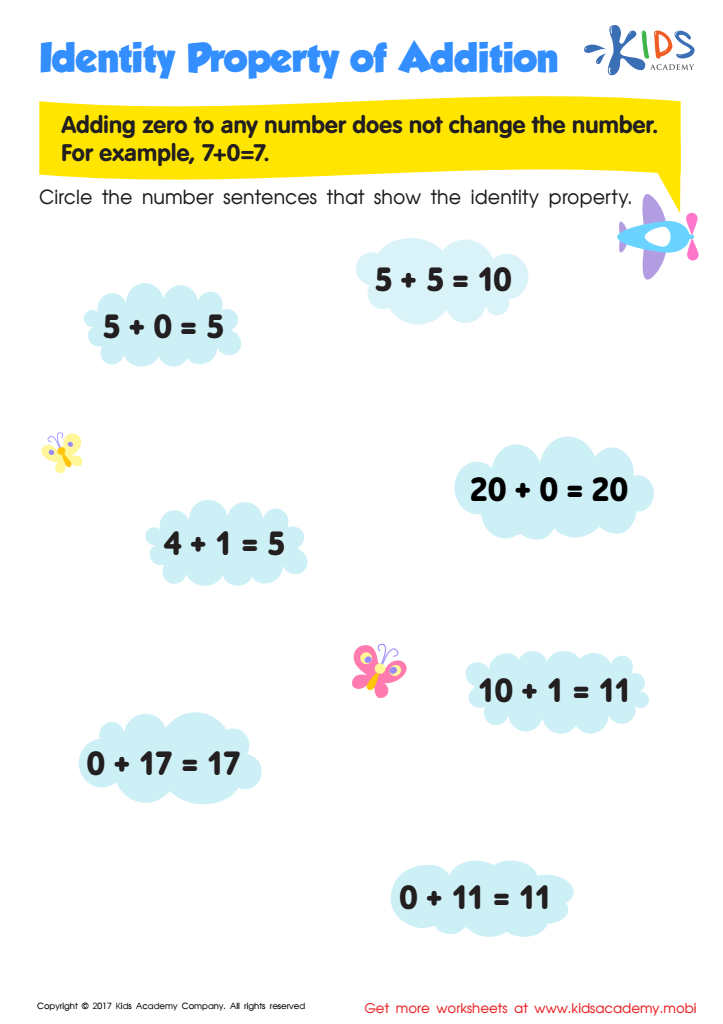
Identity Property of Addition Worksheet
Kids must learn the identity property of addition in math. It states that adding zero to an equation does not change the number. A great way to help kids understand this concept is with a Kids Academy worksheet. It encourages kids to identify which number sentences demonstrate the identity property of addition. Doing so builds vital mental math skills for fast addition.
 Assign to My Students
Identity Property of Addition Worksheet
Worksheet
Join Kids Academy for Free
Who is primarily going to use this learning content?








Enhancing math skills, particularly addition, for children ages 5-7 is vital for several reasons. At this age, children develop foundational numeracy skills that are critical for future mathematical understanding. Strong addition skills promote not only academic growth but also cognitive development, as children learn to process and solve problems systematically. Mastery of these basic mathematical principles can boost a child’s confidence and enthusiasm towards math, helping to foster a positive attitude towards learning overall.
Moreover, early math skills are linked to later success in more complex mathematics. Research shows that children who develop a solid understanding of addition often excel in higher-level math, laying the groundwork for subjects like subtraction, multiplication, and division. When parents and teachers prioritize enhancing these skills, they can create a supportive environment that encourages exploration and curiosity.
Furthermore, engaging in fun, interactive activities can strengthen a child’s comprehension of addition, making learning enjoyable. As math is a part of daily life, fostering these skills also prepares children for practical situations, such as shopping or sharing. In short, by supporting the enhancement of addition skills, parents and teachers are nurturing lifelong learners equipped for success both academically and practically.








