
Observation skills Addition Worksheets for Ages 5-7
3 filtered results
Difficulty Level
Grade
Age
-
From - To
Subject
Activity
Standards
Develop keen observation skills for children ages 5-7 with our engaging addition worksheets. Each printable worksheet is designed to enhance critical thinking and improve mathematical abilities. Through fun and interactive activities, these worksheets help young learners identify patterns, recognize differences, and solve addition problems effectively. By integrating observation with basic math, we lay a strong foundation for future academic success. Ideal for both classroom and home use, our expertly crafted worksheets encourage children to focus, analyze, and master essential addition skills. Nurture your child's cognitive development with our thoughtfully designed printables that make learning both enjoyable and effective.
Favorites
With answer key
Interactive
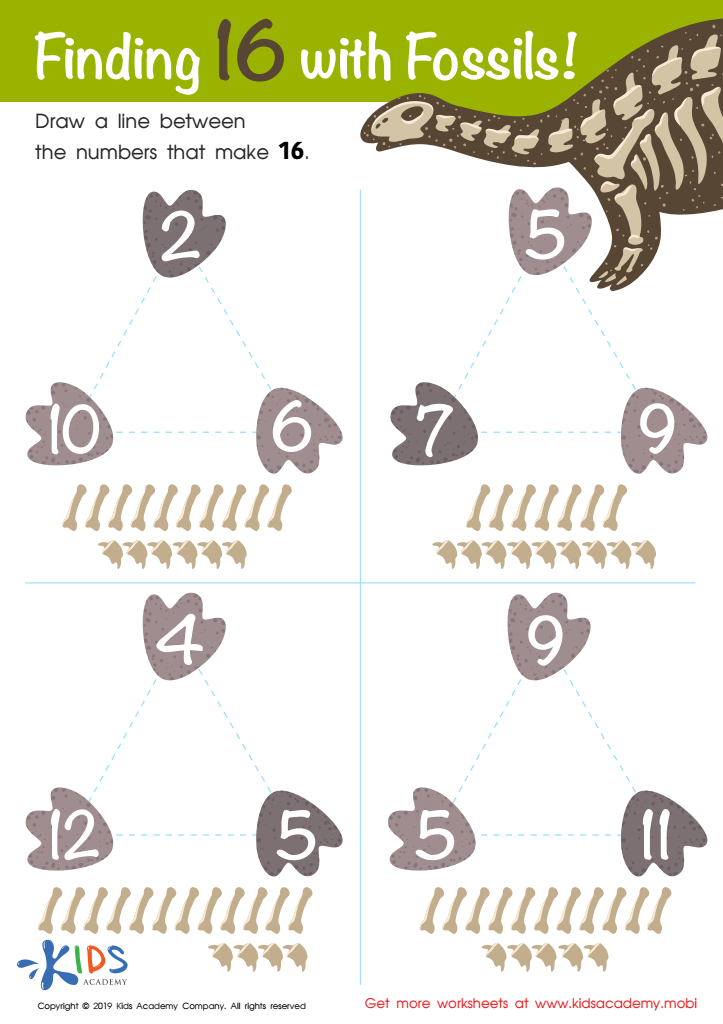
Finding 16 With Fossils Worksheet
Experts hunt for fossils, dig them up, and study them to learn more about past life forms - how they lived, what they looked like, and when they lived. Show kids the picture in this worksheet and point out the fossils. Help them count the bones and draw a line between the numbers that add up to 16 in each triangle.
 Assign to My Students
Finding 16 With Fossils Worksheet
Worksheet
Join Kids Academy for Free
Who is primarily going to use this learning content?







.jpg)
Observation skills are foundational for young children's overall development, and parents and teachers should prioritize nurturing these abilities in children aged 5-7. At this stage, children's brains are rapidly growing, making it an ideal time to sharpen their observation skills, which are crucial for cognitive and social development.
Firstly, keen observation aids in academic success. By noticing details in their environment, children become more adept at understanding concepts in subjects like science and math. For example, recognizing patterns, sorting objects, or spotting differences contributes to problem-solving skills and logical thinking.
Secondly, observation skills enhance language acquisition. By paying attention to speech nuances, facial expressions, and body language, children can improve their communication skills. This is crucial for reading and writing development, as it helps them better grasp letters, sounds, and words.
Moreover, social development benefits greatly when children can observe others’ emotions and behaviors, enabling empathy and effective interaction with peers. This equips them with a better understanding of social cues.
Lastly, fine-tuning observation skills sparks curiosity and encourages children to explore their surroundings, fostering a lifelong love for learning. Parents and teachers who emphasize these skills set children on a path to becoming attentive, inquisitive, and articulate learners, which benefits their academic and personal growth immensely.








