
Cognitive skill development Math Worksheets for Ages 5-7
3 filtered results
Difficulty Level
Grade
Age
-
From - To
Subject
Activity
Standards
Enhance your child's cognitive skills with our engaging math worksheets designed specifically for ages 5-7! Our printable resources nurture critical thinking, problem-solving, and analytical abilities through fun math activities. Each worksheet incorporates appealing visuals and age-appropriate challenges that help children master essential math concepts while developing important cognitive skills. As children explore counting, addition, and simple subtraction, they will boost their confidence and foster a love for learning. Let your little ones embark on a mathematical adventure that stimulates their minds and prepares them for future academic success! Explore our collection today and watch their cognitive abilities flourish!
Favorites
With answer key
Interactive
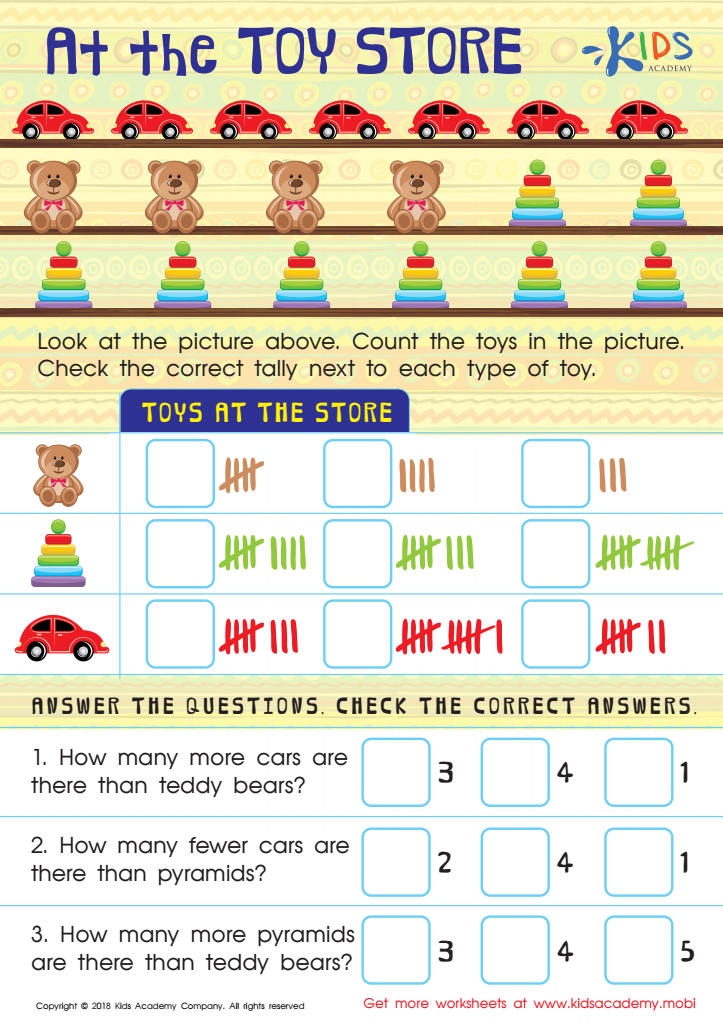
Tally Chart: At the Toy Store Worksheet
Kids Academy has a fun worksheet to help kids practice counting and using tally marks! They can think about the number of toys and compare them. At the bottom, help them answer the questions about the toys on this math page. It's an easy way to learn that one tally mark equals one item.
 Assign to My Students
Tally Chart: At the Toy Store Worksheet
Worksheet
Join Kids Academy for Free
Who is primarily going to use this learning content?








Cognitive skill development in math for children aged 5-7 is crucial for several reasons. At this early stage, children undergo significant brain development, making it an optimal time for them to build a strong foundation in mathematical concepts. Developing these skills enhances their problem-solving abilities, critical thinking, and logical reasoning, essential traits for lifelong success.
Math skills learned during these formative years can set the stage for future academic achievement. A solid understanding of basic math concepts—such as numbers, addition, subtraction, and patterns—helps children transition smoothly into more complex topics as they progress in school. Additionally, engaging with math promotes confidence and curiosity, empowering children to explore and understand the world around them.
Moreover, math shouldn't be perceived as a solitary subject; it intersects with literacy, science, and real-world problem-solving. By scaffolding cognitive skill development in math, parents and teachers can help develop well-rounded learners who apply these skills beyond academic settings.
Furthermore, early math experiences can mitigate future learning challenges, ensuring all children have equitable access to educational opportunities. Therefore, prioritizing cognitive skill development in math during ages 5-7 lays the groundwork for a child's academic journey and fosters essential life skills.








