
Learning subtraction Math Worksheets for Ages 5-7
3 filtered results
Difficulty Level
Grade
Age
-
From - To
Subject
Activity
Standards
Unlock your child's potential with our engaging "Learning Subtraction Math Worksheets" for ages 5-7. Designed to build a strong foundational understanding, these interactive worksheets make learning subtraction fun and easy. Bright visuals and hands-on activities encourage young learners to practice subtracting numbers with confidence. Whether your child is just beginning to explore math or looking to refine their skills, our worksheets provide the perfect blend of challenge and support to facilitate growth. Empower your child to master essential subtraction skills and develop a love for learning through our thoughtfully crafted, grade-appropriate worksheets.
Favorites
With answer key
Interactive
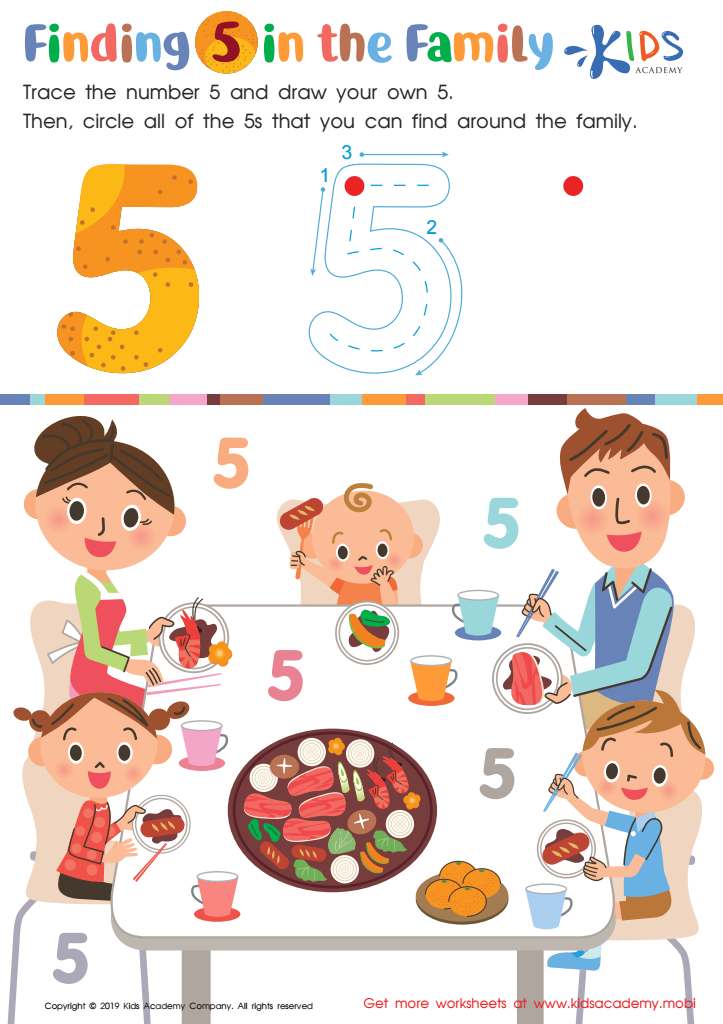
Finding 5 in the Family Worksheet
This worksheet helps kids identify and write the number 5. Ask what the family is doing and who the family members are. Help them trace and draw the 5, then have them circle all 5s in the picture.
 Assign to My Students
Finding 5 in the Family Worksheet
Worksheet
Join Kids Academy for Free
Who is primarily going to use this learning content?


%20(1).jpg)

.jpg)



Teaching subtraction to children aged 5-7 is crucial for their cognitive and academic development. At this age, kids are exploring the basics of numeracy, and subtraction is a fundamental arithmetic skill that underpins future mathematical learning. Parents and teachers should care about it because subtraction helps develop critical thinking and problem-solving abilities. It’s more than just taking numbers away; it’s about understanding relationships between quantities and how they change.
Moreover, mastering subtraction contributes to a child’s confidence in math. Early success and comfort with subtraction can foster a positive attitude toward more complex mathematical concepts in later grades. Subtraction also has real-world applications that children encounter regularly, like determining remaining objects when sharing toys or calculating how much time is left before a playdate ends. This practical knowledge equips kids to handle everyday situations efficiently.
From a developmental perspective, learning subtraction enhances memory, attention to detail, and logical reasoning. It also provides a solid foundation for advanced subjects like algebra, geometry, and calculus. By emphasizing subtraction at an early age, parents and teachers are setting the stage for lifelong numeracy skills, ensuring children are not only prepared for higher education but also capable of logical thinking in numerous real-life contexts.








