Telling time Math Worksheets for Ages 5-7
4 filtered results
-
From - To
Discover engaging "Telling Time" math worksheets tailored for ages 5-7 at Kids Academy. Our expertly designed printables introduce young learners to reading analog and digital clocks, understanding hours and minutes, and practicing time-related problems. Each worksheet features colorful illustrations and interactive exercises to make learning fun and effective. These resources support fundamental time-telling skills crucial for everyday life. Perfect for classroom or home use, our worksheets help children build confidence and proficiency in math through hands-on practice. Explore our collection to help your child master the art of telling time in an enjoyable and educational way.
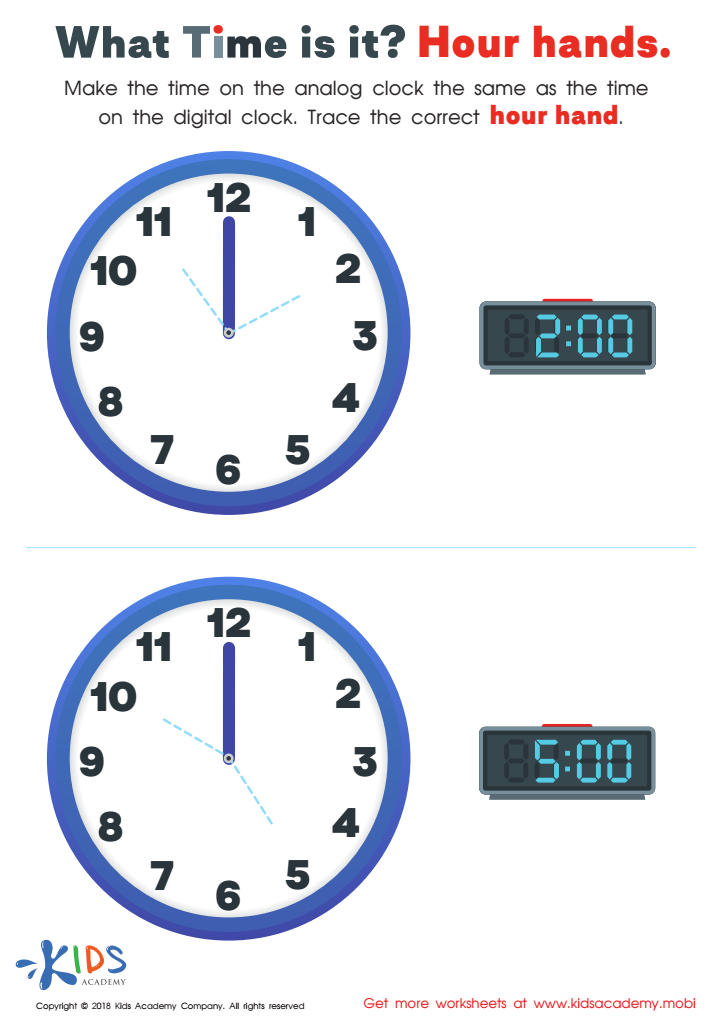
What Time Is it? Hour Hands Worksheet
 Assign to My Students





.jpg)


Parents and teachers should care about teaching children ages 5-7 how to tell time because it lays a crucial foundation for both mathematical and life skills development. At this formative stage, children are beginning to grasp basic number concepts, and learning to tell time on an analog clock directly leverages these skills. It helps them understand sequences, durations, and the idea of before and after.
Telling time also builds their cognitive abilities by integrating several skill sets. Recognizing numbers, understanding the position of the hour and minute hands, and correlating these with actual daily activities consolidate their learning in both numerical and practical contexts. This multi-faceted learning develops fine motor skills as they point to different numbers and can include writing practice when they depict times on blank clock faces.
Moreover, understanding time fosters responsibility and time management, skills that are important for academic success and daily life. It helps children conform to routines, understand transitions between activities, and the limited nature of time, promoting discipline.
Parents and teachers nurturing these skills help children assimilate concepts crucial to their effective functioning. Preventing time-related frustrations, this understanding substantially supports their transitions to more complex mathematical concepts and nurtures a sense of autonomy and self-efficacy prosocially.








