
Understanding grouping Math Worksheets for Ages 5-7
3 filtered results
Difficulty Level
Grade
Age
-
From - To
Subject
Activity
Standards
"Understanding Grouping Math Worksheets for Ages 5-7" will transform your child's math learning journey. Tailored for young minds, these worksheets simplify the concept of grouping, helping kids understand the basics of addition, subtraction, and number sense. Exercises feature colorful illustrations and engaging activities that make learning fun and effective. Designed in line with educational standards, our resources foster critical thinking and problem-solving skills. Perfect for classroom use or extra practice at home, these worksheets set a strong foundation in math that boosts confidence and competence in young learners. Start exploring today to enhance your child's math abilities!
Favorites
With answer key
Interactive
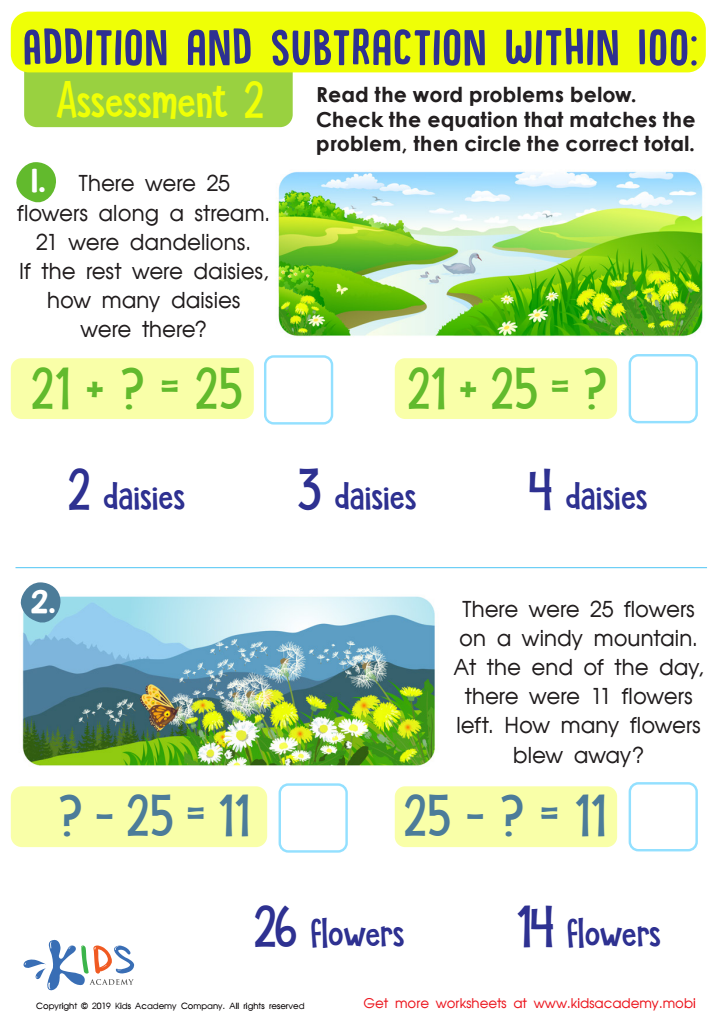
Assessment 2 Math Worksheet
Using fun exercises and pictures, you can get kids excited about math. With practice and reminders of what they've learnt, they'll be solving simple addition and subtraction equations with ease. Read the word problems in the picture to them, then help them check the equation and choose the correct answer.
 Assign to My Students
Assessment 2 Math Worksheet
Worksheet
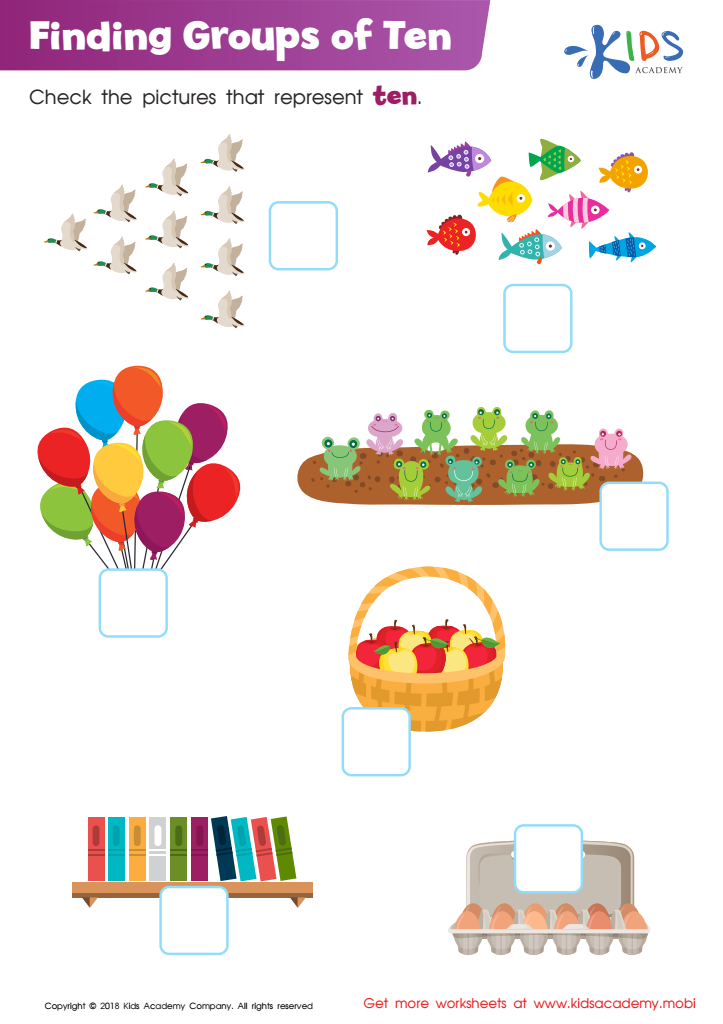
Finding Groups of Ten Worksheet
Can your kids count? If they can't go higher than tens, introduce them to this worksheet. Counting can be fun and easy with this exercise. Ask if they can identify the pictures, then help them count each group. Help them check the pictures that represent ten.
Finding Groups of Ten Worksheet
Worksheet
Join Kids Academy for Free
Who is primarily going to use this learning content?


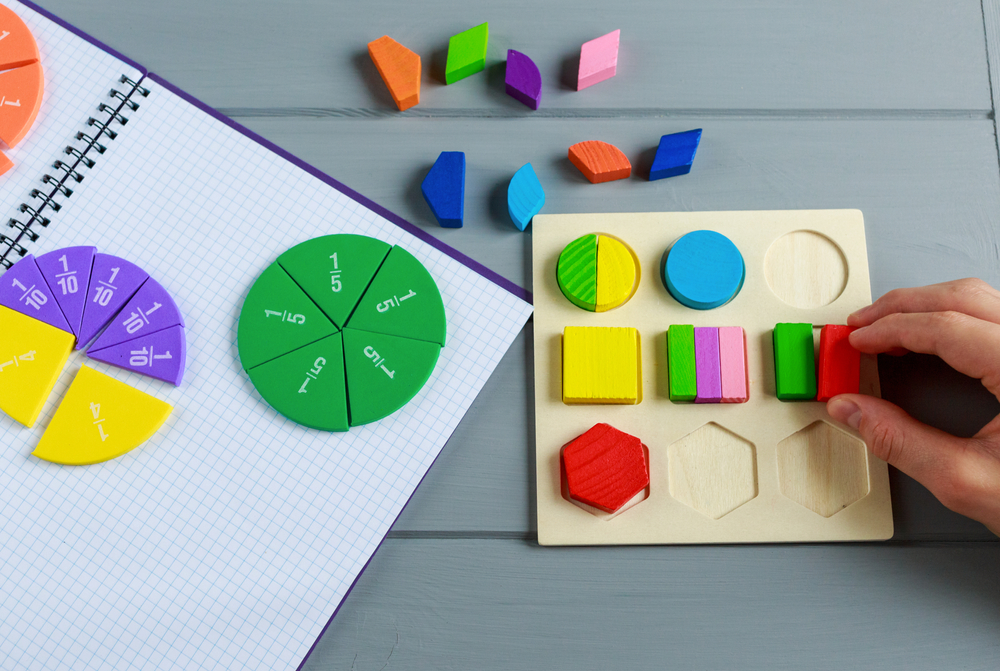




Understanding grouping math, or the concept of organizing objects into sets, is fundamental for children aged 5-7 because it lays the groundwork for more advanced mathematical skills. At this early stage, children are developing their ability to recognize patterns, categorize objects, and understand quantity, all of which are key components of mathematical thinking.
Firstly, grouping aids in the development of number sense. When children group objects, whether by size, color, or shape, they begin to understand the concept of "how many" in each group, which is a precursor to addition and subtraction. For example, grouping helps them visualize that 5 blocks and 3 blocks together make 8 blocks, fostering an intuitive grasp of combining numbers.
Secondly, it enhances cognitive skills. Grouping requires sorting and classifying, exercises that bolster problem-solving and critical thinking. These skills are not only vital in math but also in everyday decision making and scientific reasoning.
Lastly, mastering grouping math boosts confidence. Success in early math can create a positive feedback loop, encouraging a child to tackle more complex problems with assurance. Engaging parents and teachers in recognizing and nurturing these grouping activities can create a supportive learning environment that promotes a lifelong love of mathematics.
In summary, focusing on grouping math for young children builds essential foundational skills, enhances cognitive development, and fosters confidence, all of which are crucial for their academic and everyday life success.








