
Understanding number bonds Math Worksheets for Ages 5-7
3 filtered results
Difficulty Level
Grade
Age
-
From - To
Subject
Activity
Standards
Boost your child's mathematical skills with our "Understanding Number Bonds" math worksheets, designed specifically for ages 5-7. These engaging and educational worksheets help young learners grasp essential math concepts by visualizing the relationships between numbers. By practicing number bonds, children will develop a strong foundation for addition and subtraction, enhancing their overall math fluency. Our worksheets feature a variety of fun activities, including connected numbers, interactive games, and real-life scenarios, making learning both enjoyable and effective. Perfect for home or classroom use, these resources will support your child’s growth in math proficiency while building confidence in their abilities.
Favorites
With answer key
Interactive
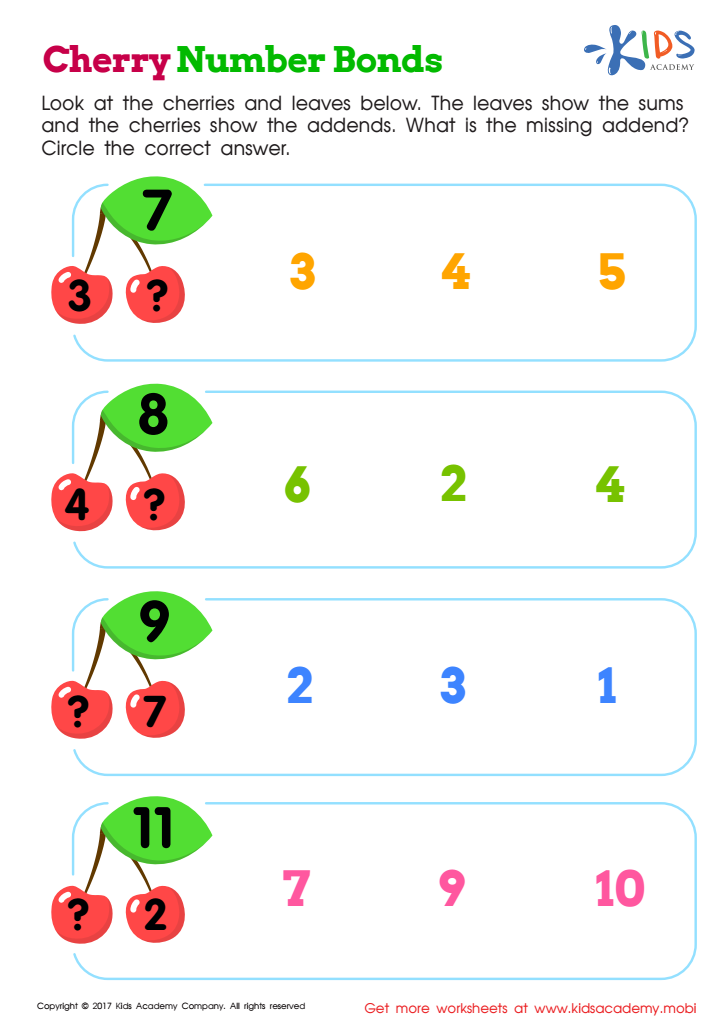
Cherry Number Bonds Worksheet
Help your child figure out which number on the right side is missing from the equation. Look at the worksheet together and you'll see that the numbers on the leaves are the sum of the numbers on the cherries.
 Assign to My Students
Cherry Number Bonds Worksheet
Worksheet
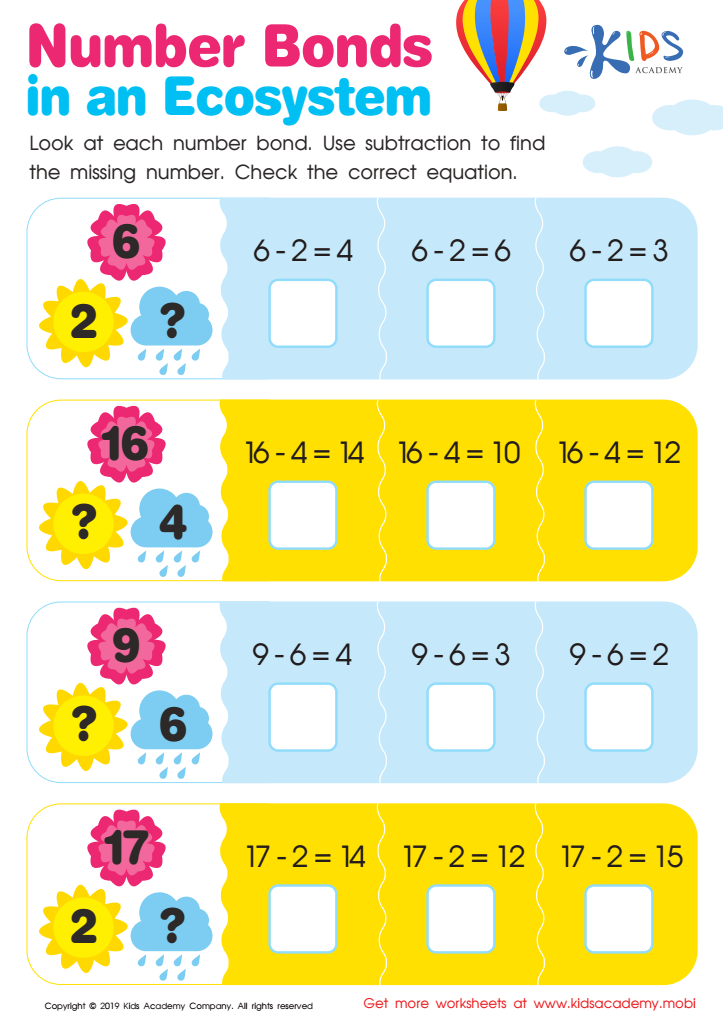
Number Bonds in an Ecosystem Worksheet
This worksheet is a great tool to help your kids sharpen their maths skills. Use the colourful images to teach them how to subtract the missing numbers and check the equation. Show them the four different images and let them try solving each number bond. With your guidance, they'll be able to hone their maths skills in no time!
Number Bonds in an Ecosystem Worksheet
Worksheet
Join Kids Academy for Free
Who is primarily going to use this learning content?




.jpg)


Understanding number bonds is essential for children aged 5-7, as it forms a foundational concept in mathematics. Number bonds are simple pairs of numbers that combine to make a specific sum, helping young learners grasp addition and subtraction more effectively. When parents and teachers emphasize number bonds, they empower children to recognize relationships between numbers, supporting mental math skills.
For instance, knowing that 3 and 2 make 5 or that 5 subtracts 3 equals 2 helps children manipulate numbers and tackle more complex arithmetic tasks with confidence, laying the groundwork for future mathematical concepts.
Furthermore, number bonds foster problem-solving skills and critical thinking. They enable students to visualize equations and enhance their ability to recognize patterns—skills that are crucial for their overall cognitive development.
Encouraging a strong number bond foundation not only boosts academic success but also builds positive attitudes towards math. Children frequently develop fear or anxiety about math as they progress, but a solid understanding of number bonds fosters confidence.
Ultimately, care for understanding number bonds is an investment in children's future learning and can lead to proficiency and enjoyment of math as they grow. Parents and teachers play a vital role in nurturing these essential skills during this critical developmental period.








