
Understanding pollination Math Worksheets for Ages 5-7
3 filtered results
Difficulty Level
Grade
Age
-
From - To
Subject
Activity
Standards
Explore our engaging "Understanding Pollination Math Worksheets" designed for children aged 5-7! These interactive worksheets combine essential math skills with the fascinating topic of pollination, making learning fun and informative. Young learners will enhance their counting, addition, and pattern recognition skills as they discover the important role that bees and other pollinators play in our ecosystem. Colorful illustrations and hands-on activities will spark curiosity and encourage a love for nature and mathematics. Perfect for home or classroom use, these worksheets provide a unique way to connect math concepts with environmental awareness, laying the foundation for holistic learning. Get started today!
Favorites
With answer key
Interactive
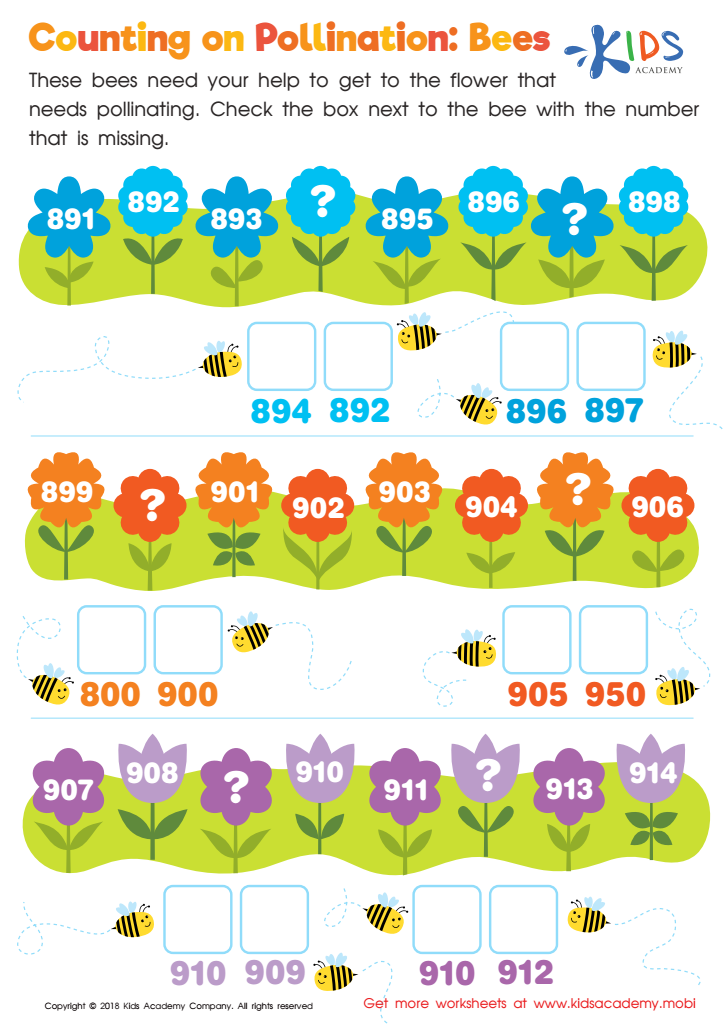
Counting on Pollination: Bees Worksheet
This downloadable worksheet helps kids improve their math skills while having fun - they'll help the bees pollinate the flowers by finding the missing number. It's an entertaining way to practice number patterns, sequences and number line skills, aiding in fast and efficient math computations.
 Assign to My Students
Counting on Pollination: Bees Worksheet
Worksheet
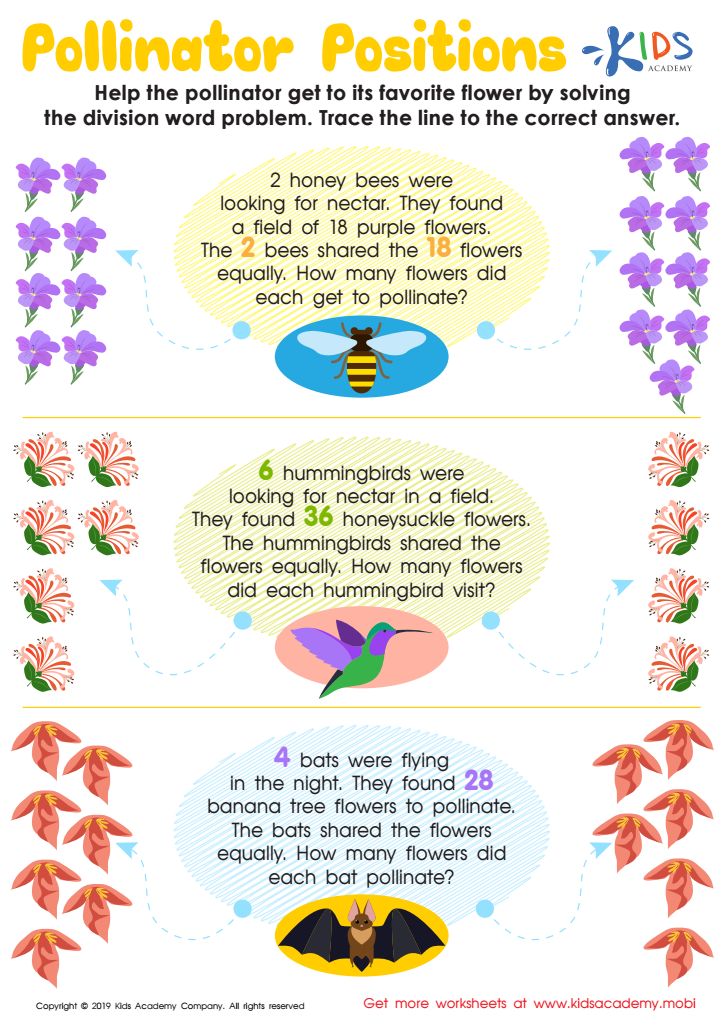
Pollinator Positions Worksheet
Kids will love learning about pollinators and how vital they are. Help their favorite friends get to the right flowers with this fun PDF. Children can solve the problems without even knowing they're doing division; just read the word problems and use the highlighted numbers. Finish by tracing the lines to the correct quotient!
Pollinator Positions Worksheet
Worksheet
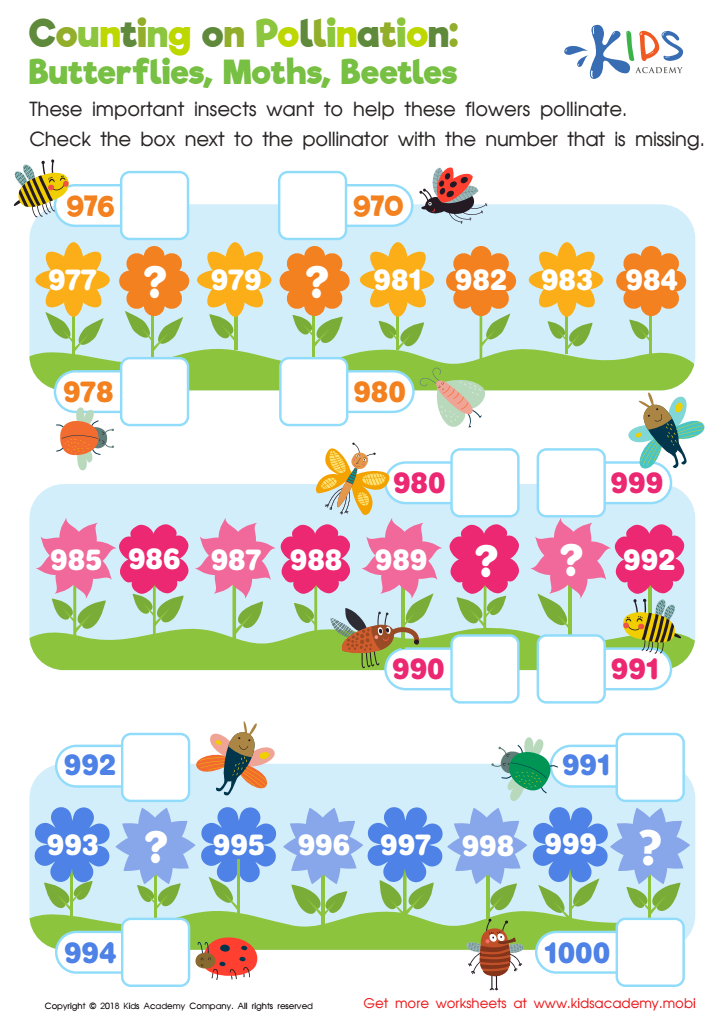
Counting on Pollination: Butterflies, Moths, Beetles Worksheet
A number line can help boost computation accuracy and efficiency. It can also be used with more advanced numbers. Help your child practice by having them identify missing numbers in sequences. This fun worksheet lets them help the pollinators in the process, as they strengthen their number sense.
Counting on Pollination: Butterflies, Moths, Beetles Worksheet
Worksheet
Join Kids Academy for Free
Who is primarily going to use this learning content?





Understanding pollination math introduces young learners to crucial concepts about nature while enhancing their mathematical skills. For parents and teachers, fostering an early appreciation for biological processes like pollination not only bolsters children’s scientific literacy but also strengthens their math abilities in a practical context. By integrating basic math problems involving pollination—such as counting flowers visited by pollinators, calculating the amount of fruit produced from pollinated flowers, or measuring distances between plants—children can see the direct application of math in understanding the ecosystem.
Moreover, this knowledge fosters curiosity and encourages critical thinking. Children can explore the impact of their math calculations on real-life environments, deepening their engagement with the subject matter. Additionally, exploring this topic helps raise awareness about the role of pollinators, promoting environmental stewardship and sustainability from an early age.
Through activities related to pollination math, children also develop important skills, such as problem-solving, data collection, and analytical thinking. By caring about how pollination and math intersect, parents and teachers lay a strong foundation for interdisciplinary learning, preparing young minds to become more informed and responsible citizens in a complex world.








