
Writing practice Tracing Letters Worksheets for Ages 5-8
4 filtered results
Difficulty Level
Grade
Age
-
From - To
Subject
Activity
Standards
Enhance your child's writing skills with our engaging Tracing Letters Worksheets, specially designed for ages 5-8. These hands-on resources provide young learners with the opportunity to practice letter formation through fun and interactive activities. Each worksheet promotes fine motor skills as children trace both uppercase and lowercase letters, reinforcing their alphabet knowledge while building confidence in their writing abilities. Ideal for home or classroom use, our worksheets are varied in difficulty to cater to all levels. Start your child on the path to successful writing with these essential and enjoyable tracing exercises that effectively nurture their literacy development!
Favorites
With answer key
Interactive

Letter A Tracing Page
Trace and write the letter "A"! Start with the big red dot, then do the capital and lowercase versions. Then write it again with two words - apple and alligator. Download more tracing worksheets at Kids Academy.
 Assign to My Students
Letter A Tracing Page
Worksheet
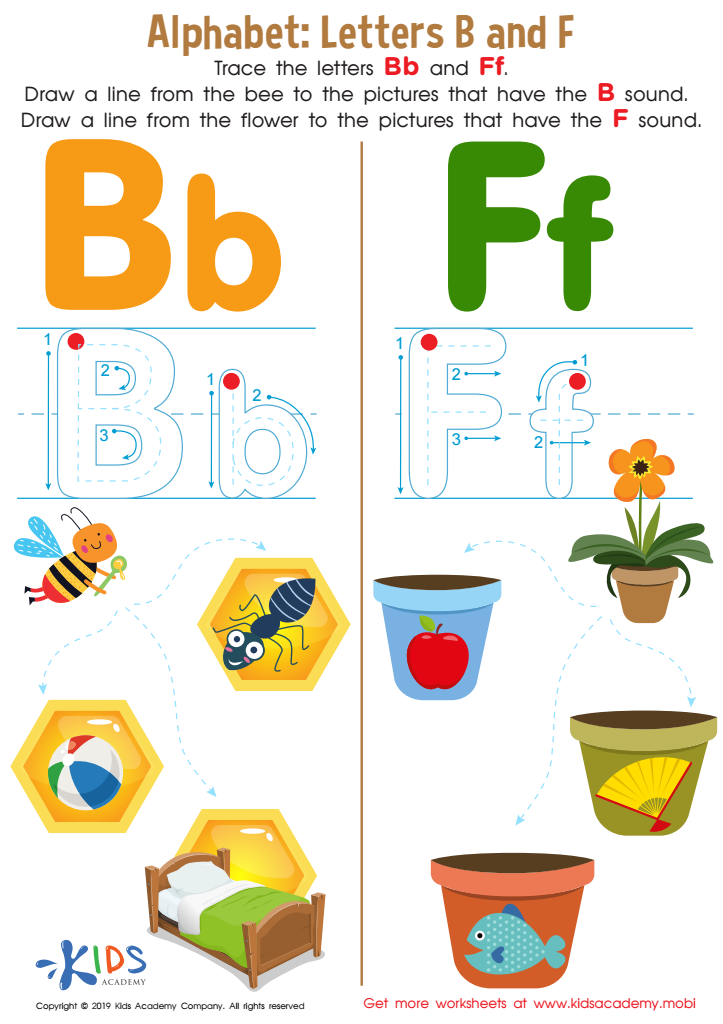
Letters B and F Tracing Worksheet
Does your kid know the letters B and F? This tracing sheet helps them practice by tracing each letter, then drawing a line from a bee and a flower to related words. Recognizing words with pictures develops a great skill, and students will master it in no time!
Letters B and F Tracing Worksheet
Worksheet

Letter H Tracing Page
Trace the letter "H", then practice writing its lowercase form. Finally, choose your favorite form of transport and ride away! Get our worksheets to make learning fun and easy.
Letter H Tracing Page
Worksheet
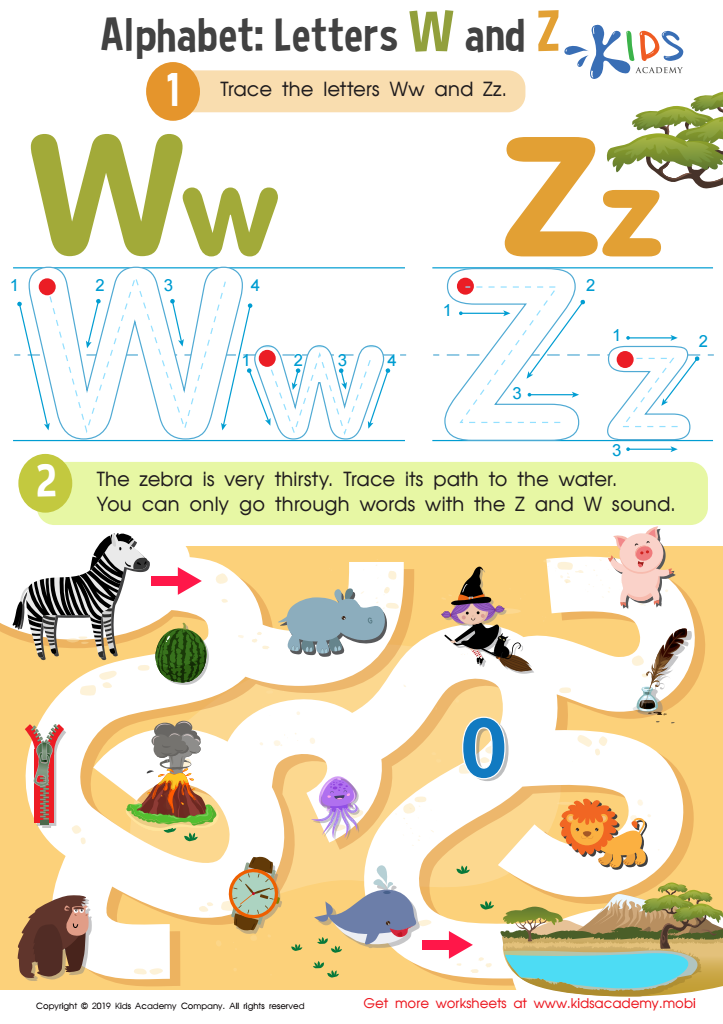
Letters W and Z Tracing Worksheet
Kids will go on a safari exploration of letters W and Z with this worksheet. Students will trace «W» and «Z» and then help the zebra find their watering hole, only following the path of the «W» and «Z» words among many others. It'll be a fun learning activity!
Letters W and Z Tracing Worksheet
Worksheet
Join Kids Academy for Free
Who is primarily going to use this learning content?








Writing practice, particularly tracing letters, is essential for children aged 5-8, and both parents and teachers should prioritize it. At this developmental stage, children are honing their fine motor skills, which are crucial for writing. Tracing letters helps them to develop better control over their hand movements, improving their dexterity and coordination. This foundational practice supports not only letter recognition but also lays the groundwork for when they begin to form letters independently.
Furthermore, tracing letters helps reinforce literacy skills. As children trace, they become familiar with the shapes and patterns of letters, increasing their understanding of language. This process enhances their ability to read as well and contributes to a cohesive understanding of written communication. Engaging in tracing activities can also boost children's confidence in their writing skills. As they see progress, they feel more empowered to practice further, fostering a positive relationship with learning.
Additionally, tracing letters can be a fun, interactive activity that can easily be incorporated into home and classroom environments. By emphasizing traceable writing, parents and teachers can effectively support children’s literacy development, fine motor skills, and overall academic success. In a digital age, nurturing traditional writing skills remains vital for well-rounded education.








