
Alphabetical order practice Worksheets for Ages 5-8
3 filtered results
Difficulty Level
Grade
Age
-
From - To
Subject
Activity
Standards
Explore our engaging Alphabetical Order Practice Worksheets designed for children ages 5-8! These educational resources help young learners master the concept of arranging words in alphabetical order, enhancing their reading and organizational skills. Our printable worksheets feature fun activities, including word puzzles, matching games, and fill-in-the-blanks that keep kids motivated and entertained. With colorful illustrations and interactive tasks, our worksheets are perfect for home or classroom use. Foster a love for learning while building essential skills with our thoughtfully crafted materials. Visit our website and download these worksheets to make alphabetizing a fun experience for your little learners!
Favorites
With answer key
Interactive
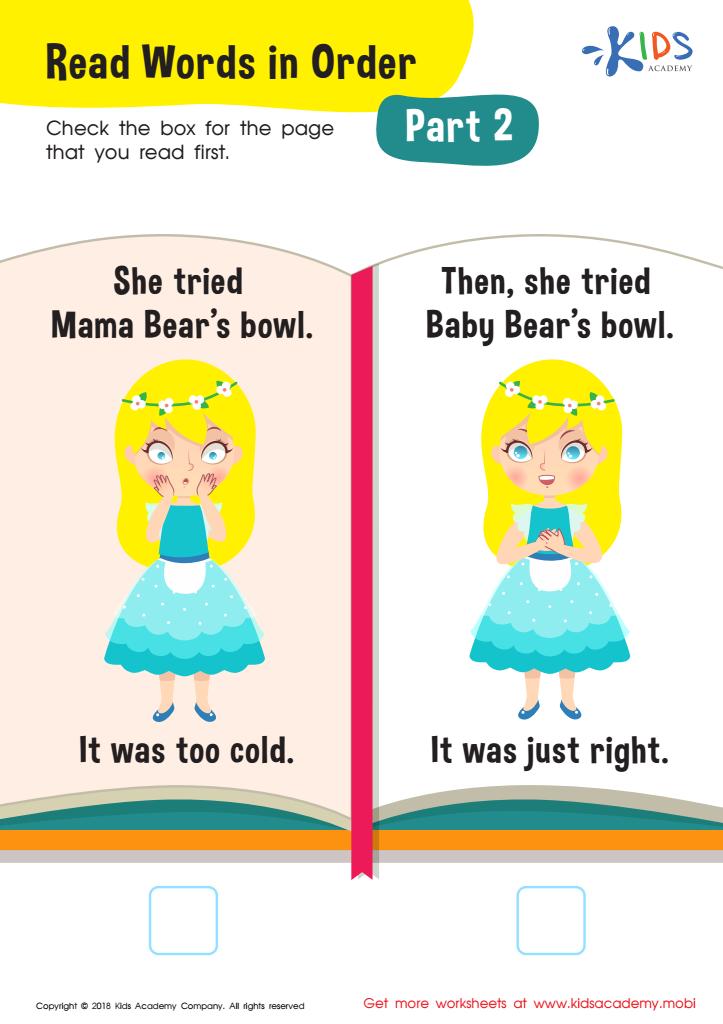
Read Words Order Part 2 Worksheet
Help your students make progress with reading by using this easy worksheet. It includes two pictures with short sentences your child should be able to read. Ask them to read these out loud, and if they're struggling, help them. Then, they should check the box that shows the page they'd read first.
 Assign to My Students
Read Words Order Part 2 Worksheet
Worksheet
Join Kids Academy for Free
Who is primarily going to use this learning content?








Alphabetical order practice is crucial for children aged 5-8 as it lays the foundation for essential literacy skills. First and foremost, understanding alphabetical order enhances a child’s ability to recognize and organize information. This skill proves invaluable for reading, writing, and researching, as they will be able to locate words, topics, and resources more efficiently in dictionaries, glossaries, and libraries.
Moreover, organizing words alphabetically hones cognitive skills, such as sequencing and categorization. Children learn to recognize the unique first letters of words and how these letters determine the order, fostering phonemic awareness, a key component in reading development.
Engaging in alphabetical order activities can also motivate children to interact with language in a fun and dynamic way. For instance, games involving sorting, singing songs related to the alphabet, or creating lists can ignite enthusiasm and enhance retention.
Lastly, the ability to use alphabetical order equips students with organizational skills that are useful throughout their academic journey. This essential skill promotes independence in learning, ultimately supporting parents and teachers as they nurture confident and capable readers ready to tackle future educational challenges.








