
Basic science knowledge Worksheets for Ages 5-8
3 filtered results
Difficulty Level
Grade
Age
-
From - To
Subject
Activity
Standards
Unlock your child's curiosity with our comprehensive collection of Basic Science Knowledge Worksheets for ages 5-8. At Kids Academy, we've tailored fun and engaging printable worksheets that encourage exploration and learning in young scientists. Each worksheet introduces fundamental concepts such as the human body, animals, plants, weather, and more. Designed to align with school curricula, our resources help children develop critical thinking and observation skills. Foster a love for science from an early age with activities that make learning exciting and interactive. Visit us today and embark on a fun scientific journey with your child!
Favorites
With answer key
Interactive
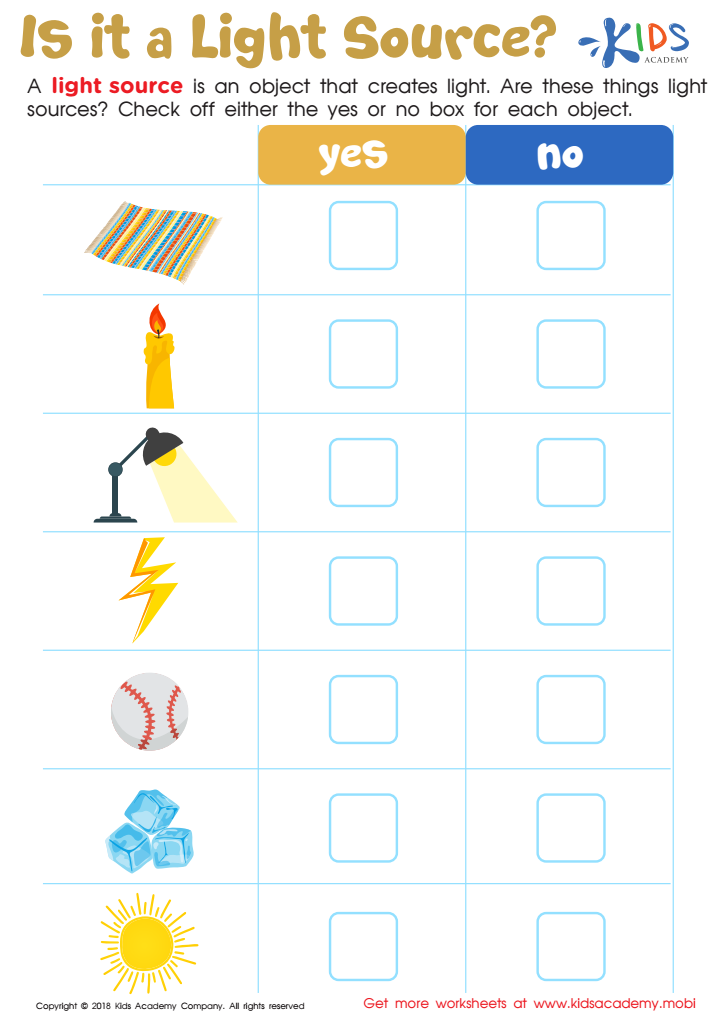
Is It a Light Source? Worksheet
This worksheet is a fun way to teach kids about light sources. Children must identify natural sources like the sun and lightning, and man-made sources such as candles and lamps. Ask them to look at each object and check the box to indicate if it's a light source or not.
 Assign to My Students
Is It a Light Source? Worksheet
Worksheet
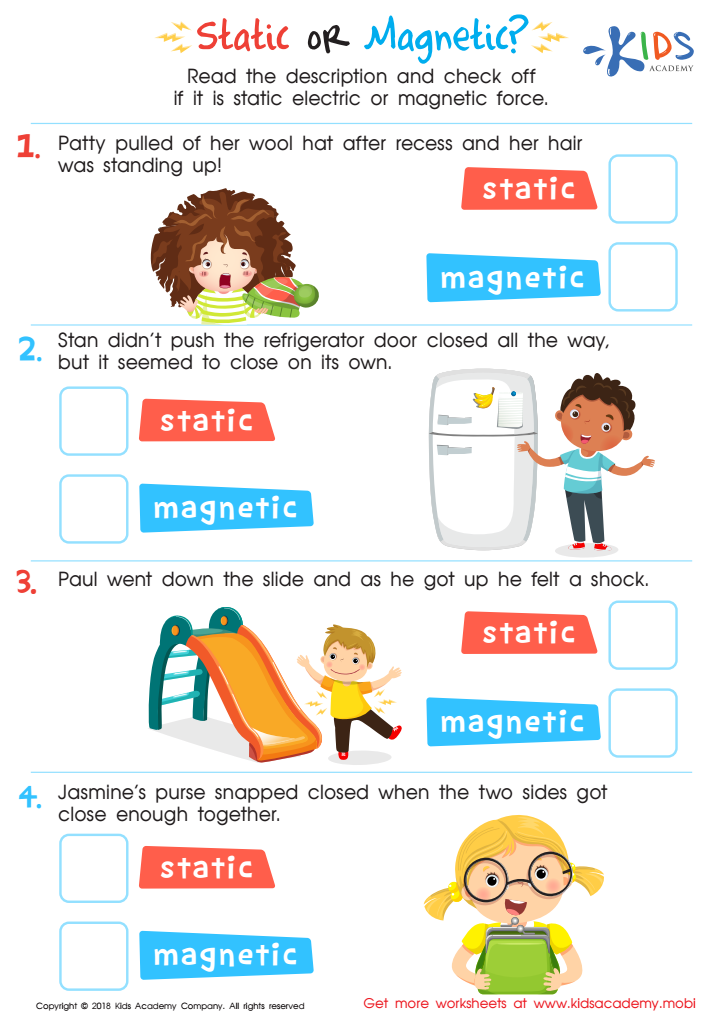
Static or Magnetic Printable Worksheet
Ever wondered if a situation involved static or magnetic force? This printable worksheet has the answer! Read the scenarios and check out the illustrations to decide which force is in play for each. Learn about these two amazing forces with this fun activity!
Static or Magnetic Printable Worksheet
Worksheet
Join Kids Academy for Free
Who is primarily going to use this learning content?








Basic science knowledge for children aged 5-8 is crucial for several reasons, and parents and teachers should prioritize it. Firstly, early exposure to science nurtures curiosity and a desire to explore the world. This intrinsic motivation can foster a lifelong love for learning and discovery. During these formative years, children are naturally inquisitive, and guiding this curiosity towards scientific thinking helps develop critical thinking and problem-solving skills.
Moreover, understanding basic scientific concepts lays a strong foundation for future learning. Grasping ideas such as gravity, states of matter, and simple machines not only supports later, more complex scientific education but also aids in comprehending everyday phenomena, making the world more accessible and less intimidating for young minds.
Science education also promotes hands-on learning experiences. Whether it's planting a seed, observing a butterfly, or mixing baking soda and vinegar, these activities are engaging and interactive ways to learn. They support fine motor skills and encourage collaborative learning, communication, and teamwork.
Lastly, fostering a solid science foundation contributes to informed and responsible citizenship. Understanding the natural world encourages respect for the environment, awareness of health and safety practices, and an appreciation for technology and innovation. Hence, investing in basic science education for young children is investing in a well-rounded, confident, and knowledgeable future generation.








