
Comparing heights Worksheets for Ages 5-8
3 filtered results
Difficulty Level
Grade
Age
-
From - To
Subject
Activity
Standards
Discover our engaging collection of Comparing heights Worksheets tailored for ages 5-8! These fun and educational worksheets are designed to help young learners develop essential math and observation skills. Through a variety of age-appropriate activities, children will practice comparing the heights of different objects and characters, enhancing their understanding of measurement concepts. Perfect for both classroom and at-home learning, our worksheets encourage hands-on involvement and critical thinking. Foster your child's curiosity and build a strong foundation in math with our easy-to-use, printable resources from Kids Academy!
Favorites
With answer key
Interactive
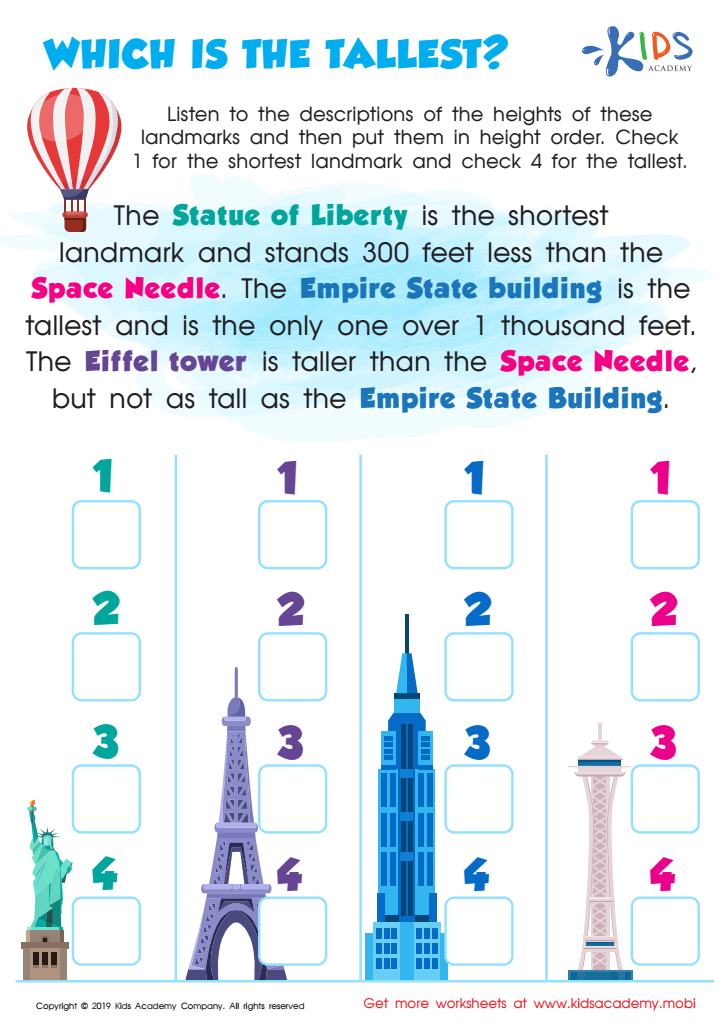
Which is the Tallest? Worksheet
Help your kids arrange the buildings in order of height: highest (4) to lowest (1). Ask them if they can think of other ways things can be measured. Read the texts describing the buildings and check 4 for the tallest and 1 for the shortest.
 Assign to My Students
Which is the Tallest? Worksheet
Worksheet
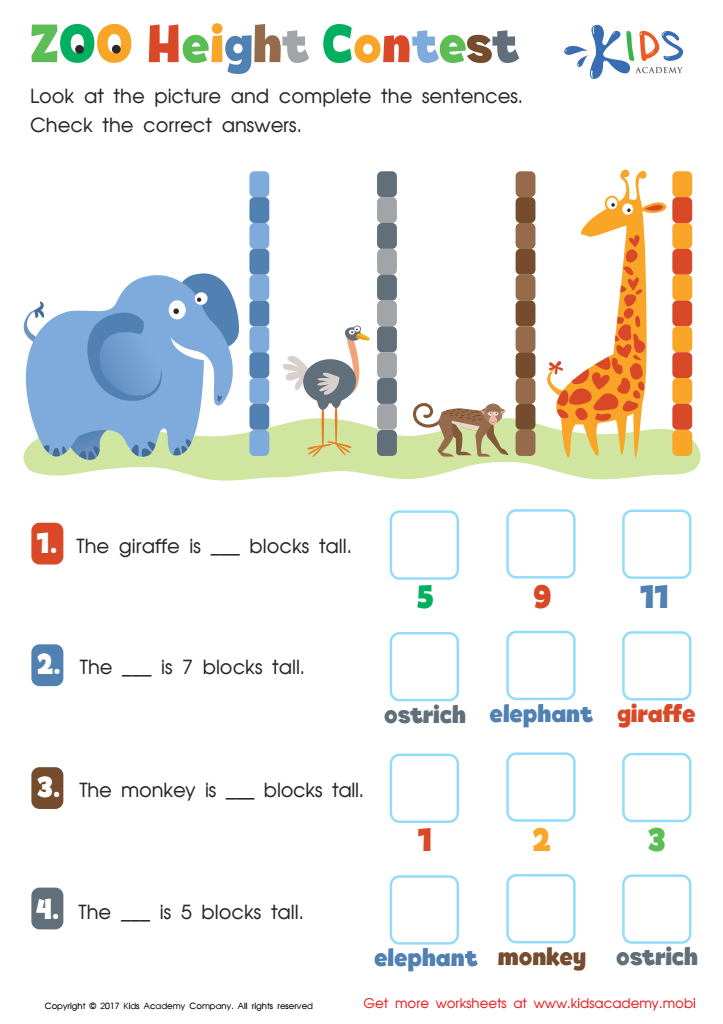
Zoo Height Contest Worksheet
Let's head to the zoo and use colorful blocks to measure your child's favorite animals! With this Kids Academy worksheet, help them practice and prepare for learning measurement. Guide them in looking at the zoo animals and counting blocks to find the height. Then, read the questions and check the box next to the correct answer.
Zoo Height Contest Worksheet
Worksheet
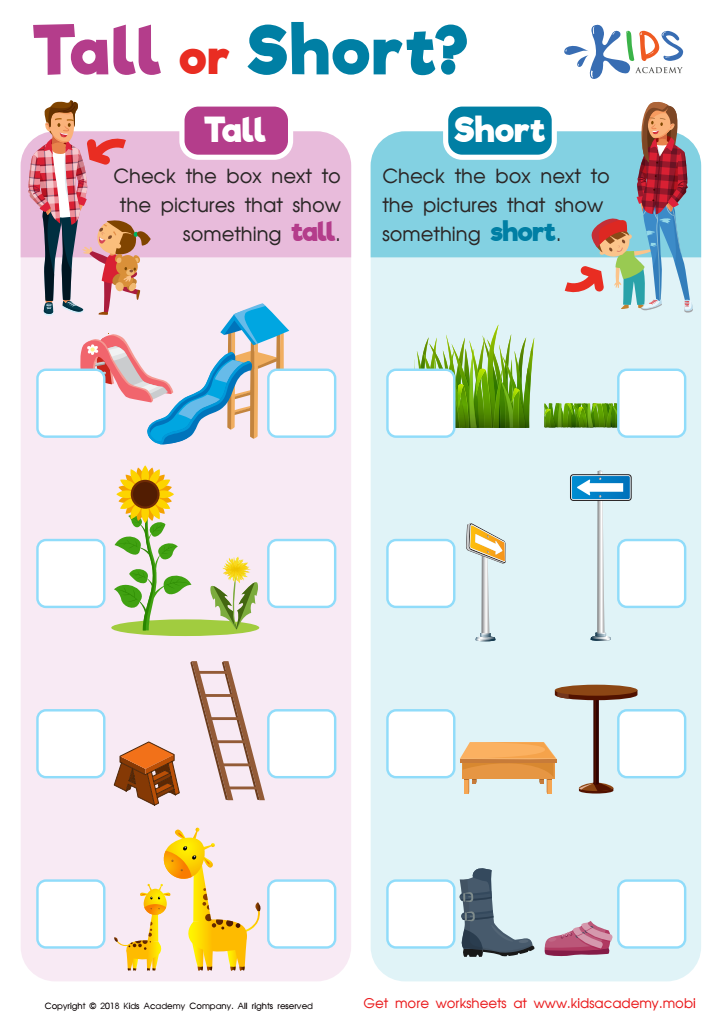
Tall or Short? Worksheet
Comparing tall and short objects is an early math skill. Our free worksheet uses fun colors and pictures to help kids practice. This will give them a head start for higher-level measurement skills, and they'll remember tangible objects for comparison.
Tall or Short? Worksheet
Worksheet
Join Kids Academy for Free
Who is primarily going to use this learning content?







Comparing heights for children ages 5-8 can play a crucial role in their developmental progress and education. For parents and teachers, it's about fostering numeracy skills, promoting social understanding, and recognizing potential health concerns. Children in this age group are developing basic math skills, and comparing heights provides a hands-on way to grasp concepts like measurement, greater than, less than, and equal to. It engages them in conversations about numbers and proportions in a context they can easily understand.
Socially, discussing and comparing heights can help children appreciate human diversity. By observing differences and similarities, children learn to accept variances in physical characteristics, promoting empathy and reducing the likelihood of biases forming early on.
From a health perspective, regularly comparing heights can act as an informal screening tool. Significant deviations from typical growth patterns might indicate health issues that require medical attention, such as nutritional deficiencies or hormonal imbalances. Keeping track ensures that any concerns are promptly addressed.
Overall, engaging 5-8-year-old children in comparing heights is not merely an academic exercise; it's a multidimensional activity that nurtures their intellectual growth, social skills, and overall well-being. Parents and teachers who incorporate this into daily routines can broadly support a child’s development.








