Understand number relationships Worksheets for Ages 5-8
5 filtered results
-
From - To
Discover the exciting world of number relationships with our engaging worksheets designed for children ages 5-8! These thoughtfully crafted activities help young learners grasp essential math concepts such as greater than, less than, and equal to. Our worksheets offer a variety of exercises that promote critical thinking and problem-solving skills, making math fun and interactive. Perfect for homeschoolers or in-class use, these resources foster confidence in young mathematicians as they explore the connections between numbers. Encourage your child's numeric understanding and pave their path to math success with our easy-to-use, printable worksheets that turn learning into an enjoyable adventure!
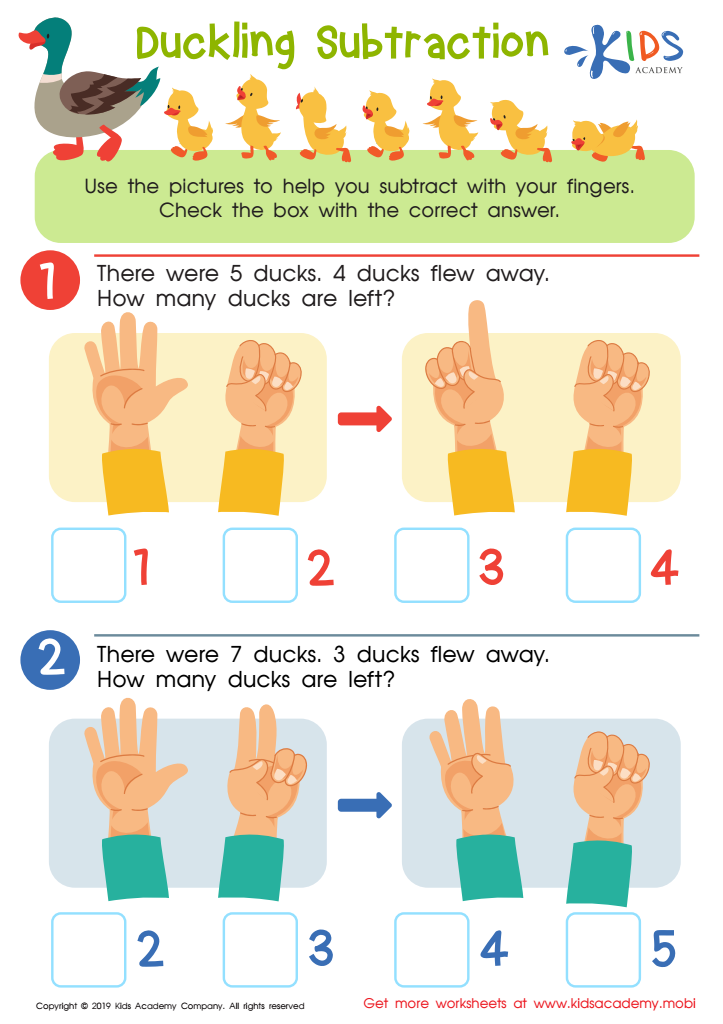
Duckling Subtraction Worksheet
 Assign to My Students







.jpg)
Understanding number relationships is foundational for young learners aged 5-8, as it forms the basis for mathematical reasoning and problem-solving skills. At this age, children are beginning to grasp the concepts of addition, subtraction, multiplication, and division. By understanding number relationships—such as how numbers compare, group, and relate to one another—they will develop a deeper comprehension of these mathematical operations.
For parents and teachers, promoting awareness of number relationships helps children build confidence and encourages a positive attitude toward math. Recognizing patterns, understanding quantity, and grasping the concept of 'more than' or 'less than' cultivate critical thinking and logical reasoning, vital skills beyond mathematics itself.
Furthermore, a solid understanding of number relationships aids in the development of skills that are transferable across subjects, enhancing children's ability to approach complex problems in various contexts. Engaging children in discussions about numbers and their relationships—through games and everyday activities—also fosters strong communication and collaboration skills. As children become adept at navigating their numerical environment, they are better prepared for future academic challenges, ultimately setting them on a path for lifelong success in both mathematics and beyond.








