Understanding Quantities Worksheets for Ages 5-8 - Page 3
53 filtered results
-
From - To
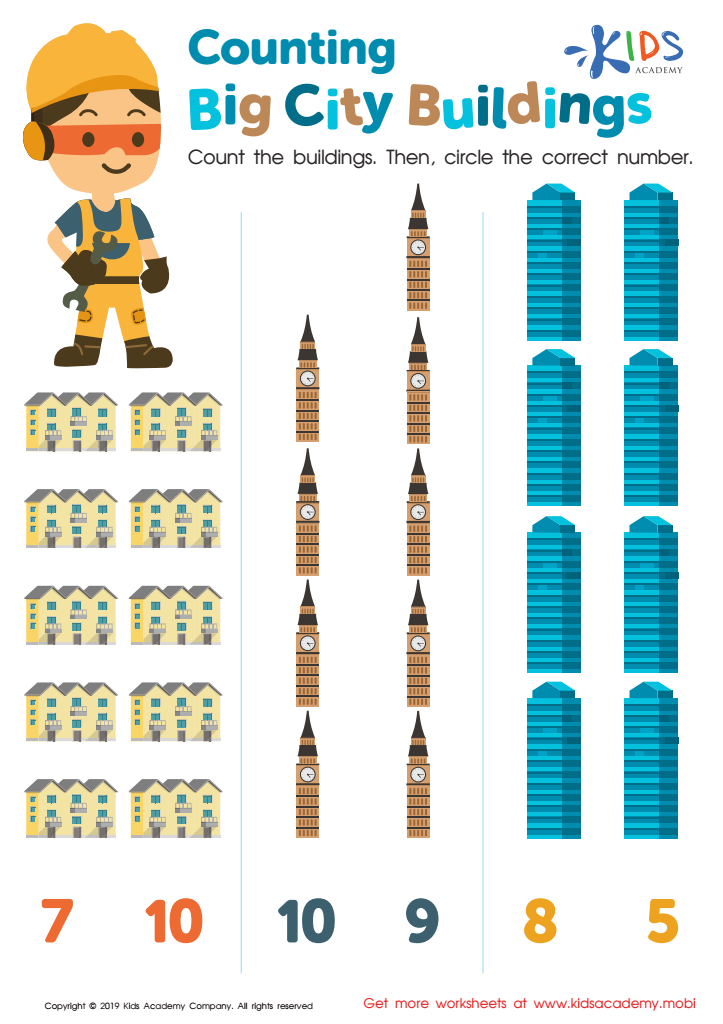
Counting Big City Buildings Worksheet
 Assign to My Students








Understanding quantities is a fundamental skill that serves as the backbone of mathematical development for children ages 5-8. During this critical stage, children begin to explore numbers, counting, and the relationship between quantities, laying the groundwork for future mathematical concepts. Parents and teachers should care about this development because foundational skills in understanding quantities directly influence a child’s confidence and competence in math.
Mastering quantities helps children grasp essential concepts such as addition, subtraction, and early measurement, promoting logical thinking and problem-solving abilities. This understanding fosters a positive attitude toward math, making children more likely to engage with the subject rather than shy away from it.
Moreover, engaging with quantities sets the stage for real-world applications, including financial literacy and critical thinking necessary for everyday situations. It also encourages collaboration and communication as children learn to express their thoughts and strategies while interacting with peers during quantitative activities.
Early intervention and support in developing a strong foundation for understanding quantities can help prevent future learning gaps, paving the way for a smoother transition into more complex mathematical ideas. Therefore, parents and teachers play a crucial role in nurturing these skills, ensuring children are well-prepared for their educational journey ahead.








