
Visual representation Worksheets for Ages 5-8
3 filtered results
Difficulty Level
Grade
Age
-
From - To
Subject
Activity
Standards
Explore our engaging Visual Representation Worksheets designed specifically for children ages 5-8! These worksheets help young learners enhance their observation and critical thinking skills through colorful activities that encourage creativity and comprehension. With a variety of fun illustrations and prompts, kids will enjoy practicing skills like categorizing, interpreting, and expressing ideas visually. Ideal for both classroom and at-home learning, our worksheets support early childhood development by fostering an imaginative approach to learning. Empower your child’s educational journey with captivating visuals that make learning enjoyable and effective. Start inspiring a love for learning today with our interactive visual representation resources!
Favorites
With answer key
Interactive
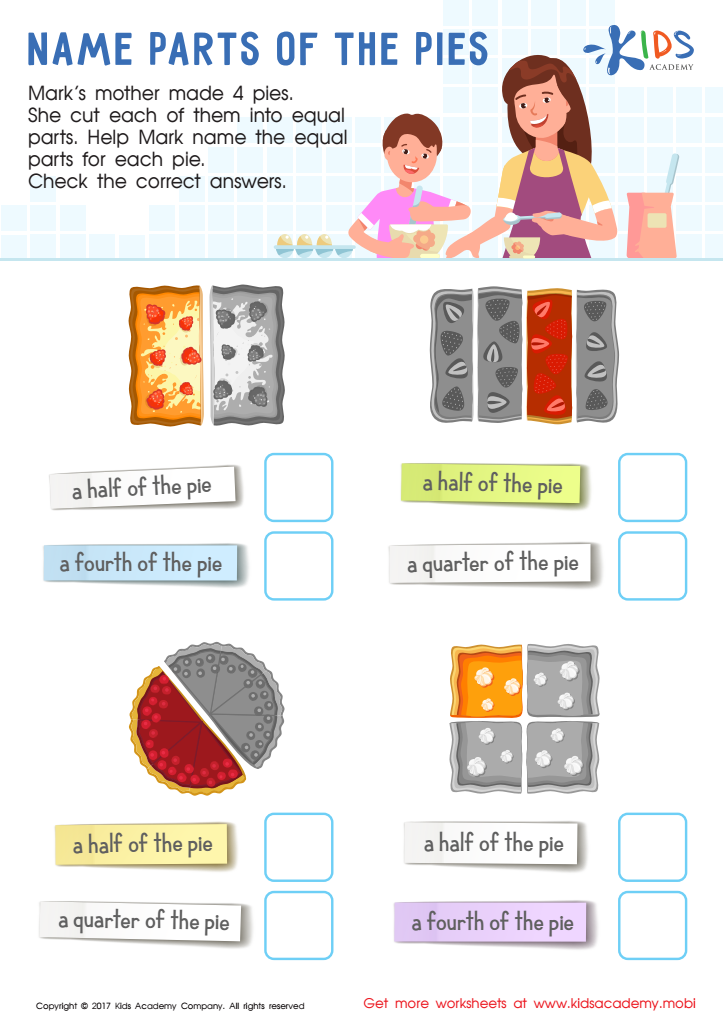
Name Parts of the Pies Worksheet
Mark and his mom are making pies. He's dividing them into equal parts and needs help to name them. Let your students aid him by checking the correct answer for each picture. Have them think of their own roles in the kitchen when they're done. How do they help their moms?
 Assign to My Students
Name Parts of the Pies Worksheet
Worksheet
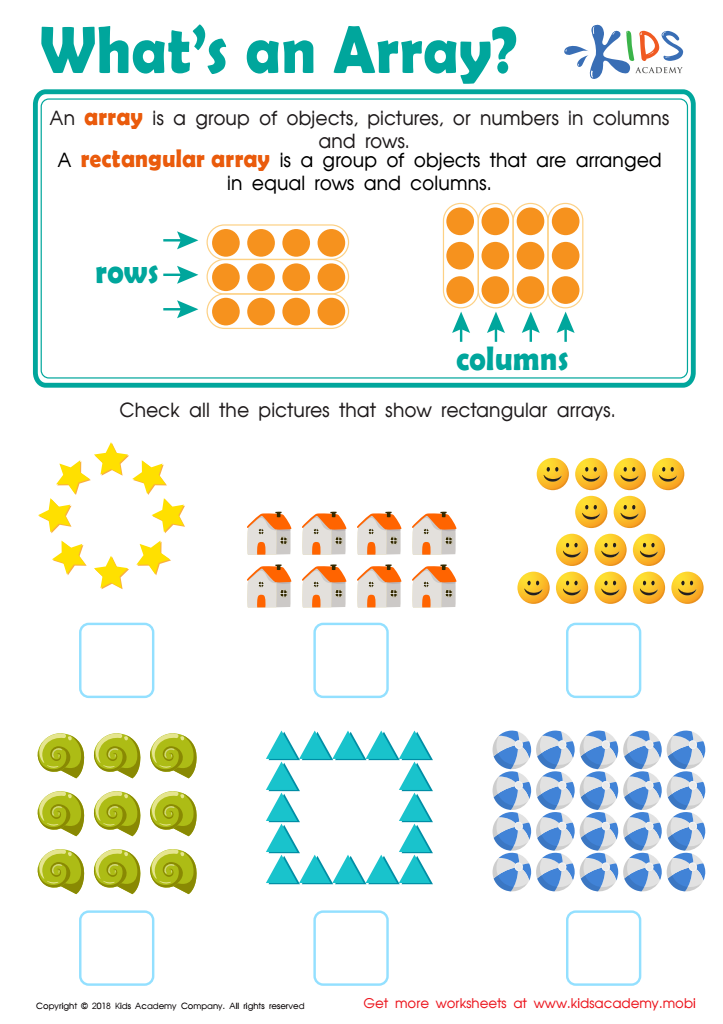
What's an Array? Worksheet
Explain to your child that an array is a group of objects, pictures, or numbers in columns and rows. Show them a rectangular array is a group of objects in equal rows and columns. Guide them to check the pictures in the worksheet to spot any rectangular arrays. Help them remember this concept.
What's an Array? Worksheet
Worksheet
Join Kids Academy for Free
Who is primarily going to use this learning content?






.jpg)

Visual representation is fundamental in the developmental stages of children aged 5-8, as it enriches their learning experiences and cognitive understanding. First, visuals cater to young learners' natural inclination towards images, helping them grasp complex ideas more easily. For instance, charts, diagrams, and pictures can simplify concepts like numbers or the scientific method, making learning more accessible and engaging.
Moreover, visual aids strengthen memory retention. When children associate information with images, they are more likely to recall it later, supporting overall academic success. This strategy also plays a crucial role in developing critical thinking and comprehension skills, as children learn to interpret and analyze visual data.
Additionally, incorporating visuals fosters creativity and self-expression. When children create their representations of knowledge, whether through drawings or digital media, they not only reinforce their understanding but also build confidence in sharing their ideas.
Lastly, visual representation can aid in inclusivity. Many children have varying learning preferences, and visuals serve as a universal tool that can bridge gaps between different skill levels. For these reasons, parents and teachers should prioritize visual representation as a key element in the educational journey of children aged 5-8.








