Basic Addition Skills Adding up to 100 with Regrouping Worksheets for Ages 5-8
3 filtered results
-
From - To
Enhance your child's mathematical abilities with our "Basic Addition Skills Adding Up to 100 with Regrouping Worksheets," designed specifically for ages 5-8. These engaging worksheets help young learners master the foundational concepts of addition, including regrouping, in a fun and interactive way. With a variety of problems that gradually increase in difficulty, children will build confidence while developing critical thinking skills. Each worksheet fosters independent learning, making it easy for parents and teachers to support students’ progress. Download now and inspire a love for mathematics as your child embarks on their journey to mastering addition up to 100!
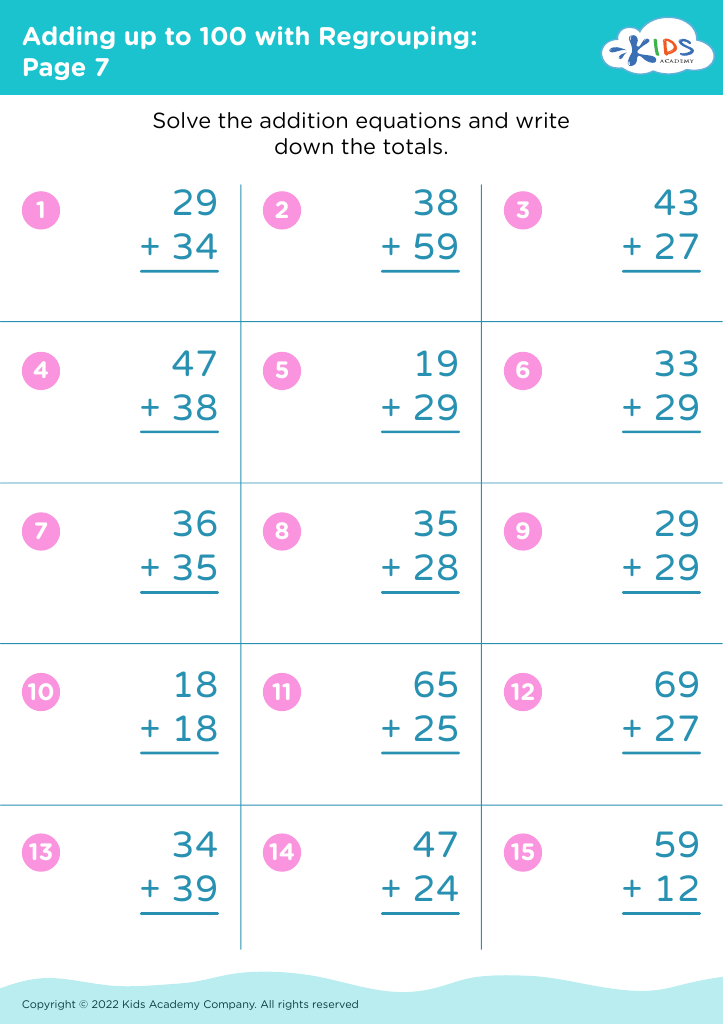
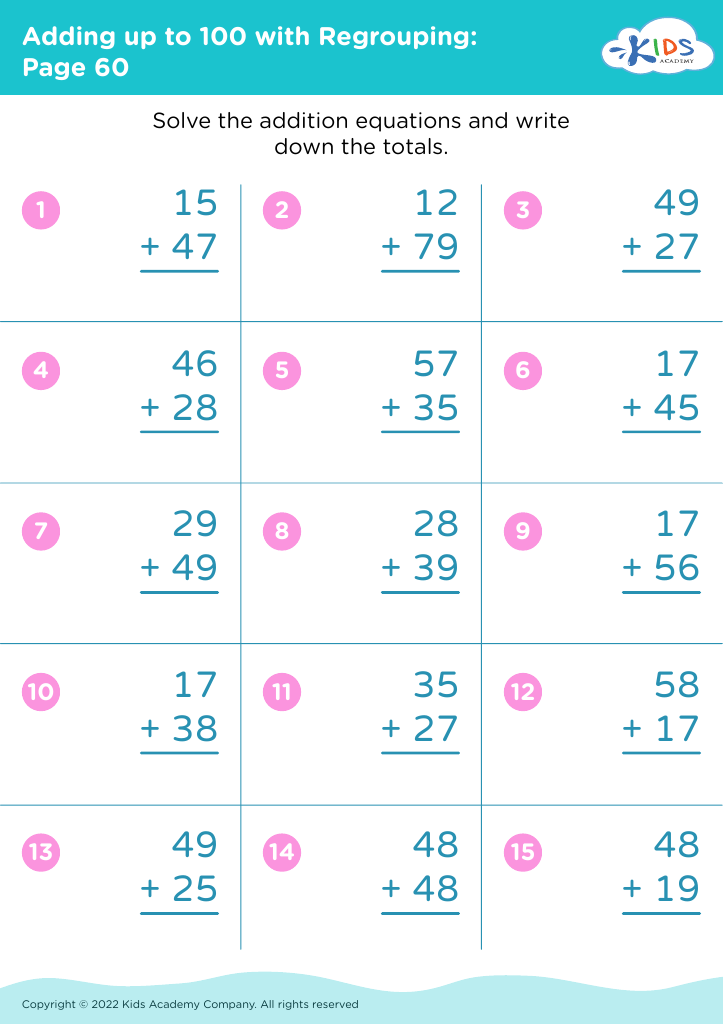
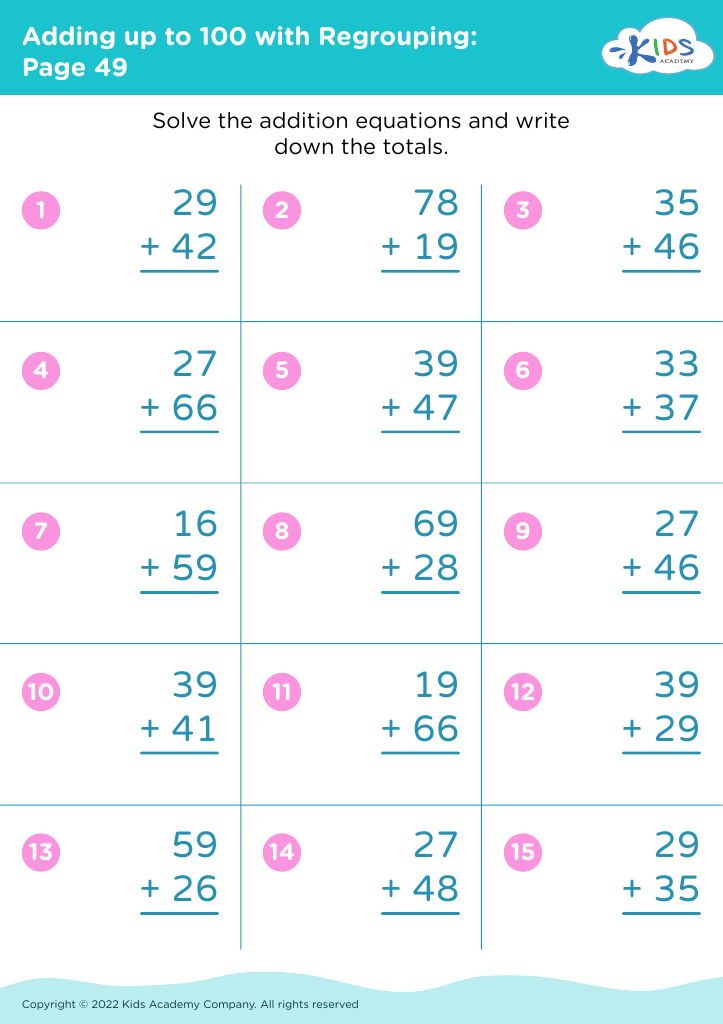




Basic addition skills, including the ability to add numbers up to 100 using regrouping, are crucial for children ages 5-8. Mastering these skills lays a strong foundation for a child's mathematical understanding, which is essential not only for academic success but also for real-life problem-solving.
At this age, students are transitioning from simple addition and need to build confidence in tackling larger numbers. Regrouping teaches them how to reorganize numbers when sums exceed ten, promoting logical reasoning and critical thinking. Understanding this concept encourages perseverance and the ability to tackle more complex mathematical operations in later grades.
Moreover, when parents and teachers prioritize basic addition skills, they foster a positive attitude towards math. A strong mathematical base leads to improved performance in later subjects, as mathematics concepts build upon one another cumulatively.
Teaching and supporting students in mastering addition up to 100 also engages them socially and emotionally, offering numerous opportunities for group activities, games, and collaborative problem-solving. This holistic approach ultimately nurtures their love for learning and enhances their overall skills, making strong math abilities a beneficial asset for their future educational endeavors and daily activities.