Counting practice Adding up to 100 with Regrouping Worksheets for Ages 5-8
5 filtered results
-
From - To
Explore our engaging "Counting Practice Adding up to 100 with Regrouping Worksheets for Ages 5-8"! These worksheets are designed to build young learners' math skills and confidence with colorful, interactive exercises. Perfect for students beginning to understand addition, these activities focus on mastering regrouping and carrying over in addition problems. With beautiful graphics and easy-to-understand instructions, this resource makes math practice enjoyable and effective. Ideal for classroom use or at-home learning, these worksheets offer a hands-on approach to help children achieve proficiency in adding numbers up to 100. Nurture essential arithmetic skills with Kids Academy today!
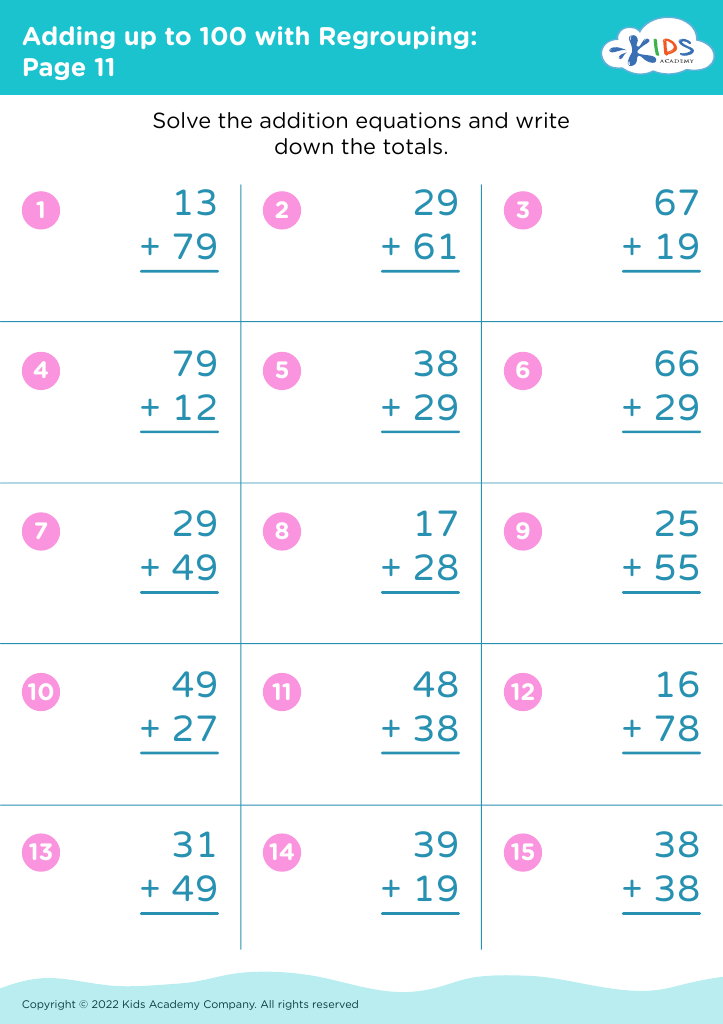
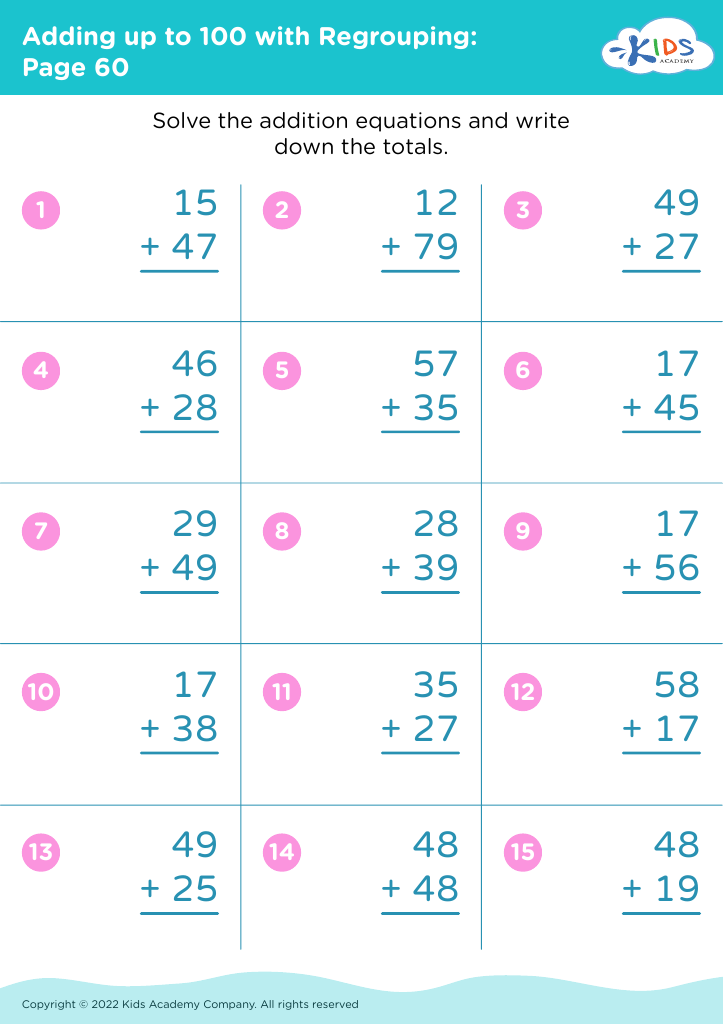
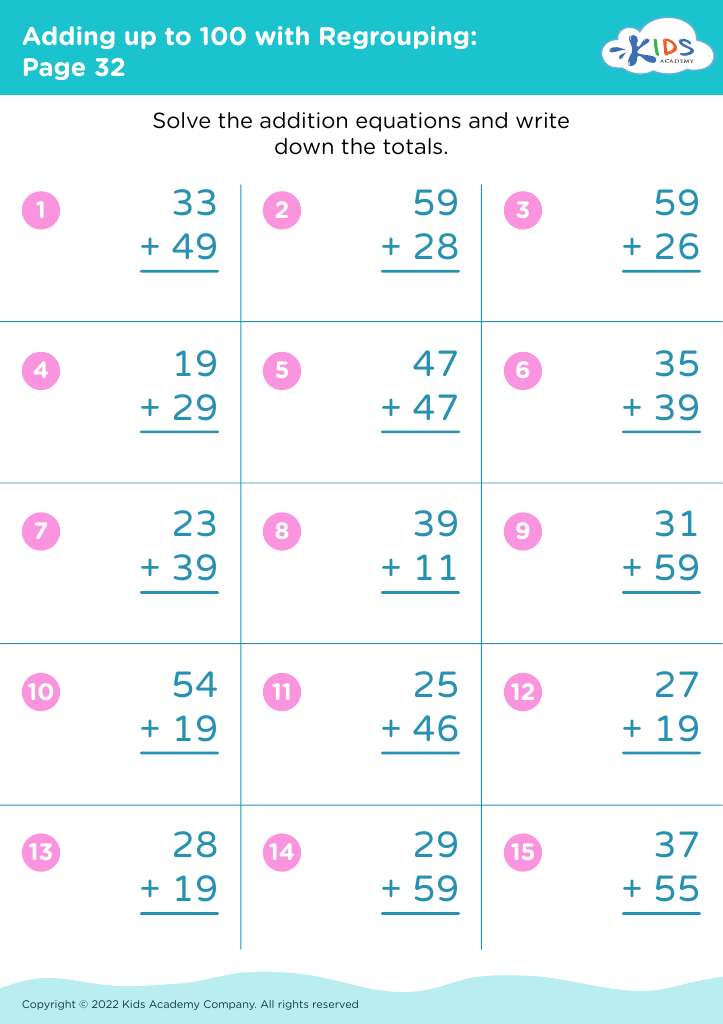
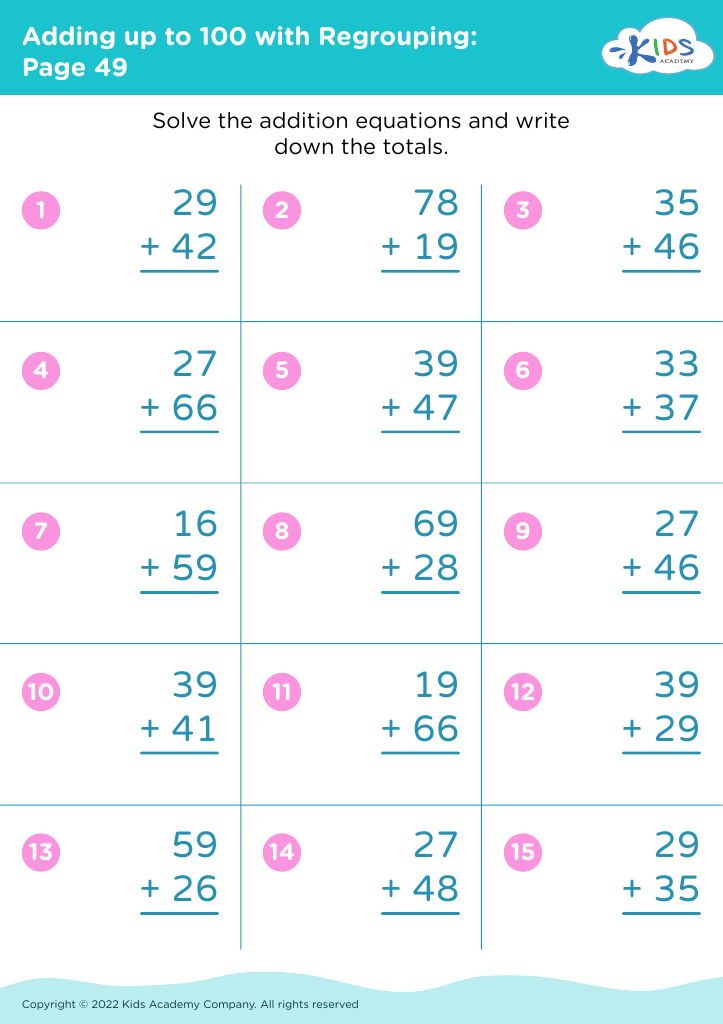
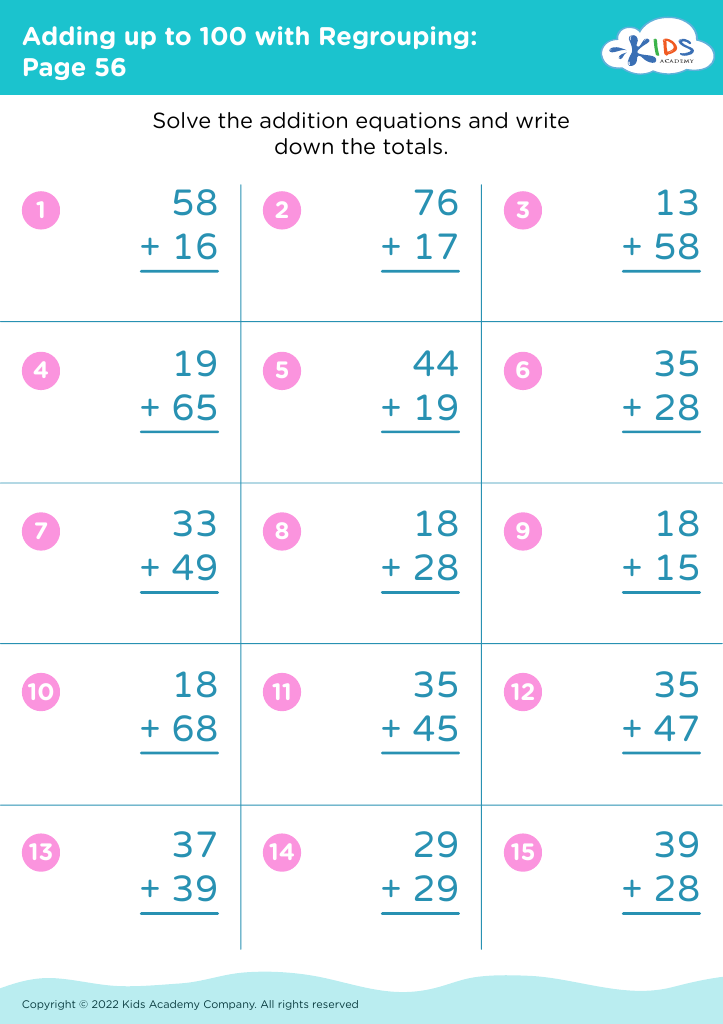




Counting practice and adding up to 100 with regrouping (also known as “carrying” over in addition) are foundational skills for young learners aged 5-8, essential for their mathematical development. Parents and teachers should prioritize these skills for several compelling reasons:
First, these skills enhance number sense, or the ability to understand, relate, and connect numbers. Strong number sense forms the bedrock of advanced mathematical concepts and real-world problem-solving. For example, recognizing that the number 100 can be broken down into ten sets of ten fosters a deeper understanding of our base-ten number system, which underpins virtually all mathematical operations.
Second, the ability to regroup, where values are carried over in addition, is crucial for accuracy in more complex calculations. This skill directly impacts future proficiency in operations like subtraction (borrowing), multiplication, and division, fostering a smoother transition to these higher-level math topics.
Furthermore, counting and adding to 100 fosters cognitive skills such as focus, memory, and logical thinking. It also builds a child’s confidence and persistence when faced with challenges, as they experience success through practice.
Lastly, these early math skills have correlations with later academic performance. Studies suggest that early math proficiency is a predictor of later academic achievement, making early intervention critical. By ensuring basic arithmetic skills are solidified, parents and teachers help lay a robust educational foundation.