Mathematical reasoning Adding up to 100 Without Regrouping Worksheets for Ages 5-8
3 filtered results
-
From - To
Enhance your child's numerical skills with our "Mathematical Reasoning: Adding up to 100 Without Regrouping Worksheets" tailored for ages 5-8. These engaging activities help young learners grasp addition concepts with ease, focusing on sums up to 100 without the need for regrouping. Each worksheet is designed to foster mathematical reasoning, build confidence, and promote a strong foundational understanding of arithmetic. Developed by education experts, these resources offer fun and productive practice to improve your child's proficiency in addition. Visit Kids Academy to download and start your child's journey to becoming a math whiz today!
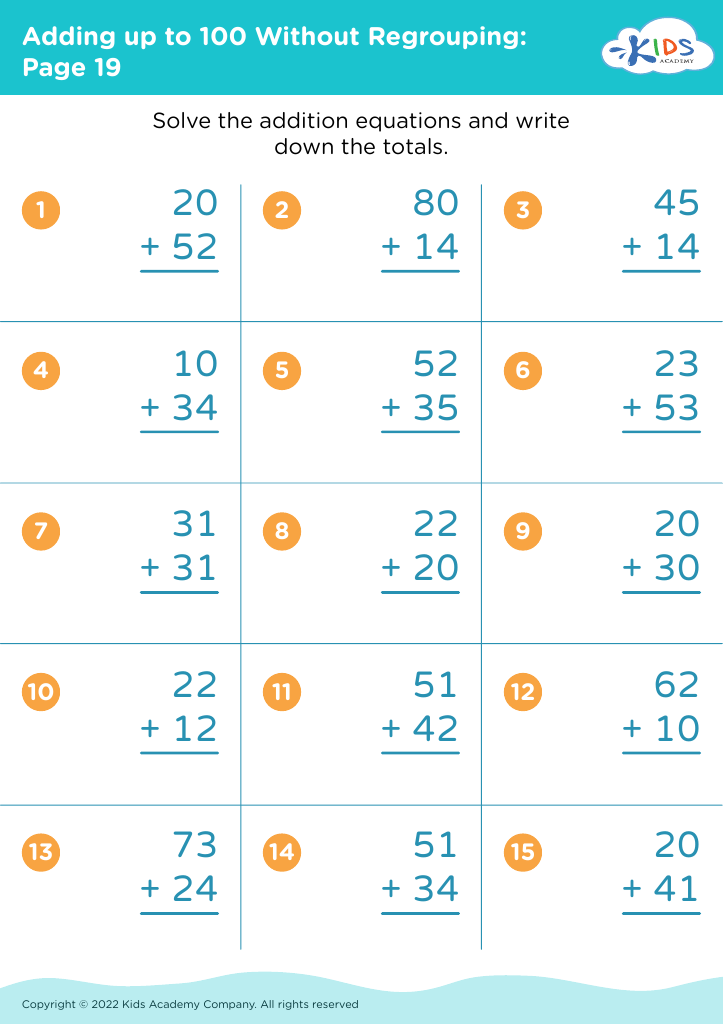
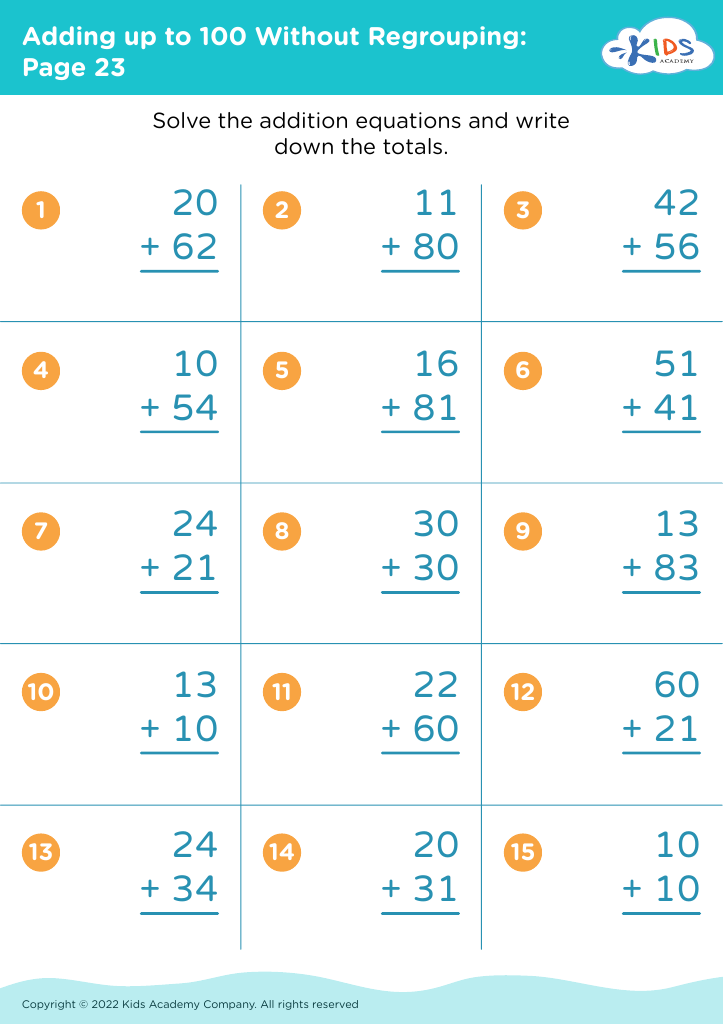
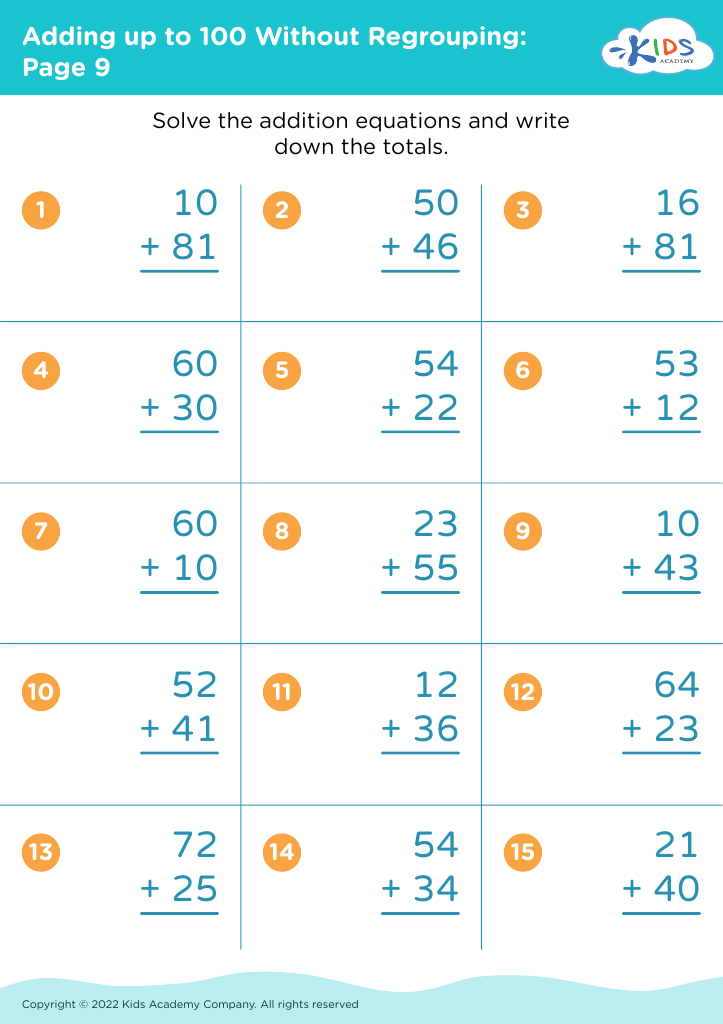




Mathematical reasoning and activities such as adding up to 100 without regrouping for ages 5-8 are fundamental in developing key intellectual skills in young children. Firstly, mathematical reasoning lays the foundation for critical thinking and problem-solving abilities. At this age, children's brains are highly receptive and capable of grasping basic mathematical concepts that will form the bedrock for more advanced topics. By practicing adding numbers up to 100, children better understand numerical relationships and patterns, enhacing their computational fluency.
Parents and teachers should emphasize this skill because it improves mental arithmetic, which bolsters both speed and accuracy in everyday calculations. This confidence in numbers can alleviate math anxiety, creating a positive mindset toward the subject. Encouraging mathematical activities lends itself to better concentration, memory retention, and logical reasoning which are transferable skills useful across all areas of learning and later life situations.
Moreover, mastering addition without regrouping keeps children engaged through manageable challenges without overwhelming them. This balance ensures steady learning progression, underpins a solid understanding of base-ten concepts, and sets the stage for mastering complex operations involving addition, subtraction, multiplication, and division later on. This foundational math competency is essential for academic success and day-to-day financial literacy, making it crucial for parents and teachers to address.