Comparing quantities Adding up to 50 Worksheets for Ages 5-8
3 filtered results
-
From - To
Promote essential math skills with "Comparing Quantities: Adding up to 50 Worksheets for Ages 5-8" from Kids Academy. Designed for early elementary students, these engaging worksheets help kids practice addition up to 50 while fostering their ability to compare quantities easily. Bright illustrations and fun activities ensure a captivating learning experience, enhancing children's numerical fluency and problem-solving abilities. Aligned with educational standards, these worksheets provide a solid math foundation, perfect for both classroom and home use. Empower your child’s math journey with hands-on practice and real-life applications with these comprehensive resources from Kids Academy!
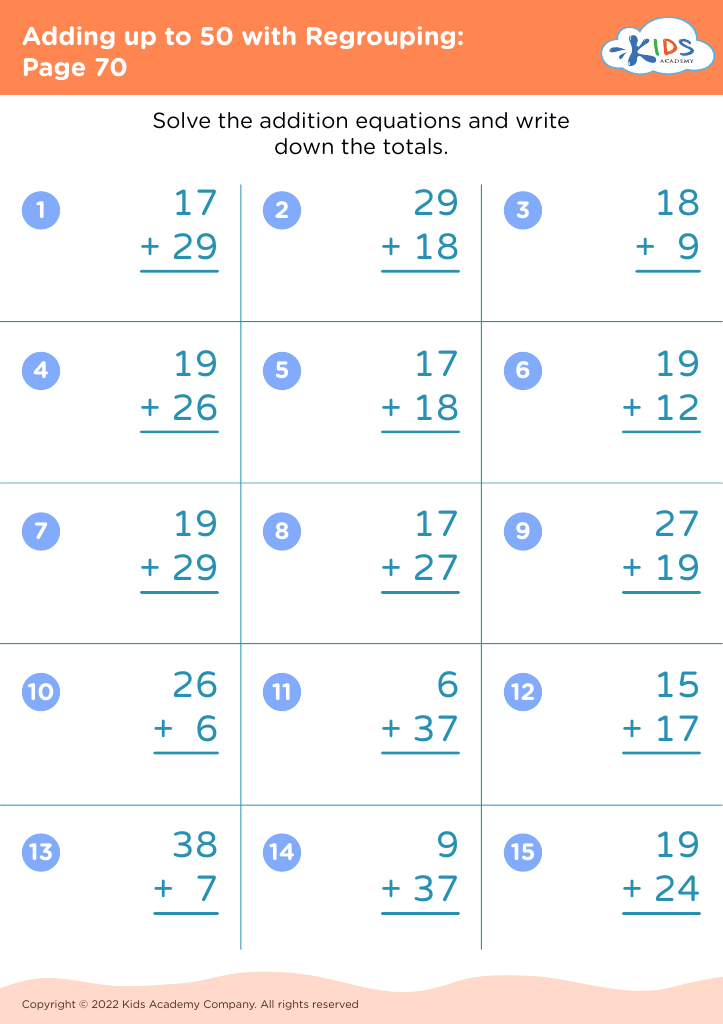
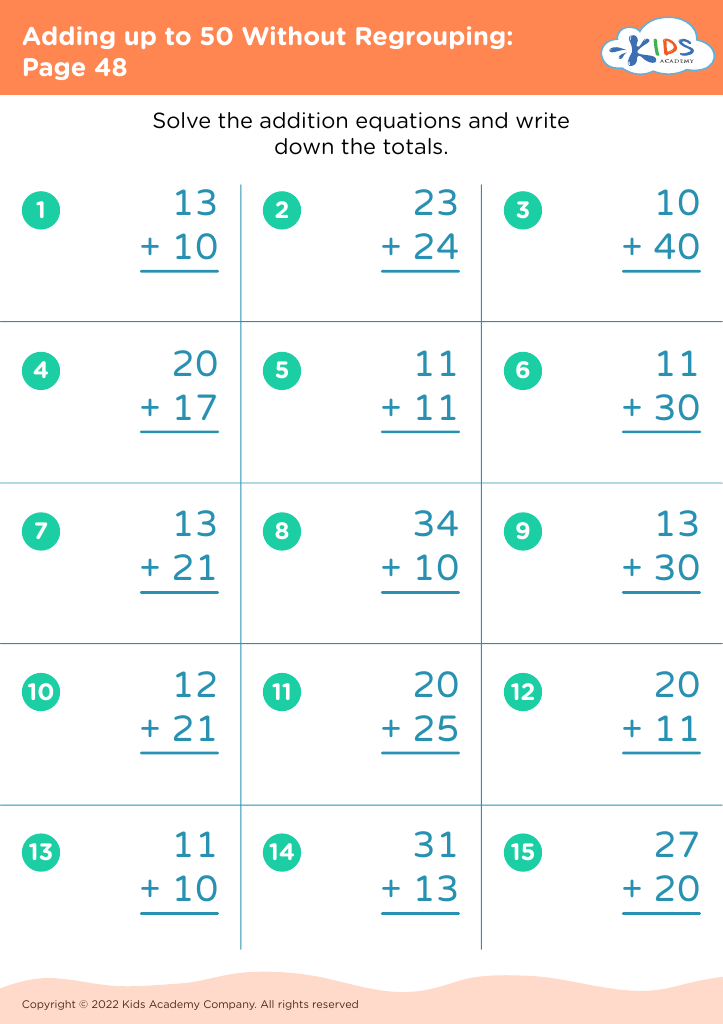
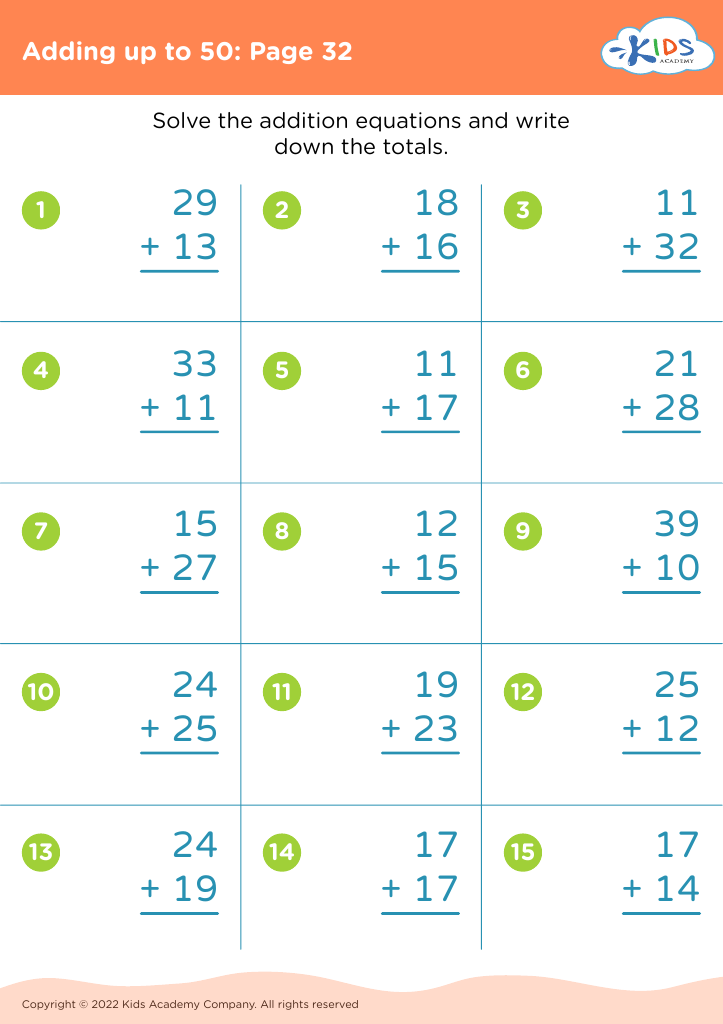




Fostering proficiency in comparing quantities and adding up to 50 is crucial for children aged 5-8, as these skills form the foundational blocks of their math education and cognitive development. First, comparing quantities helps young learners develop a sense of number magnitude, understanding which numbers are larger or smaller, and lays the groundwork for more complex mathematical concepts such as subtraction, multiplication, and division.
Moreover, mastering addition up to 50 enhances critical thinking and problem-solving skills. It enables children to perform essential daily tasks, such as counting money, telling time, or measuring ingredients in a recipe. This early practice also promotes computational fluency, speed, and accuracy, preparing them for higher-level math in subsequent grades.
Algebraic thinking starts young, and comparing and adding numbers cultivates logical reasoning abilities. These activities engage children in pattern recognition and sequencing while nurturing persistence as they encounter and solve progressively challenging problems.
Furthermore, success in these early math skills boosts a child's confidence and fosters a positive attitude towards learning, crucial for lifelong educational success. Thus, teachers and parents should prioritize and create engaging contexts for these fundamental arithmetic concepts, as they serve as the bedrock for all future mathematical understanding and practical life skills.








