Mathematical reasoning Adding up to 50 Worksheets for Ages 5-8
4 filtered results
-
From - To
Discover our engaging "Mathematical Reasoning: Adding Up to 50 Worksheets" designed for young learners aged 5-8. These worksheets provide a fun and interactive way for kids to enhance their addition skills while developing critical thinking and problem-solving abilities. With a variety of exercises tailored to different learning levels, these worksheets inspire confidence in mathematical reasoning. Your child will enjoy colorful visuals and stimulating challenges that make learning exciting! Perfect for at-home practice, homework, or classroom activities, our worksheets will guide your child to master addition up to 50 effortlessly. Start the journey to math success today!
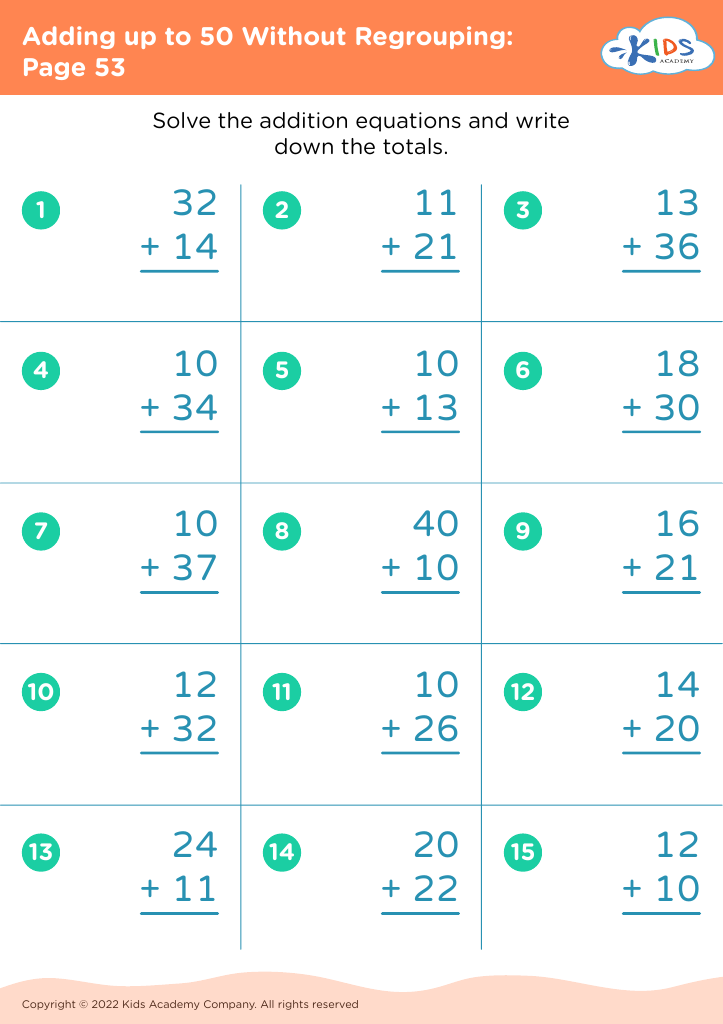
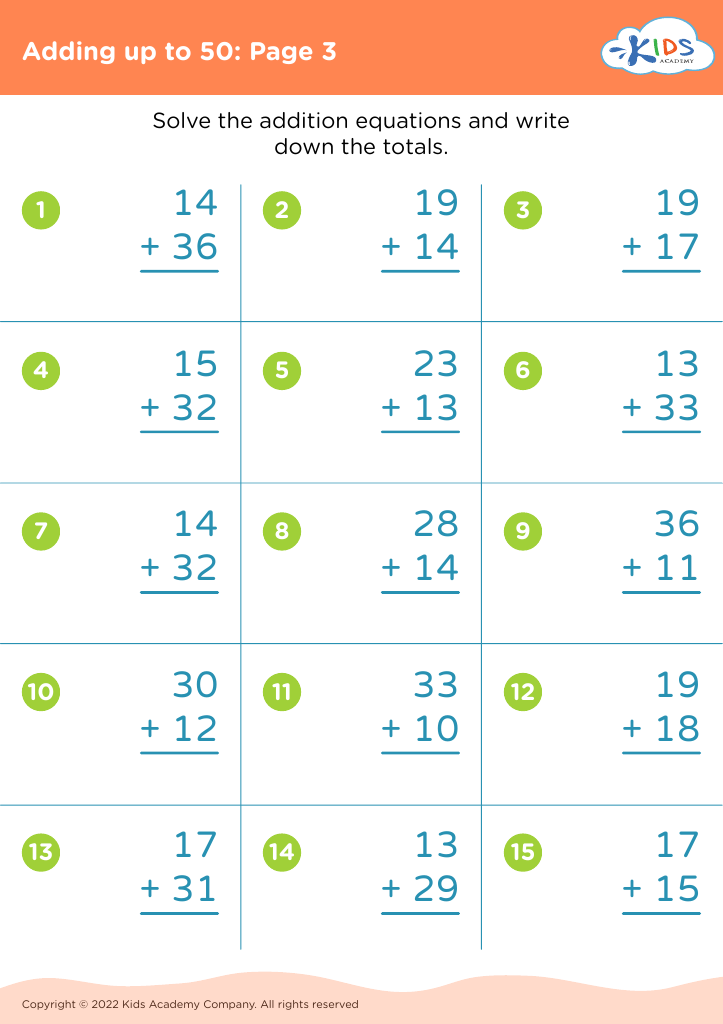
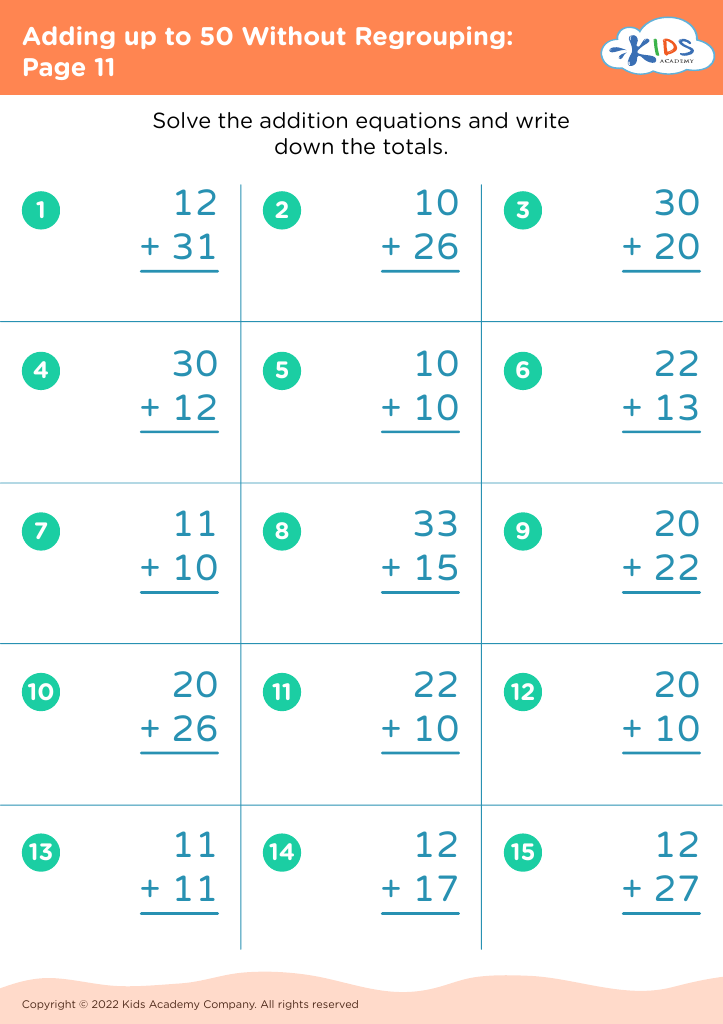
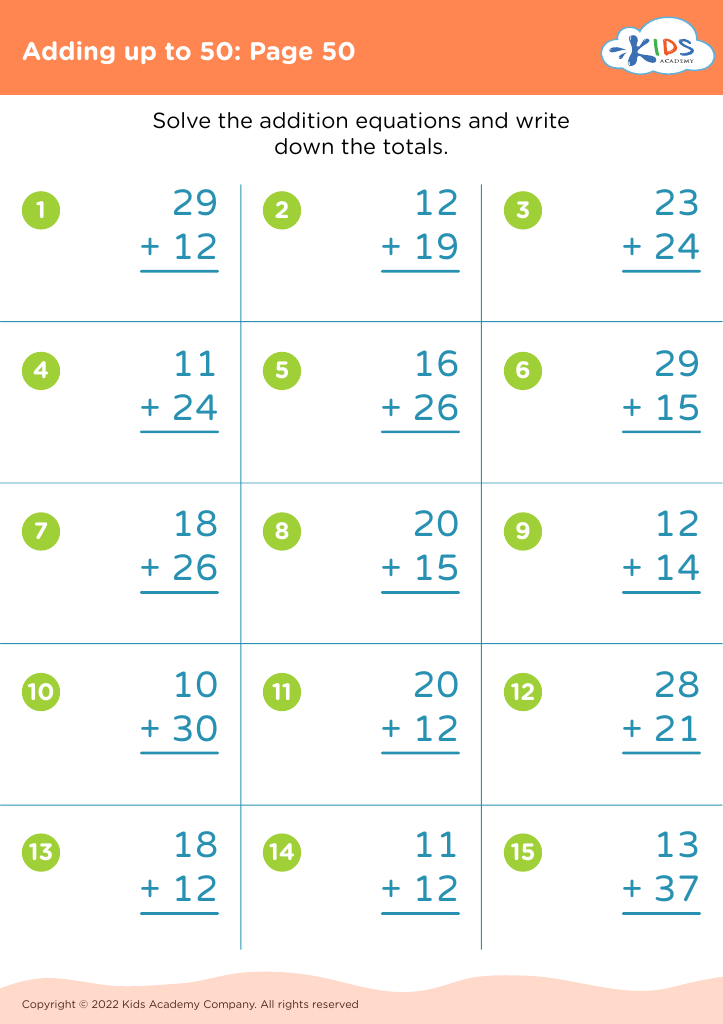




Mathematical reasoning is a foundational skill for children ages 5-8, particularly when it comes to concepts such as adding up to 50. This age group is critical for developing cognitive skills that will support future learning in mathematics and other subjects. Parents and teachers should emphasize mathematical reasoning because it fosters critical thinking, problem-solving abilities, and confidence in children.
Understanding how to add up to 50 helps young learners to visualize numbers and understand the relationships between them. Participating in these activities enables children to use strategies like counting, grouping, and number bonds. This enhances their ability to tackle more complex math concepts later on, like addition, subtraction, and even early algebraic thinking.
Moreover, engaging children in meaningful math discussions encourages them to articulate their thought processes, which deepens their understanding and improves retention. When children see the relevance of math in everyday scenarios, they develop a positive attitude toward the subject and see it as relevant to their lives.
Involving parents in this process strengthens the home-school connection and builds a supportive learning environment. Ultimately, encouraging mathematical reasoning lays the groundwork for academic success and promotes life skills essential for future educational pursuits.








