Problem-Solving Skills Adding up to 50 Worksheets for Ages 5-8 - Page 2
26 filtered results
-
From - To
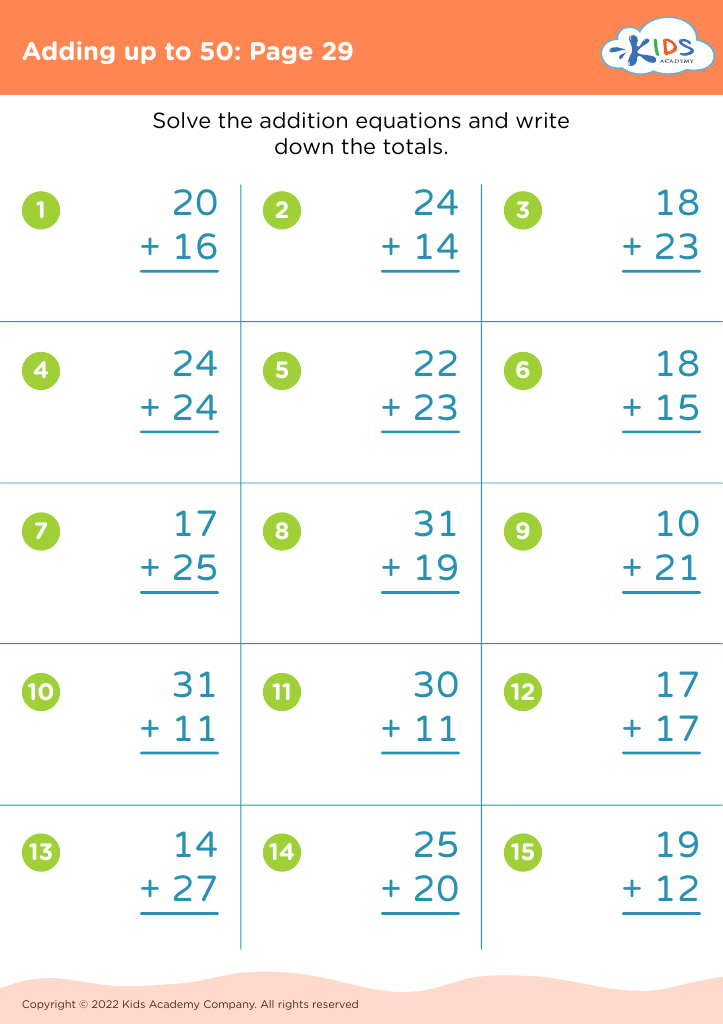
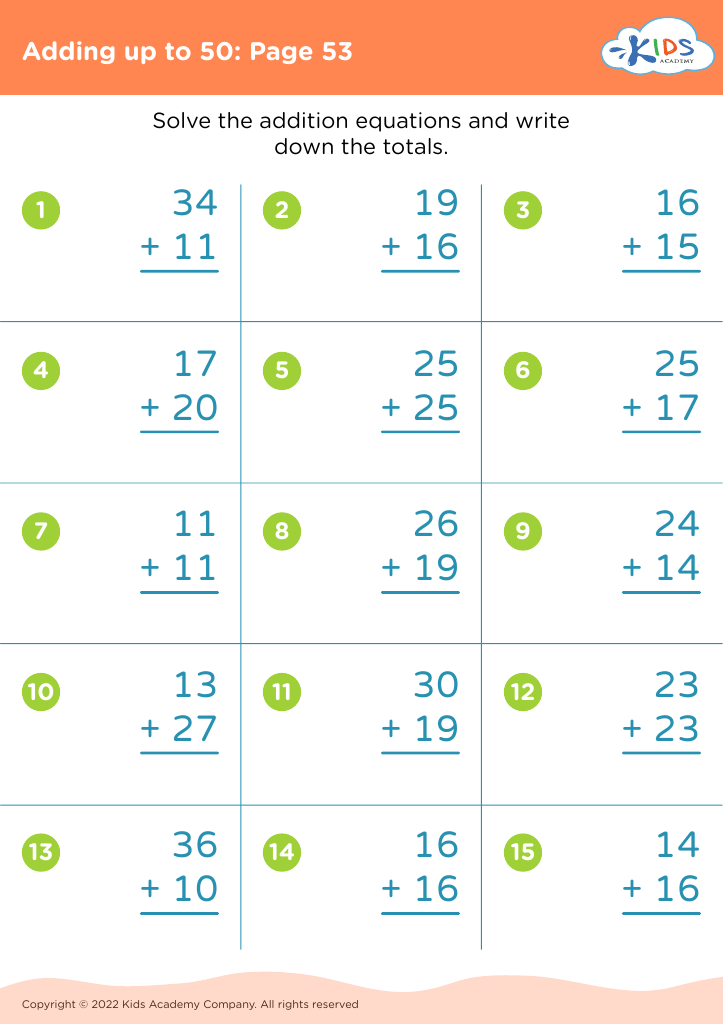




Problem-solving skills are crucial for young children's cognitive and social development, especially in the foundational age range of 5 to 8. Focusing on activities that involve adding up to 50 provides several significant benefits. First, these exercises help children hone their arithmetic skills, laying a strong mathematical foundation that is critical for future academic success. Working within the sum of 50 is challenging but achievable, helping to build confidence and a sense of accomplishment.
Moreover, problem-solving activities stimulate children's critical thinking and reasoning abilities. These skills foster curiosity and the ability to evaluate multiple approaches, which are transferable to other areas of learning and life. Collaborative problem-solving with peers can also enhance social skills, including communication, listening, and teamwork.
In addition, engaging with such tasks supports fine motor skills as children write numbers and perform calculations, promoting both hand-eye coordination and patience. Importantly, successful problem-solving experiences can instill a growth mindset, teaching children that challenges are opportunities for growth rather than obstacles.
Overall, parents and teachers must view problem-solving as more than just a math exercise. It's a comprehensive developmental tool that nurtures a wide array of essential life skills, preparing children for both academic and personal success.








