Developing critical thinking Addition & Subtraction Worksheets for Ages 5-8
3 filtered results
-
From - To
Enhance your child's math skills with our Developing Critical Thinking Addition & Subtraction Worksheets designed for ages 5-8. These engaging worksheets focus on strengthening problem-solving abilities through interactive and creative exercises. By encouraging kids to think critically about mathematical concepts, they learn to approach problems from various angles, boosting their confidence and independence in learning. Our resources feature colorful visuals and relatable real-life scenarios that make learning enjoyable. Perfect for classroom use or at-home reinforcement, these worksheets not only teach essential math skills but also foster a lifelong love for learning. Start your child's journey towards mathematical mastery today!
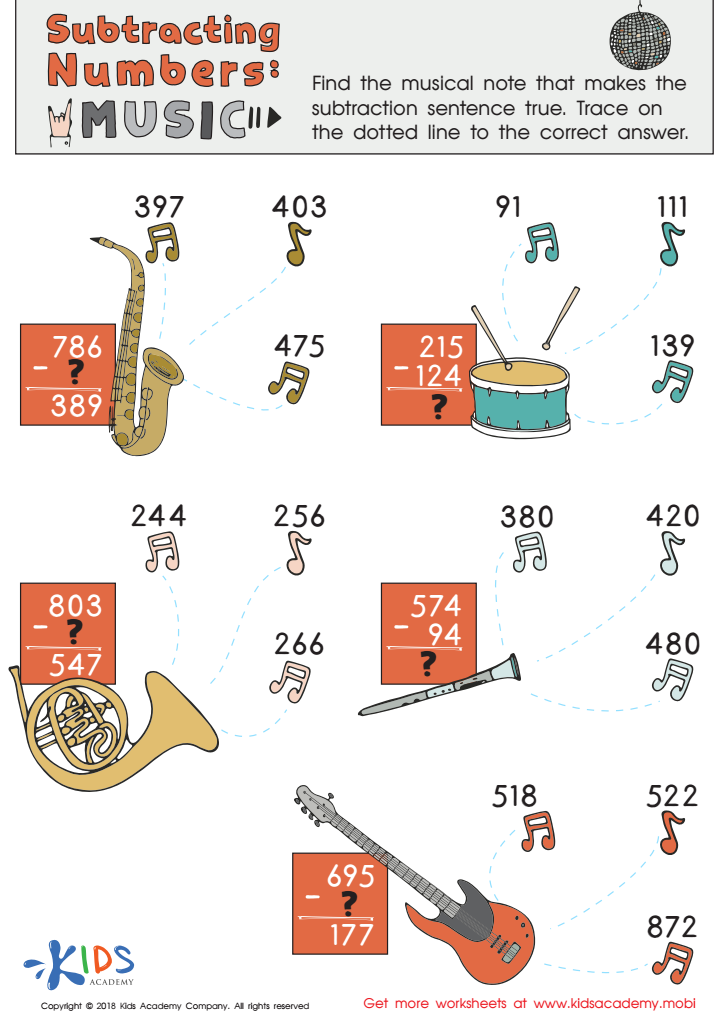
Subtracting Numbers: Music Worksheet
 Assign to My Students








Developing critical thinking skills in addition and subtraction for children ages 5-8 is essential for several reasons. First, critical thinking encourages children to analyze, evaluate, and synthesize information, leading to a deeper understanding of mathematical concepts beyond rote memorization. Instead of simply learning to add and subtract, children learn to grasp the underlying principles, enabling them to apply these skills in various real-life situations.
Second, as children learn to approach problems creatively and logically, they become more resilient problem solvers. This resilience is crucial in a world where they need to navigate complex challenges and make informed decisions. Moreover, fostering critical thinking in early education supports cognitive development, enhancing skills such as reasoning, questioning, and decision-making.
Third, parents and teachers play a pivotal role in shaping children's attitudes toward math. By encouraging critical thinking, they can help instill a positive mindset, portraying math as not just a subject but a valuable tool for understanding the world. Ultimately, this foundation not only promotes mathematical proficiency but also prepares children for lifelong learning, as they develop the skills necessary to think critically in all areas of their education and future careers. Engaging young learners in this manner supports their growth into confident, capable individuals.








