Math problem-solving skills Addition & Subtraction Worksheets for Ages 5-8
4 filtered results
-
From - To
Enhance your child's mathematical abilities with our comprehensive collection of Math Problem-Solving Skills Addition & Subtraction Worksheets tailored for ages 5-8. These engaging, printable worksheets are thoughtfully designed to bolster kids' understanding of fundamental arithmetic concepts. By practicing with fun, age-appropriate problems, young learners can develop essential cognitive skills such as logical thinking and problem-solving strategies. Each worksheet provides step-by-step exercises, ensuring repeatable success and boosting confidence in mathematics. Ideal for both classroom and home use, these resources are perfect for paving the way to a strong math foundation. Foster a love for learning and watch your child excel!
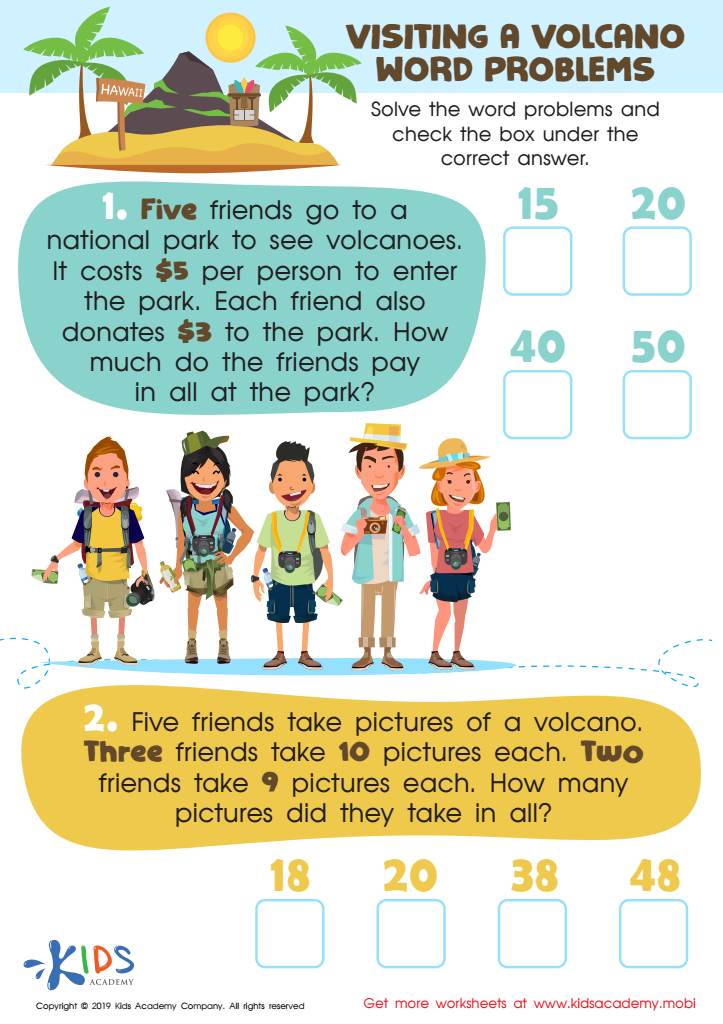
Visiting a Volcano Word Problems Worksheet
 Assign to My Students








Parents and teachers should prioritize the development of addition and subtraction skills in children aged 5-8 because these skills establish the foundation for all future mathematical learning. Understanding these basic operations is crucial as they lay the groundwork for higher-level arithmetic, including multiplication and division, fractions, and even algebra. Early proficiency in addition and subtraction facilitates cognitive development, improving problem-solving abilities, logical thinking, and decision-making.
Math problem-solving also enhances children's confidence in tackling more complex tasks. As they experience success with simple addition and subtraction, they build a positive attitude towards mathematics and learning in general. This confidence is critical as students progress through their education, facing increasingly challenging materials.
Additionally, daily life is imbued with situations requiring basic math skills, such as counting money, telling time, and measuring ingredients in recipes. Fluency in basic math ensures children can participate in everyday activities fully and independently.
Finally, mathematics enhances academic performance across multiple subjects, given its integral part of science, technology, engineering, and even humanities subjects such as geography or economics. Therefore, fostering strong math problem-solving skills in young learners equips them for a broad spectrum of future academic and life challenges.








