
Mathematical thinking Addition Worksheets for Ages 5-8
4 filtered results
Difficulty Level
Grade
Age
-
From - To
Subject
Activity
Standards
Welcome to our "Mathematical Thinking Addition Worksheets" for children ages 5-8! These engaging and educational resources are designed to foster essential addition skills while encouraging critical thinking. Our worksheets feature a variety of fun activities that challenge young learners to solve problems, recognize patterns, and develop a solid understanding of mathematical concepts. From simple exercises to more complex challenges, these printable worksheets promote mastery of addition in an enjoyable way. Perfect for classroom use or at-home practice, our worksheets aim to build confidence and enthusiasm for math in your child. Explore our collection today and watch your child's mathematical thinking flourish!
Favorites
With answer key
Interactive
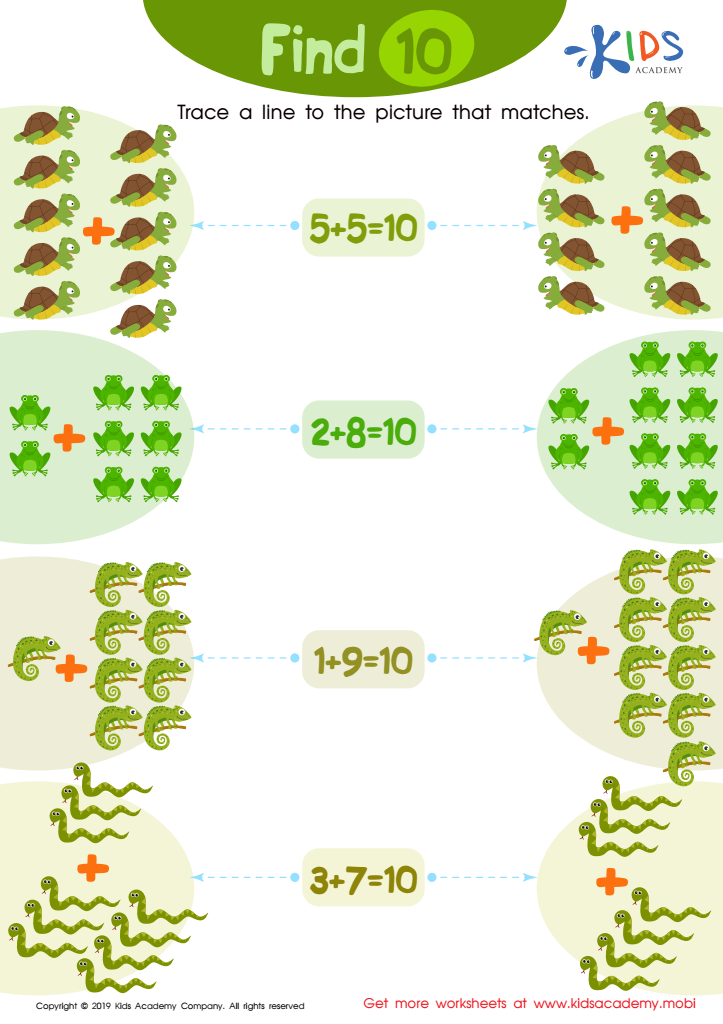
Find 10 Worksheet
Counting can be tricky, but your kids can master it with regular practice. Here's a fun activity to help: count the animals, then trace a line to the pictures that matches. With these tips, math will be an easy walk in the park.
 Assign to My Students
Find 10 Worksheet
Worksheet
Join Kids Academy for Free
Who is primarily going to use this learning content?








Mathematical thinking, particularly in addition, is crucial for children aged 5-8 as it lays the foundation for their overall cognitive development and academic success. During this formative stage, children begin to grasp basic concepts of numbers, operations, and the relationships between them. Engaging in addition helps develop critical thinking and problem-solving skills, as children learn to analyze numbers, recognize patterns, and approach challenges systematically.
Furthermore, mastering addition at an early age fosters confidence and a positive attitude toward math, which can influence their long-term learning experiences. Children who struggle with foundational math skills may face difficulties later in school, leading to anxiety and aversion to the subject. By focusing on addition, parents and teachers can create a supportive environment, encouraging exploration and discovery through games, manipulatives, and interactive activities.
Additionally, mathematical thinking supports the development of other vital skills, such as logic, reasoning, and spatial awareness. It prepares children not only for future math concepts but also equips them with tools that are applicable in real-life situations. Ultimately, investing in early mathematical knowledge nurtures lifelong learners who appreciate and are adept at navigating the ever-important world of numbers.








