Improving fine motor skills Math Worksheets for Ages 5-8
3 filtered results
-
From - To
Enhance your child's math learning experience with our expert-designed "Improving Fine Motor Skills Math Worksheets for Ages 5-8." These fun and engaging worksheets expertly balance academic concepts with activities specifically aimed at enhancing fine motor skills. Children will enjoy exercises that involve cutting, tracing, and drawing, all while strengthening their ability to solve math problems. Perfect for young learners just beginning their educational journey, our resources foster a love for math and improve dexterity. Empower your child with tools that build both mathematical understanding and essential fine motor coordination, setting the foundation for lifelong learning success. Visit us today!
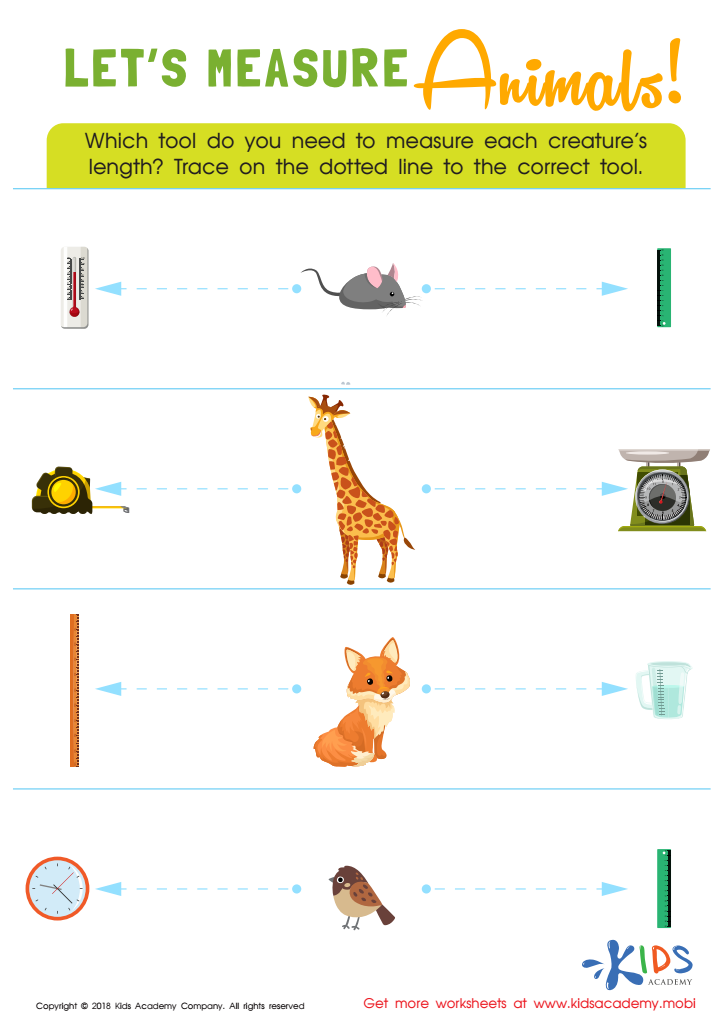
Let's Measure Animals! Worksheet
 Assign to My Students








Improving fine motor skills in math for children aged 5-8 is crucial for both academic and developmental reasons. Fine motor skills involve the coordination of small muscles, particularly in the hands and fingers, enabling children to perform essential tasks such as writing, drawing, and using tools. In math, these skills are fundamental for tasks including numeral writing, counting with manipulatives, and creating geometric shapes.
Enhanced fine motor skills facilitate clearer and more efficient numeral writing, vital for math problem-solving and communication of answers. For example, poorly written numbers can lead to confusion, misinterpretation, and frustration for both the child and the teacher. Moreover, activities like using counters, building blocks, and drawing shapes directly engage and develop these fine motor skills. Such tactile learning experiences are particularly beneficial in math, often helping to bolster understanding and retention of abstract concepts.
Moreover, investing in fine motor skill enhancement impacts broader developmental areas. It enhances overall hand-eye coordination, boosts independence in daily tasks, and fosters a sense of achievement and confidence. As children age, their improved motor skills will support more complex mathematical and academic endeavors, ultimately laying a stronger foundation for future learning.
Thus, merging fine motor skill activities with math learning not only improves mathematical ability but also equips children with integral life skills.








