
Learning subtraction Math Worksheets for Ages 5-8
3 filtered results
Difficulty Level
Grade
Age
-
From - To
Subject
Activity
Standards
Discover our comprehensive collection of subtraction math worksheets designed specifically for children ages 5-8. These engaging resources help young learners grasp the fundamentals of subtraction through fun activities, interactive exercises, and colorful illustrations. Our worksheets cater to different learning styles, ensuring that every child can master basic subtraction concepts at their own pace. With a variety of easy-to-follow problems, your child will build confidence while reinforcing essential math skills. Perfect for classroom use or at-home practice, these subtraction worksheets are an invaluable tool in establishing a strong math foundation. Visit our website and start your child's math adventure today!
Favorites
With answer key
Interactive
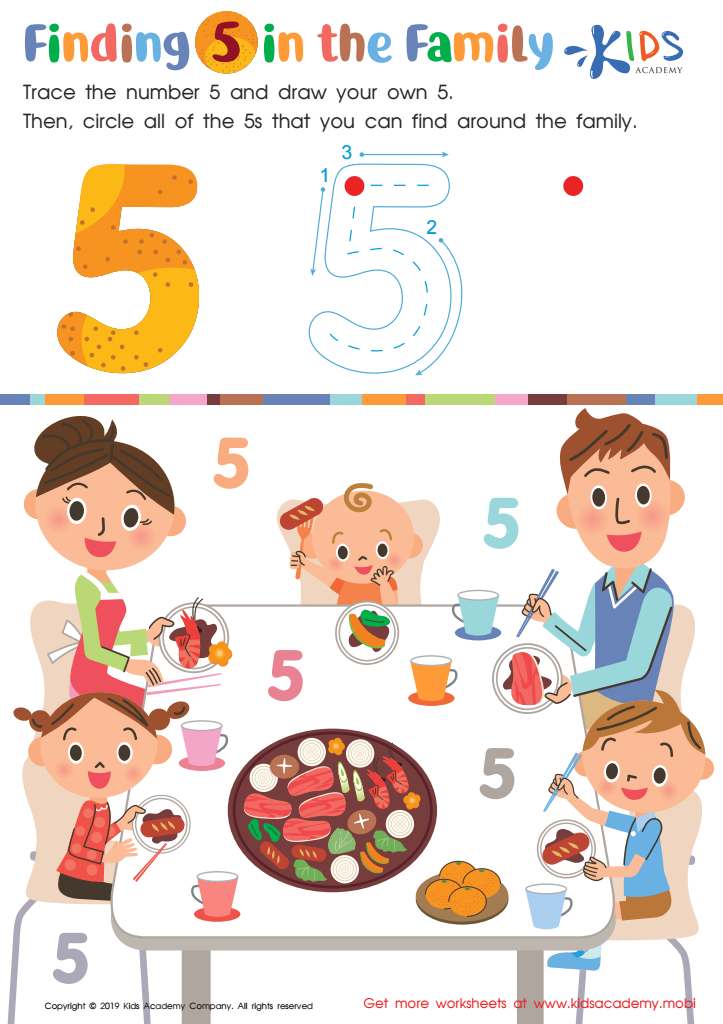
Finding 5 in the Family Worksheet
This worksheet helps kids identify and write the number 5. Ask what the family is doing and who the family members are. Help them trace and draw the 5, then have them circle all 5s in the picture.
 Assign to My Students
Finding 5 in the Family Worksheet
Worksheet
Join Kids Academy for Free
Who is primarily going to use this learning content?






.jpg)

Parents and teachers should prioritize teaching subtraction to children aged 5-8 as it lays the foundation for essential mathematical skills and promotes cognitive development. At this early stage, children are not just learning subtraction as a numerical operation; they’re also developing problem-solving strategies and critical thinking skills.
Understanding subtraction enhances a child’s ability to manipulate numbers, which is crucial in everyday life scenarios, such as counting change or determining the number of items left after some are taken away. Mastery of subtraction encourages confidence in mathematics and can lead to better performance in higher-level math concepts later on.
Moreover, subtraction fosters emotional growth, teaching perseverance and resilience as children navigate the challenges of mathematical problems. Concepts like “taking away” also align with social skills, as they often stem from real-life experiences—sharing toys, for example.
By making subtraction engaging through games and interactive activities, parents and teachers can cultivate a positive attitude towards math. Early competencies in subtraction directly influence a child's willingness to tackle more complex mathematical ideas in the future, ultimately supporting their academic journey and lifelong learning. Establishing a strong math foundation during these formative years can pave the way for a confident, capable learner.








