Understanding fact families Subtraction Worksheets for Ages 5-8
3 filtered results
-
From - To
Help your child master basic math with our "Understanding Fact Families Subtraction Worksheets for Ages 5-8." These expertly designed worksheets by Kids Academy make learning subtraction fun and engaging. By exploring the concept of fact families, children grasp the connection between addition and subtraction, enhancing their overall math skills. Each worksheet is crafted to boost the confidence of young learners, providing a solid foundation in arithmetic. Suitable for classroom use or at-home practice, these resources offer clear instructions and fun problems, perfect for reinforcing essential skills. Watch your child excel in math with our comprehensive subtraction worksheets!
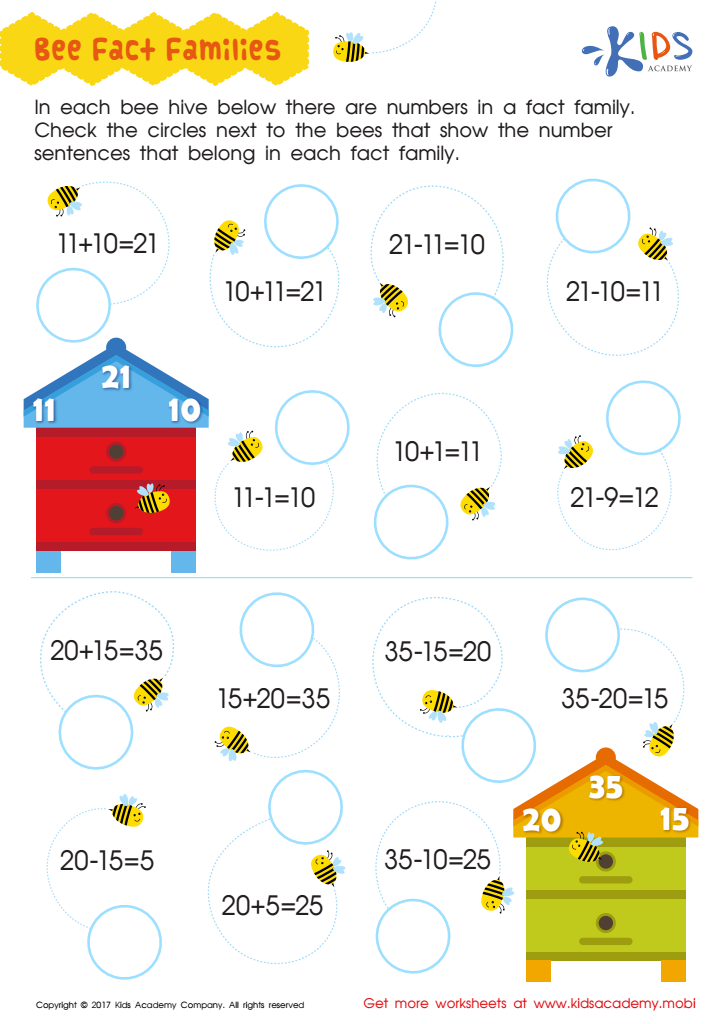
Fact Families Worksheet
 Assign to My Students
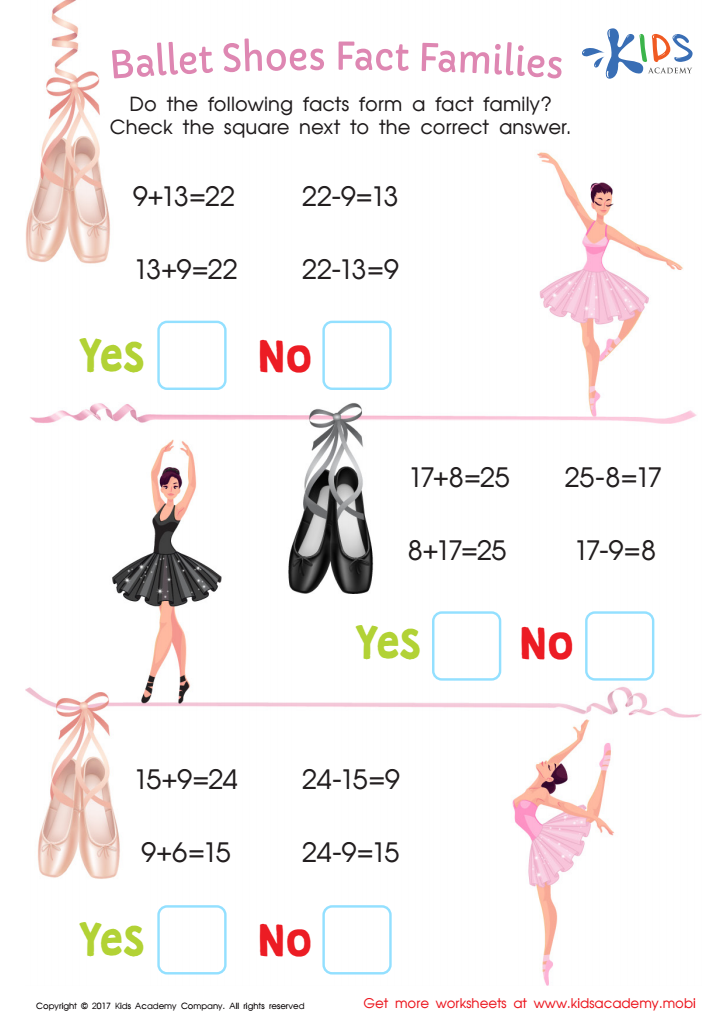
Ballet Shoes Fact Family Printable








Understanding fact families involving subtraction is crucial for young learners, ages 5-8, both for their mathematical development and for foundational reasoning skills. Fact families are groups of related mathematical facts using the same numbers. For instance, the subtraction fact family for 7, 3, and 4 involves 7 - 3 = 4 and 7 - 4 = 3, as well as their related addition facts.
First, grasping fact families enhances a child's conceptual understanding of how numbers are interconnected, going beyond rote memorization of facts. It helps them see the relationship between addition and subtraction, reinforcing that these operations are essentially inverse processes. This duality is pivotal for a solid foundation in arithmetic, which is essential for future math skills.
Second, learning about fact families promotes problem-solving skills. Children who understand these relationships can approach math problems more strategically, breaking them down to find solutions more easily.
Finally, a strong understanding of subtraction within fact families builds confidence. Young children often feel more competent in math when they see how numerical operations relate rather than treating each problem as isolated. This confidence fosters a positive attitude toward math, encouraging continued interest and effort.
By focusing on fact families, parents and teachers can equip children with robust tools for academic success, both immediately and in the future.








