
Practicing division Worksheets for Ages 5-9
3 filtered results
Difficulty Level
Grade
Age
-
From - To
Subject
Activity
Standards
Discover our engaging practicing division worksheets designed for children aged 5-9! Perfect for young learners, these worksheets simplify essential division concepts through fun activities and colorful visuals. Each worksheet encourages cognitive growth while helping kids grasp the fundamentals of division, fostering their confidence in math. Tailored to meet different learning styles, our resources include step-by-step guidance, interactive problem-solving scenarios, and games to make practicing division enjoyable. Whether at home or in the classroom, these worksheets serve as an excellent tool for reinforcing division skills. Start your child’s math journey today and watch them become division champions!
Favorites
With answer key
Interactive
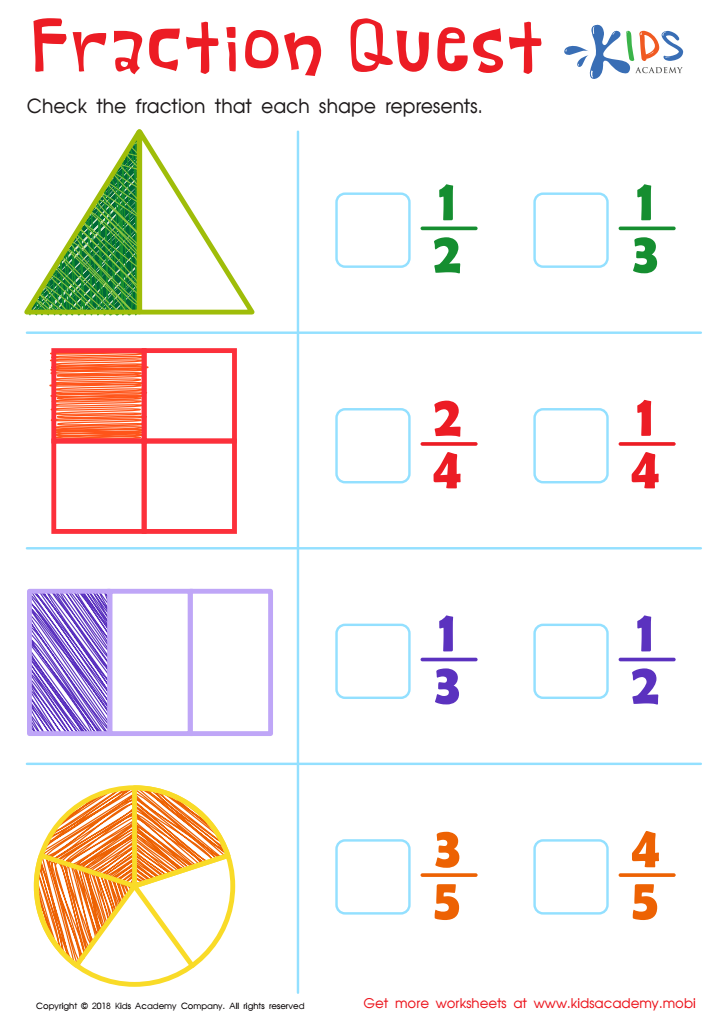
Fraction Quest Worksheet
This colorful and educative worksheet can help kids conquer their fractions struggles. Ask them to identify the four shapes, then the fractions they represent. They can then check the correct answers from the options given.
 Assign to My Students
Fraction Quest Worksheet
Worksheet
Join Kids Academy for Free
Who is primarily going to use this learning content?






Practicing division for children aged 5-9 is crucial for several reasons. First, division is one of the fundamental operations in mathematics, forming the basis for more complex concepts. Early mastery of division helps children understand the relationship between numbers and fosters their problem-solving skills. When children practice division, they learn how to share and distribute quantities, an essential life skill that encourages fairness and cooperation in everyday situations.
Moreover, engaging in division practice strengthens critical thinking. As children work through problems, they develop logical reasoning abilities and the confidence to tackle challenges. This educational foundation also enhances their overall math proficiency, which can positively impact academic performance in later years.
Additionally, practicing division can be made fun through games and interactive activities, making learning enjoyable and increasing children’s motivation. As parents and teachers reinforce these skills, they instill not only mathematical knowledge but also resilience and persistence necessary for handling difficult tasks.
Finally, division practice builds a strong numerical fluency that prepares children for advanced topics like fractions and decimals, creating a solid mathematical foundation for future learning. Therefore, parents and teachers should prioritize division practice to support well-rounded development in their children.








