
Enhancing critical thinking Addition & Subtraction Worksheets for Ages 5-9
5 filtered results
Difficulty Level
Grade
Age
-
From - To
Subject
Activity
Standards
Engage young minds with our "Enhancing Critical Thinking Addition & Subtraction Worksheets for Ages 5-9." Specifically designed to develop problem-solving skills, these printable worksheets help children master addition and subtraction while fostering critical thinking. Each activity encourages kids to think beyond the numbers, promoting analytical thinking and logical reasoning. Suitable for home or classroom use, our worksheets are a fun, educational tool to boost mathematical understanding and cognitive growth. Let your child’s learning journey be both challenging and exciting as they explore new ways to solve problems and enhance their math skills.
Favorites
With answer key
Interactive
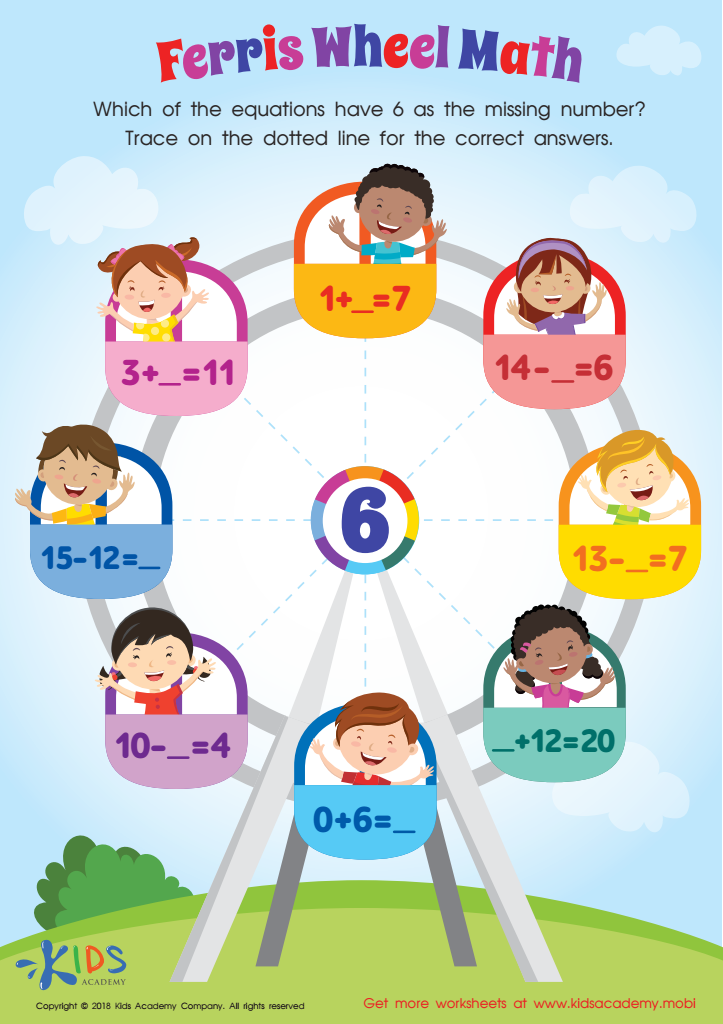
Missing Number: Ferris Wheel Math Worksheet
Hop on the Ferris wheel and solve the equations in the baskets! If the missing number is 6, draw a line from the basket to the middle of the wheel. Kids Academy's addition worksheet will not only help practice pre-algebra but also keep kids entertained with its vibrant illustrations. So, go round and round and have fun with math!
 Assign to My Students
Missing Number: Ferris Wheel Math Worksheet
Worksheet
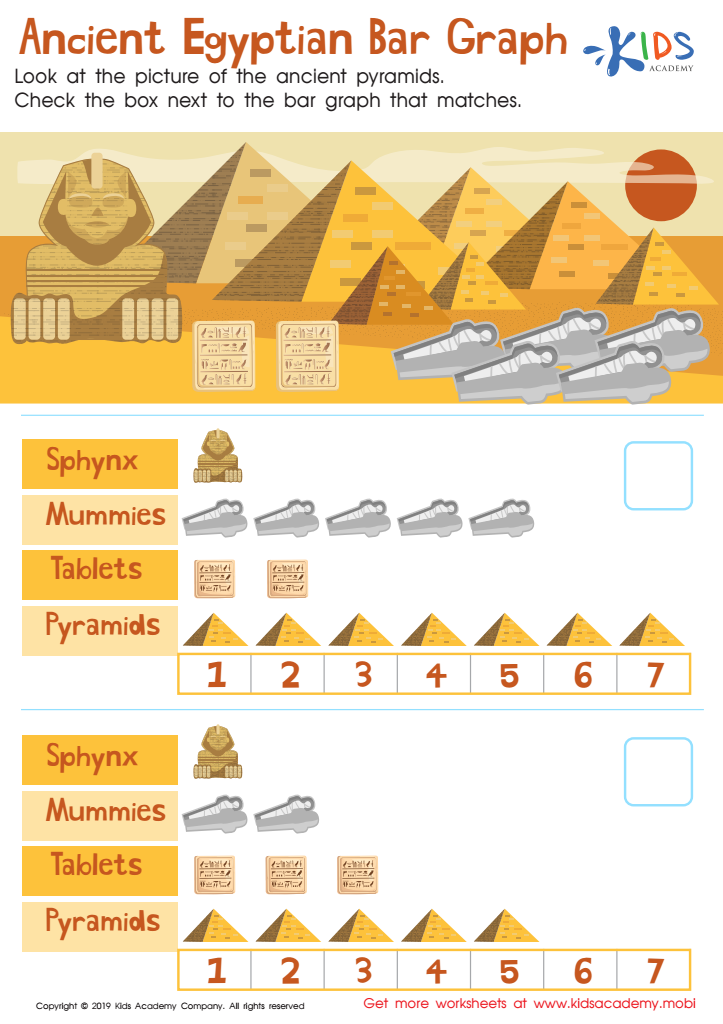
Egyptian Bar Graph Worksheet
Help your kids get a hang of bar graphs with this fun worksheet. Examine the picture of the ancient pyramids and help them match the bar graph to it. Check the box next to the correct bar graph and watch your little ones learn quickly!
Egyptian Bar Graph Worksheet
Worksheet
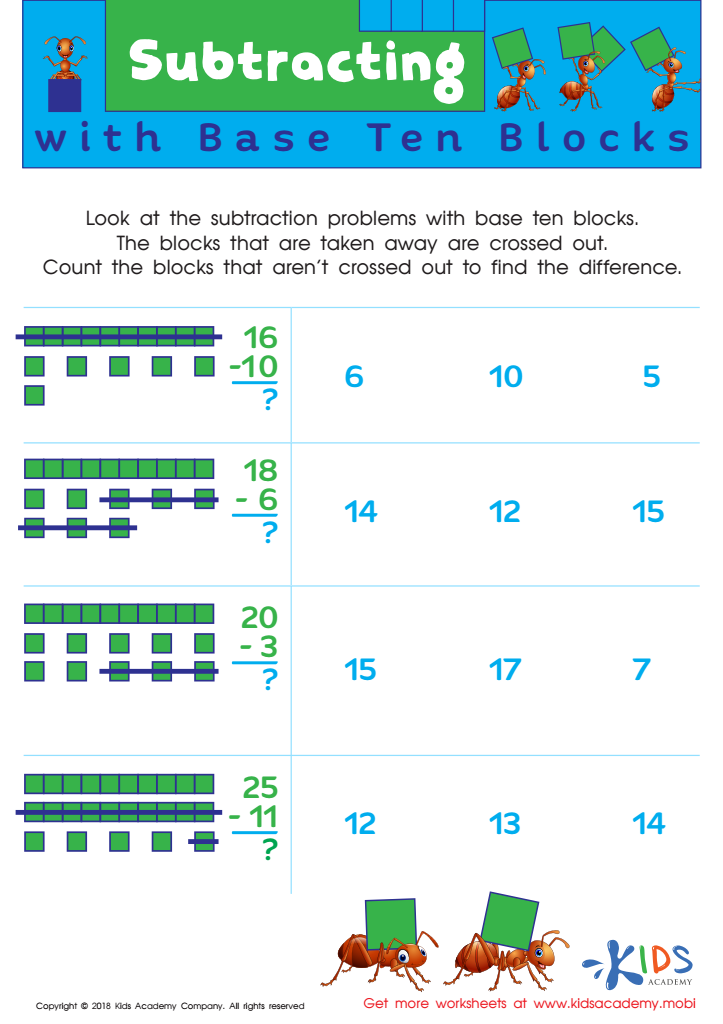
Subtracting with Base Blocks Worksheet
Little mathematicians can use base ten blocks to understand place value for subtraction. This worksheet helps them cross out blocks to solve problems with accuracy. Seeing equations like this boosts their number reasoning skills and helps them work with larger numbers.
Subtracting with Base Blocks Worksheet
Worksheet
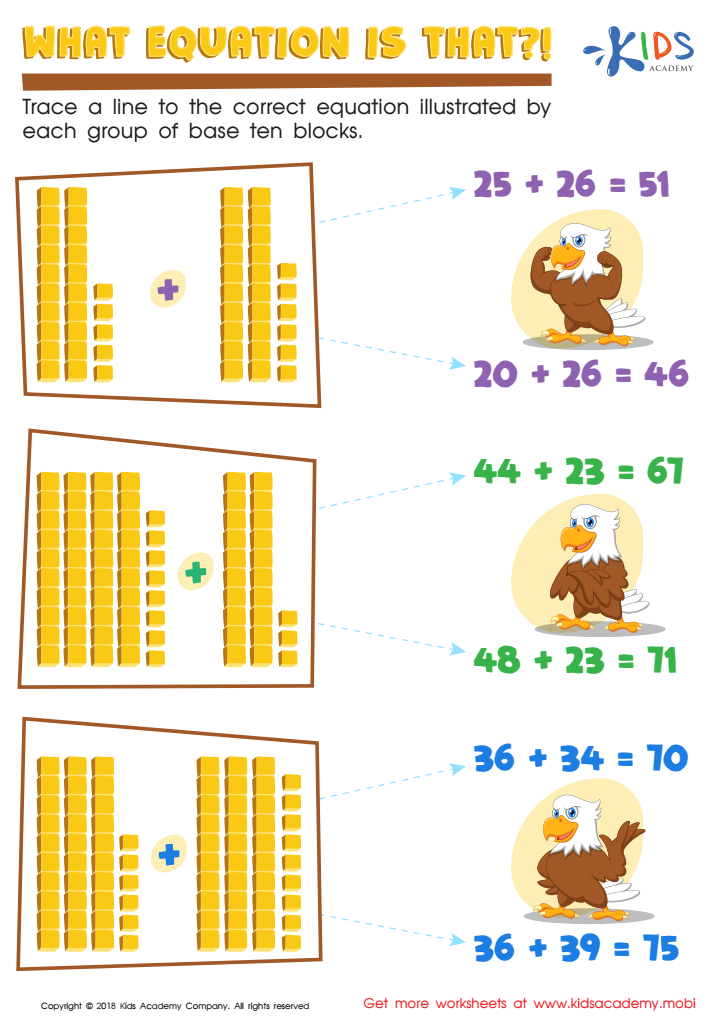
What Equation Is That? Worksheet
Have your students practice counting with base ten blocks. This will help them with math struggles. Homework and worksheets will help them improve; ask them to trace lines to the correct equation on a tracing sheet. Guide them as they count the blocks and trace the lines.
What Equation Is That? Worksheet
Worksheet
Join Kids Academy for Free
Who is primarily going to use this learning content?








Enhancing critical thinking in young children, especially in the context of addition and subtraction, is crucial for a number of reasons. Firstly, these foundational arithmetic skills underpin future learning in mathematics and science, building blocks that extend to more complex problem-solving situations children will encounter as they mature. By integrating critical thinking into these basic skills, we foster a deeper understanding, encouraging kids not just to memorize facts but to comprehend concepts.
For ages 5-9, developing these skills helps cultivate a practical problem-solving approach. This age group naturally explores and questions the world around them; leveraging their curiosity towards mathematical concepts can improve their engagement and interest in the subject. For instance, asking children to visualize or manipulate objects to understand how adding or subtracting elements changes the total fosters an active learning environment.
Moreover, critical thinking in math helps children learn to break problems down into manageable parts, equipping them with strategies to tackle a diverse array of challenges across disciplines. In a broader context, these early cognitive skills contribute to improved decision making and logical reasoning, essential life skills. By nurturing critical thinking abilities in addition and subtraction, parents and teachers set the stage for more independent, thoughtful learners who feel confident in facing both academic and real-world problems.








