Solve word problems Addition & Subtraction Worksheets for Ages 5-9
3 filtered results
-
From - To
Help children master key math skills with our 'Solve Word Problems Addition & Subtraction Worksheets' designed for ages 5-9. These engaging, interactive worksheets focus on helping young learners develop critical thinking and problem-solving abilities through fun and relatable math challenges. They offer a variety of exercises that prompt kids to apply addition and subtraction to real-life scenarios, ensuring a solid understanding of concepts. Encourage your child to explore, reason, and enjoy math with our thoughtfully crafted activities. Perfect for classroom use or at-home practice, our worksheets make learning both effective and enjoyable!
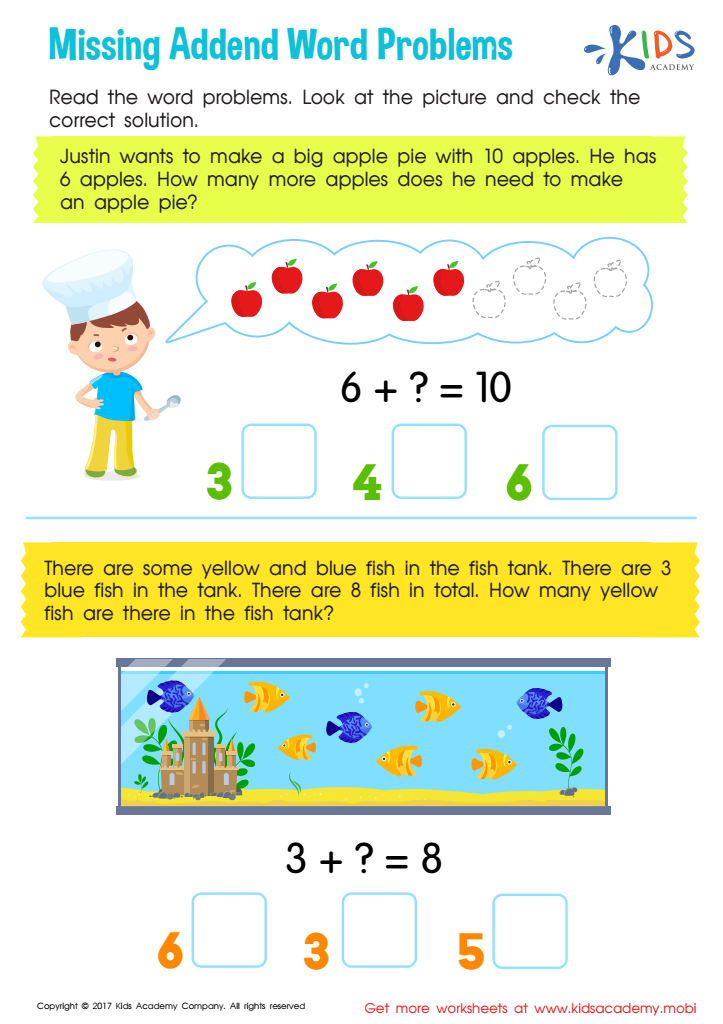
Missing Addend Word Problems Worksheet
 Assign to My Students








Parents and teachers should care about solving word problems in addition and subtraction for ages 5-9 because these foundational skills are crucial for children's overall math literacy and cognitive development. At this formative age, children are not only learning basic arithmetic but also developing critical thinking and problem-solving abilities. Word problems require young learners to read and comprehend a scenario, identify relevant information, and apply appropriate mathematical operations to find a solution. This process improves their reading comprehension, logical reasoning, and analytical skills.
Furthermore, solving word problems in addition and subtraction helps children understand how math applies to everyday life. It demonstrates the practical use of math ideas, making the subject more relevant and engaging for young learners. This real-world connection can enhance their interest and motivation to learn more complex mathematical concepts as they progress in their education.
Additionally, early mastery of these skills builds confidence. Struggling with math at a young age often leads to anxiety and a negative attitude towards the subject. By ensuring children are proficient in solving word problems, we set them on a path for success and a positive relationship with math. Overall, honing these skills benefits children's academic journey and equips them for real-life challenges they will face outside the classroom.








