
Cognitive skill development Math Worksheets for Ages 5-9
3 filtered results
Difficulty Level
Grade
Age
-
From - To
Subject
Activity
Standards
Unlock your child's potential with our engaging Cognitive Skill Development Math Worksheets, specially designed for ages 5-9. These worksheets foster essential cognitive skills such as problem-solving, critical thinking, and logical reasoning, helping young learners build a strong foundation in mathematics. Interactive and age-appropriate, our resources challenge children while keeping them entertained. Each worksheet is crafted to promote creativity and stimulate mind exploration through fun exercises that blend learning with play. Ideal for home or classroom use, our worksheets ensure that your child engages with math in a meaningful way, laying the groundwork for future academic success. Start exploring today!
Favorites
With answer key
Interactive
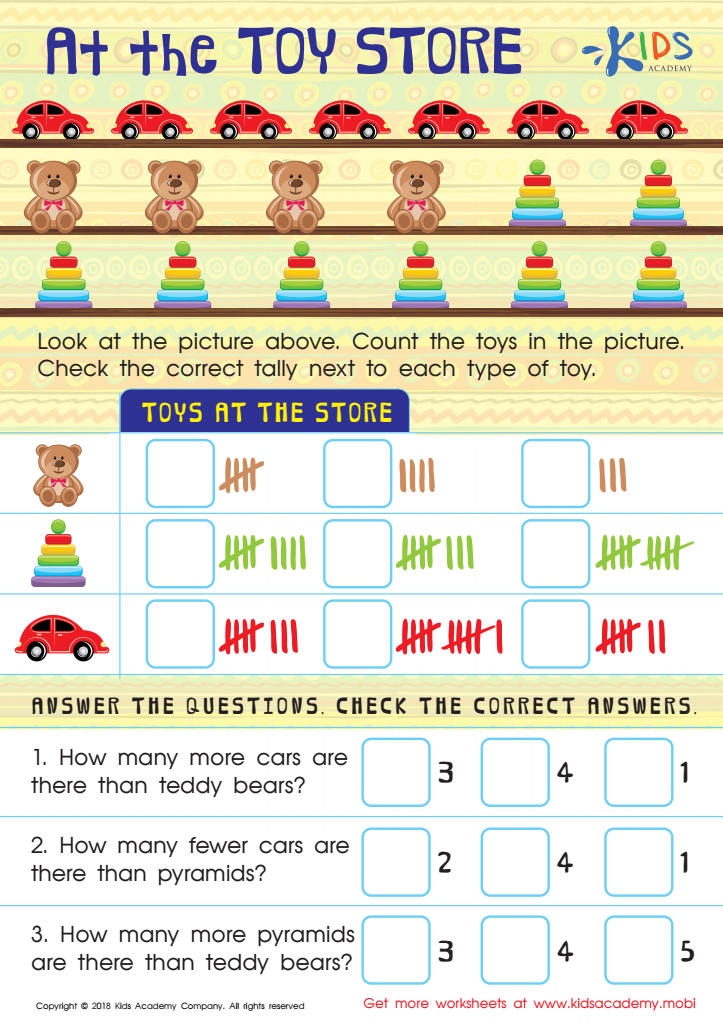
Tally Chart: At the Toy Store Worksheet
Kids Academy has a fun worksheet to help kids practice counting and using tally marks! They can think about the number of toys and compare them. At the bottom, help them answer the questions about the toys on this math page. It's an easy way to learn that one tally mark equals one item.
 Assign to My Students
Tally Chart: At the Toy Store Worksheet
Worksheet
Join Kids Academy for Free
Who is primarily going to use this learning content?








Cognitive skill development in mathematics for children aged 5-9 is crucial for several reasons. First, this stage is foundational; as children start to understand basic mathematical concepts, they also develop critical thinking, problem-solving, and reasoning skills. Early exposure to math fosters a love for the subject and builds confidence, which can lead to academic success in higher grades.
Additionally, strong cognitive math skills can improve a child's overall cognitive development. Engaging in activities that promote reasoning, such as puzzles, counting games, and simple calculations, enhances brain connections, helping children in various learning areas. This cognitive development supports not just math learning but also literacy, as children begin to understand patterns and relationships in language as well.
Moreover, math skills are essential for everyday problem-solving and decision-making. By instilling these skills early, parents and teachers equip children with the tools they need for real-world applications, such as budgeting, understanding measurements, and making informed choices.
Finally, in an increasingly technology-driven world, strong math abilities create pathways to future opportunities. Investing in math cognitive skills during these formative years can help close achievement gaps and lay the groundwork for lifelong learning and success.








