
Counting skills enhancement Math Worksheets for Ages 5-9
3 filtered results
Difficulty Level
Grade
Age
-
From - To
Subject
Activity
Standards
Enhance your child's counting skills with our engaging Math Worksheets designed specifically for ages 5-9! Our collection features interactive activities that promote foundational math concepts through fun and stimulating tasks. Each worksheet encourages children to practice counting, number recognition, and one-to-one correspondence, helping to build essential skills for their academic journey. With vibrant illustrations and varied exercises, your little learners will enjoy exploring numbers while developing confidence in their abilities. Perfect for at-home learning or classroom use, these worksheets provide a valuable resource to support your child's math education. Start their counting adventure today and watch them thrive!
Favorites
With answer key
Interactive
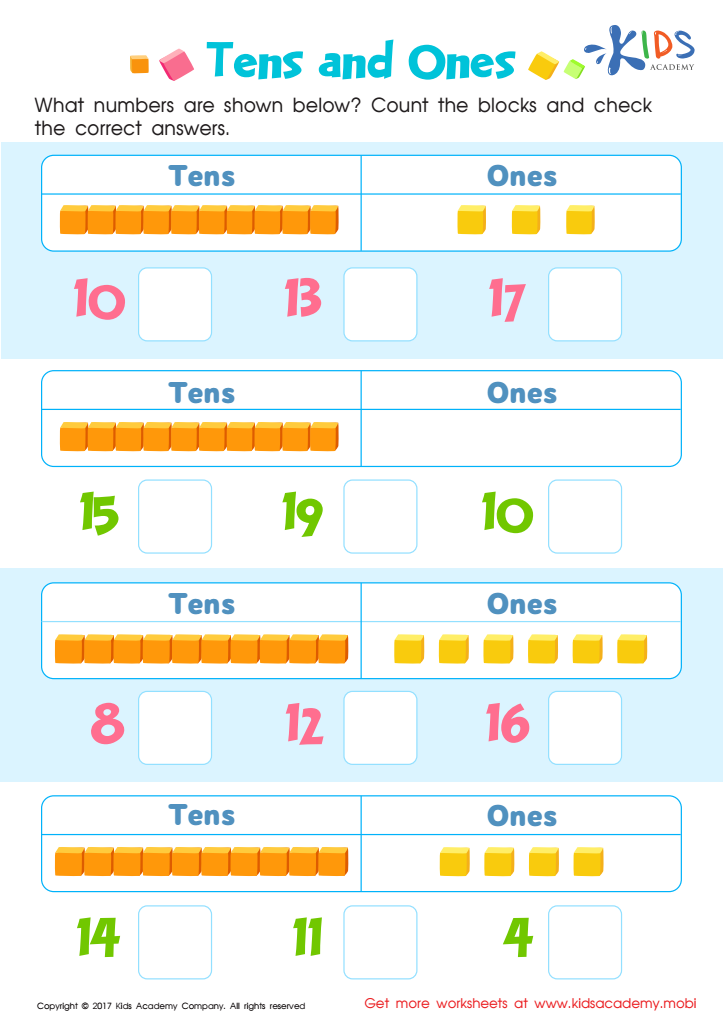
Tens and Ones Worksheet
Help your child make math fun with this worksheet! Count the blocks on both sides and enter the total in the box below the figures. This will help them overcome any math-related anxieties they might have and let them enjoy the learning process.
 Assign to My Students
Tens and Ones Worksheet
Worksheet
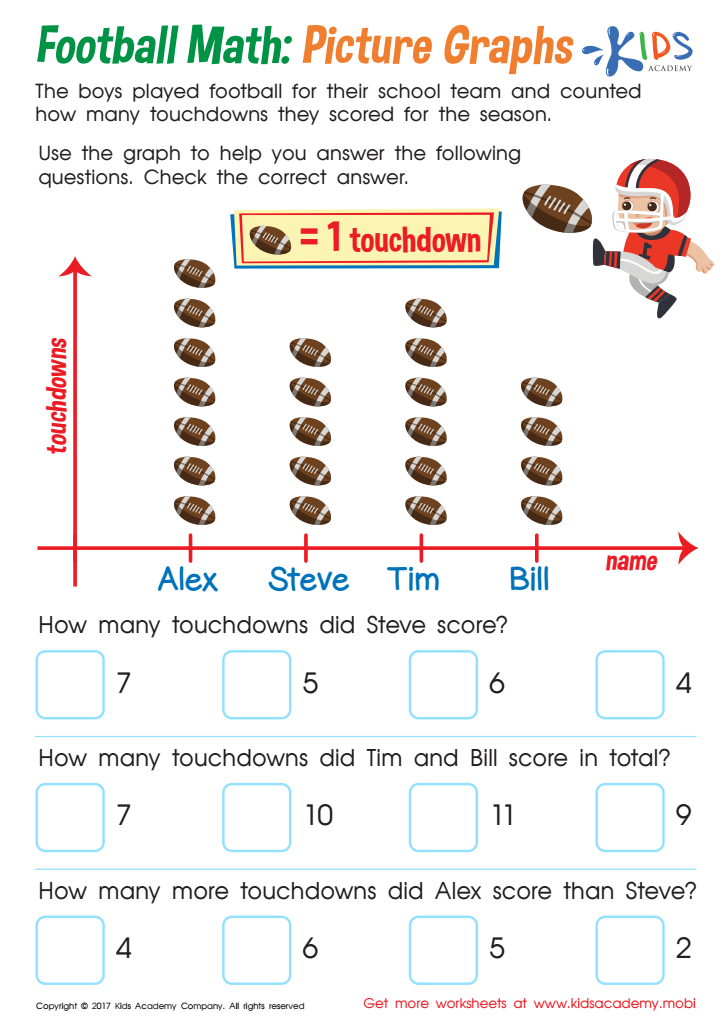
Football Math Worksheet
It uses football-themed data to compare teammates' touchdowns. Perfect for motivating your child and helping them learn to read graphs in a fun way!
Motivate your child to learn to read graphs with this fun and sporty picture graph worksheet! Football-themed data is used to compare teammates and their touchdowns, sure to delight your little sports fan. Perfect for teaching data analysis in an engaging way!
Football Math Worksheet
Worksheet
Join Kids Academy for Free
Who is primarily going to use this learning content?








Counting skills are foundational to a child's mathematical understanding, particularly for ages 5-9, a critical developmental period. Enhancing these skills nurtures cognitive development and instills a sense of number sense, which is essential for more complex mathematical concepts later on. When children can accurately count, they begin to grasp the relationship between numbers and their quantities, laying the groundwork for addition, subtraction, and eventually multiplication and division.
Parents and teachers should care deeply about fostering counting skills as they directly impact academic success. Children who struggle with counting may experience frustration in math-related activities, potentially leading to decreased confidence and a negative attitude toward learning. By prioritizing counting enhancements through engaging activities, games, and real-life applications, educators and parents jointly lay a path for positive math experiences.
Moreover, strong counting skills promote critical thinking and problem-solving abilities, key components not just in mathematics but also in daily life scenarios. Encouraging counting through fun and relatable experiences gives children the tools they need to succeed academically and beyond, ensuring that they develop a robust mathematical foundation they can build on throughout their educational journey. Fostering these skills ultimately supports holistic development, equipping children with lifelong skills.








