
Understanding ordinal numbers Math Worksheets for Ages 5-9
3 filtered results
Difficulty Level
Grade
Age
-
From - To
Subject
Activity
Standards
Welcome to our "Understanding Ordinal Numbers" math worksheets, specially designed for children aged 5-9! Our engaging activities help young learners grasp the concept of ordinal numbers, such as first, second, and third. These worksheets provide fun exercises, including illustrations and interactive challenges, making learning both effective and enjoyable. As kids practice identifying and using ordinal numbers in various contexts, they build a strong mathematical foundation. Perfect for classrooms or at-home learning, our resources aim to foster confidence and a love for math. Explore our collection today to support your child's early numeracy skills and academic growth!
Favorites
With answer key
Interactive
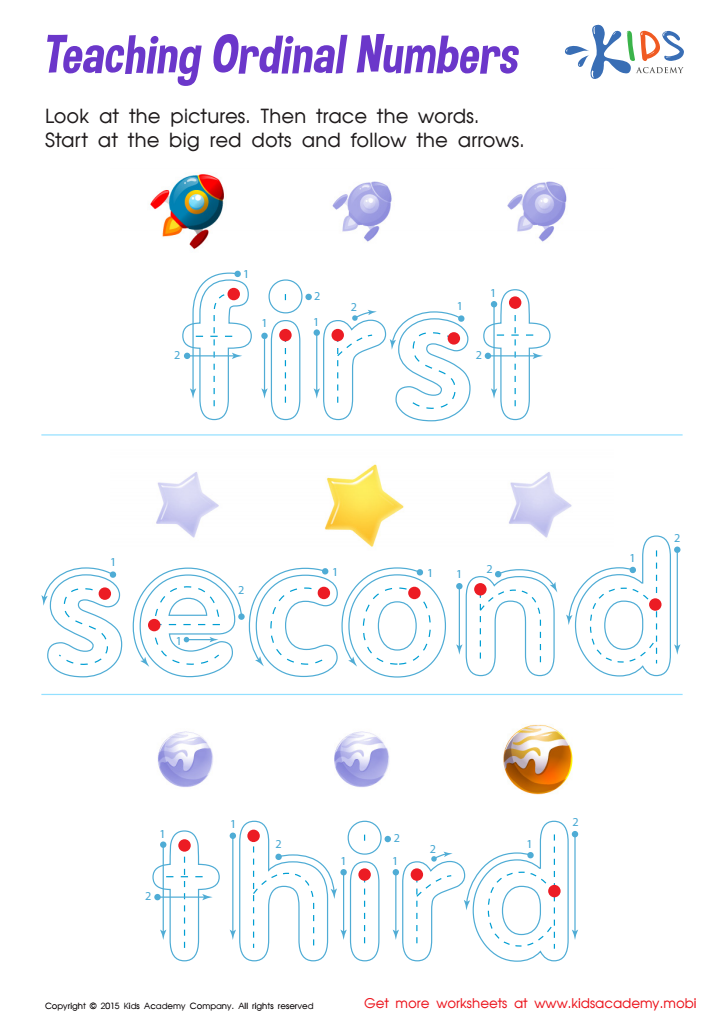
Ordinal Numbers: Teaching Ordinal Numbers Printable
Practice makes perfect!
Kids need to understand ordinal numbers - placement, recognition and spelling. Our worksheet helps kids make connections between the placement and spelling of ordinal numbers. Practice will help your little one perfect this vital number concept.
 Assign to My Students
Ordinal Numbers: Teaching Ordinal Numbers Printable
Worksheet
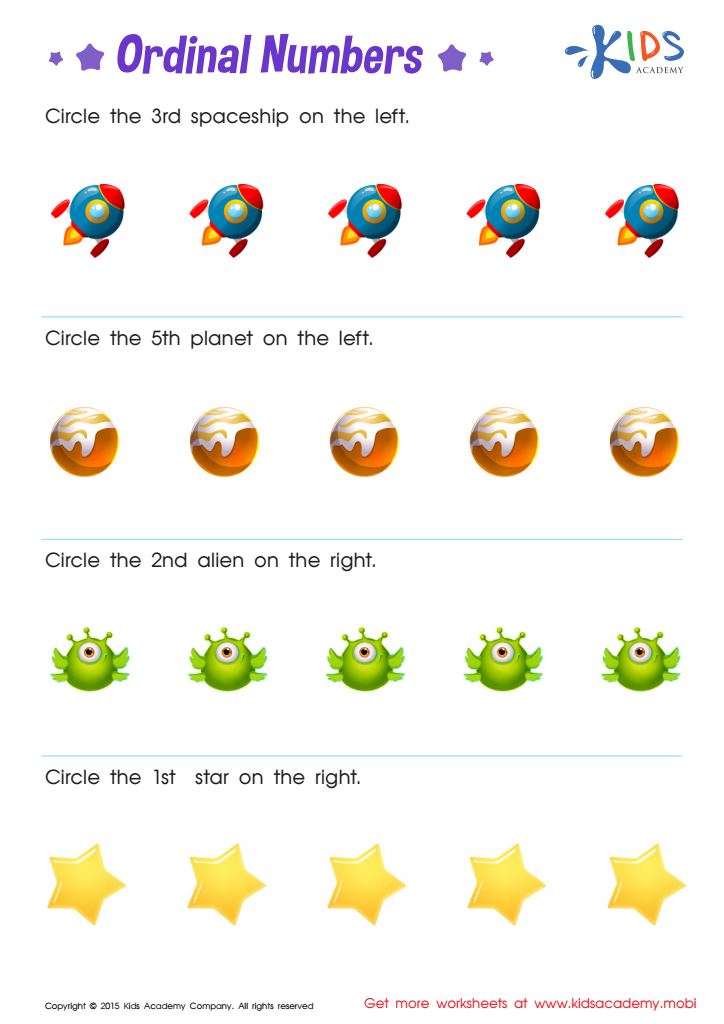
Ordinal Numbers: Space Ordinals Worksheet
Practicing with ordinal numbers worksheet PDFs helps kids master crucial concepts for higher-level math. Plus, when kids have fun learning, the knowledge sticks! So, have your child “blast off” with this space-themed worksheet to read directions, practice relative directions, and learn ordinal numbers.
Ordinal Numbers: Space Ordinals Worksheet
Worksheet
Join Kids Academy for Free
Who is primarily going to use this learning content?








Understanding ordinal numbers is crucial for children aged 5-9 as it lays the foundation for various mathematical concepts and everyday situations. Ordinal numbers, such as first, second, and third, help children grasp the idea of order and position. This understanding aids in developing sequential thinking, which is essential for following instructions, organizing tasks, and solving problems.
For parents and teachers, fostering a grasp of ordinal numbers enhances cognitive skills related to counting, comparison, and categorization. In real-world applications, these concepts are valuable; for instance, children must understand rankings in games, positions in line, or priorities when completing tasks.
Moreover, early mastery of ordinal numbers can boost confidence in young learners, creating a positive attitude towards math in general. When children encounter these concepts through playful activities, stories, or games, they are more likely to engage and retain the information. Many school curriculums emphasize the importance of ordinal numbers as part of foundational math education, thereby making it vital for educators and caregivers to nurture this skill. Ultimately, investing time in teaching ordinal numbers will cultivate a sense of structure and abstraction that benefits children academically and in their daily lives.








