Understanding quadrilaterals Math Worksheets for Ages 5-9
4 filtered results
-
From - To
Enhance your child's math skills with our "Understanding Quadrilaterals" worksheets designed for ages 5-9! These engaging, printable resources help young learners grasp the essential concepts of quadrilaterals, including squares, rectangles, trapezoids, and more. With a variety of activities such as identification, coloring, and matching, these worksheets foster a fun, hands-on learning experience. Our carefully crafted exercises encourage critical thinking while reinforcing geometric vocabulary and shapes. Perfect for at-home learning or classroom use, these worksheets are an ideal tool to build confidence and competence in foundational math skills. Explore our collection today and watch your child's understanding of geometry grow!
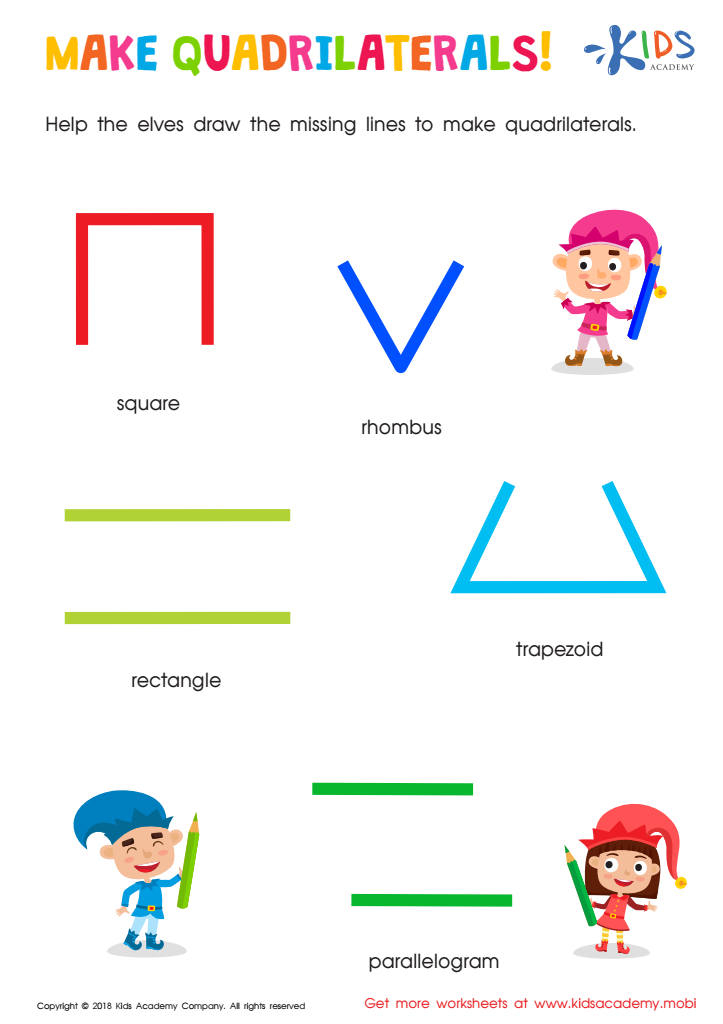
Make Quadrilaterals Worksheet
 Assign to My Students
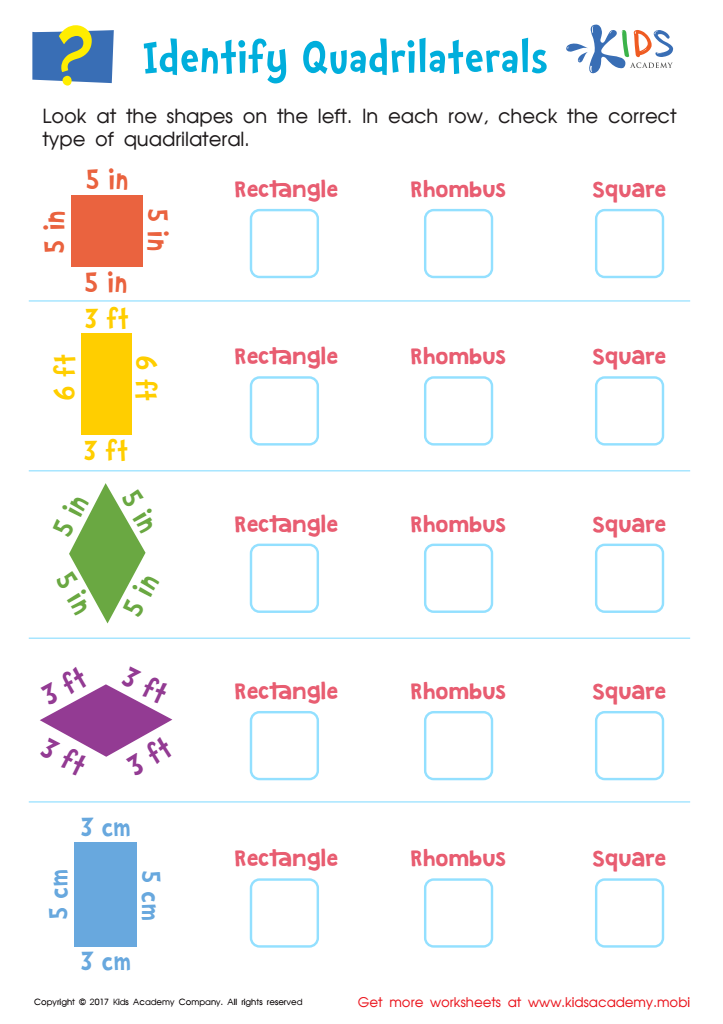
Identify Quadrilaterals Worksheet
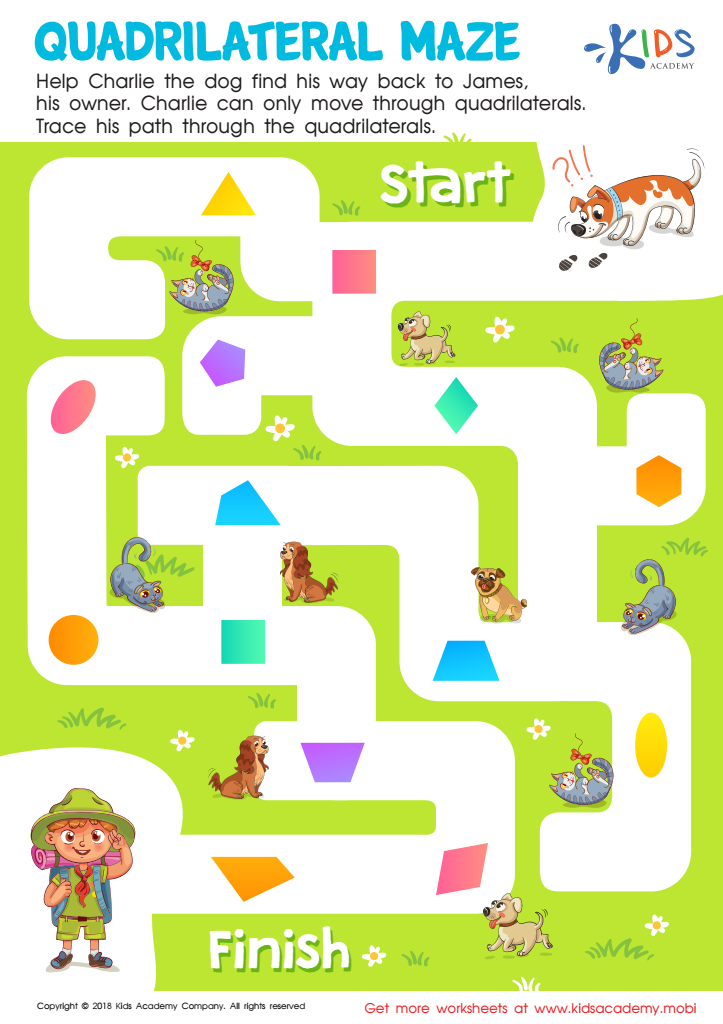
Quadrilateral Maze Worksheet
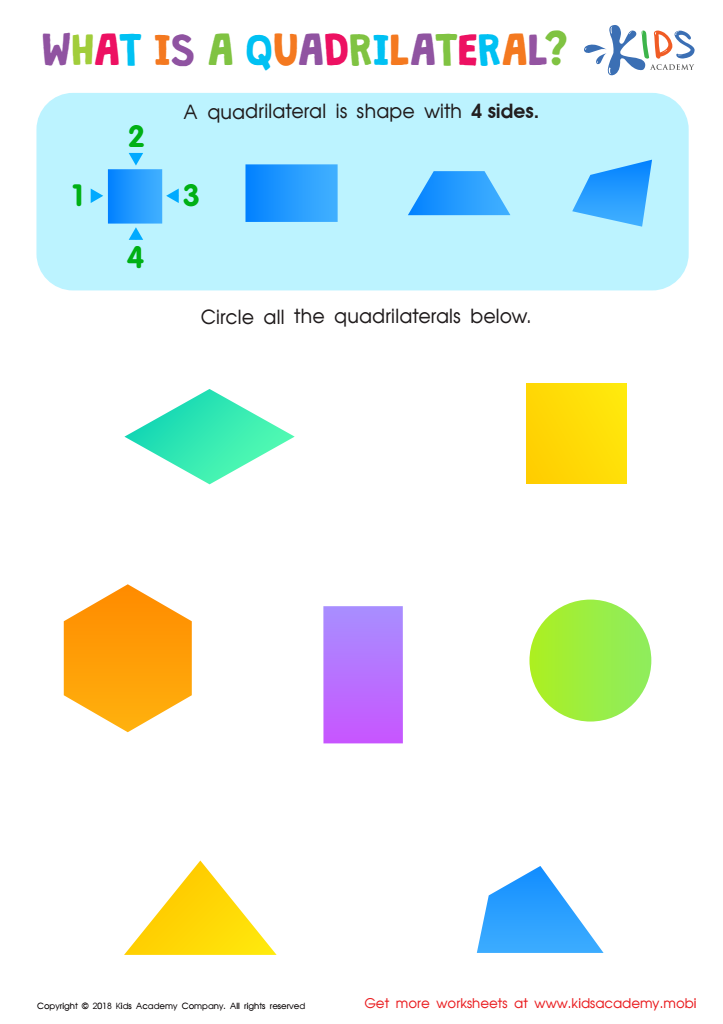
What Is a Quadrilateral? Worksheet








Understanding quadrilaterals is essential for children aged 5-9 as it lays a foundation for their mathematical and spatial reasoning skills. At this age, children are curious and beginning to explore shapes, and quadrilaterals, such as squares, rectangles, and rhombuses, provide a perfect opportunity for teaching them about geometry.
First, learning about quadrilaterals enhances a child's ability to recognize and classify shapes, which is a critical skill for future math concepts. This early exposure fosters problem-solving skills, as students learn to identify properties like sides and angles, aiding their ability to make connections between different concepts.
Moreover, understanding quadrilaterals encourages observational skills, as children are encouraged to identify these shapes in their environment, fostering a sense of experience and practicality. It also stimulates cognitive growth, as engaging with geometrical concepts often involves visualization, manipulation, and even basic measurements.
For teachers and parents, emphasizing quadrilaterals equips children with a sense of achievement and confidence in math. Fun activities and engaging lessons provide a playful context for learning, making this foundational unit an enjoyable starting point for a lifelong journey in mathematics. Supporting their early geometry skills ultimately prepares students for more complex math in the future.








