Understanding sequence Math Worksheets for Ages 5-9
6 filtered results
-
From - To
Our Understanding Sequence Math Worksheets for ages 5-9 are designed to help young learners grasp the concept of order and progression in numbers and patterns. Through engaging and colorful activities, kids will learn to recognize sequences, predict the next numbers, and understand the logical flow of items. These worksheets develop critical thinking and problem-solving skills, making math fun and accessible. Ideal for both classroom and at-home use, our worksheets cater to early grade levels, ensuring a smooth transition to more advanced mathematical concepts. Give your child the foundation they need with our expertly crafted sequence math worksheets!
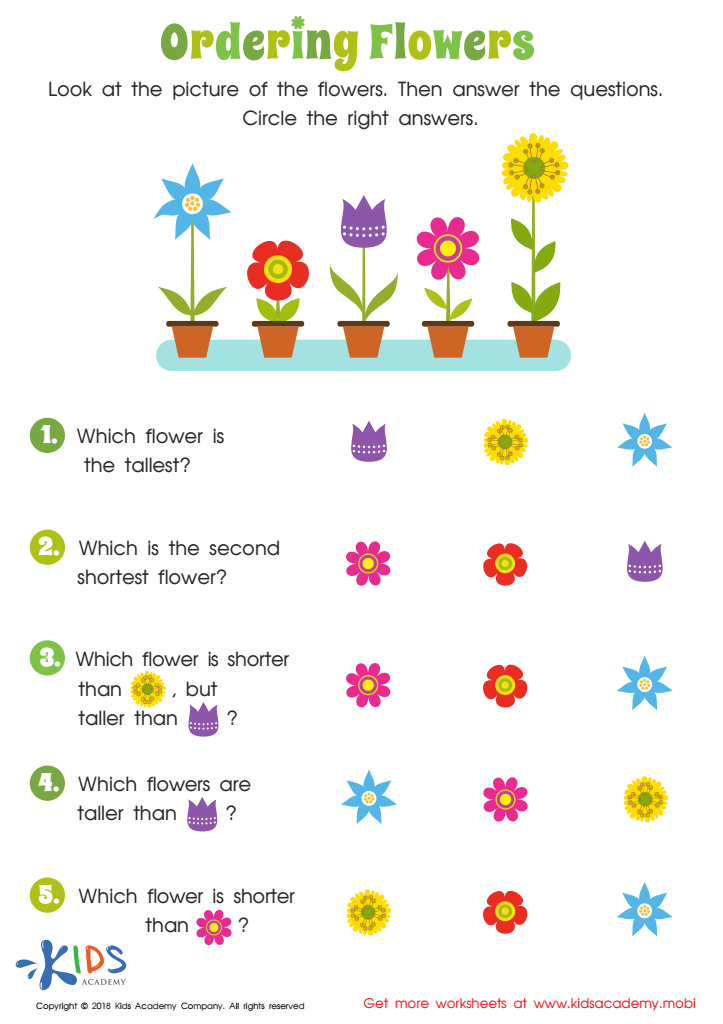
Ordering Flowers Worksheet
 Assign to My Students
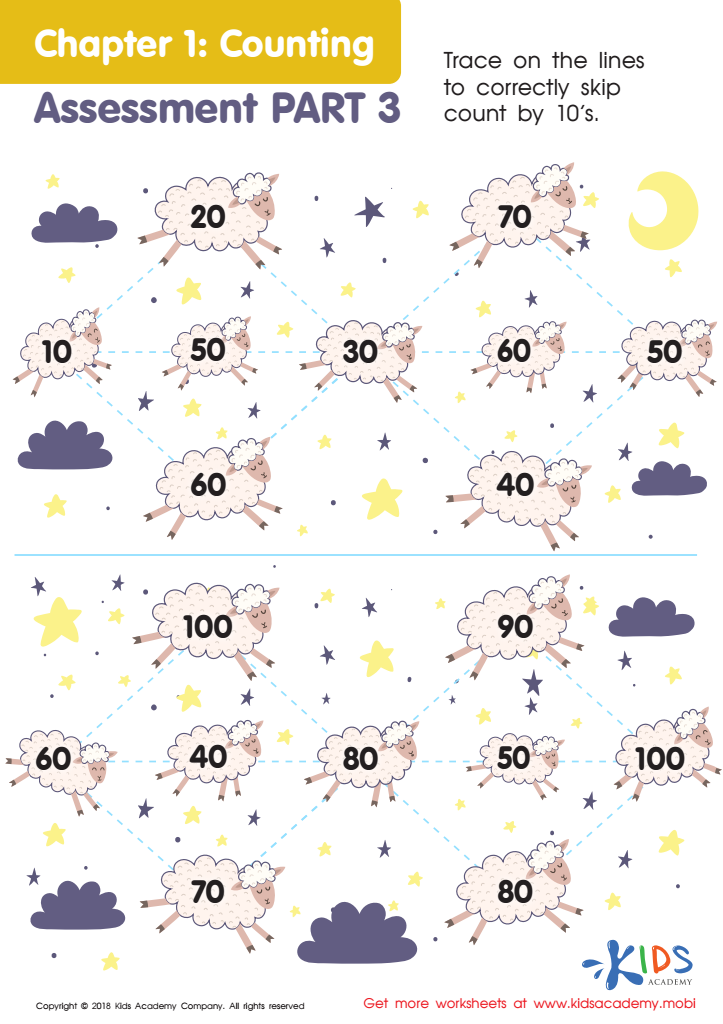
Counting: Assessment 3 Worksheet






Understanding sequence in math is crucial for children ages 5-9 as it lays the foundational skills required for more complex mathematical concepts and overall cognitive development. Sequences aid in developing logical thinking and problem-solving abilities, which are vital for academic success across all subjects. In early childhood, kids are naturally curious and keen observers, making it an ideal time to introduce them to patterns and orders.
Recognizing and creating sequences help children grasp the concept of order, understand 'what comes next,' and identify relationships between numbers and objects. This understanding is crucial for learning basic arithmetic operations such as addition, subtraction, multiplication, and division. It also supports skills like counting by 2s, 5s, or 10s, which are essential for efficient calculation strategies.
In addition, sequence learning fosters critical thinking and helps in the development of executive functions such as memory, attention-to-detail, and organizing information. These cognitive skills are the building blocks for higher-order thinking and problem-solving.
Parents and teachers play a pivotal role in reinforcing these concepts through engaging activities like games, puzzles, and daily routines, making learning both fun and effective. Thus, focusing on sequential understanding not only boosts mathematical proficiency but also contributes significantly to a child’s overall intellectual growth.








