Division practice Multiplication and Division Word Problems Worksheets for Ages 5-9
4 filtered results
Difficulty Level
Grade
Age
-
From - To
Subject
Activity
Standards
Explore our engaging Division Practice Worksheets specifically designed for children aged 5-9! Our resources aim to reinforce their understanding of multiplication and division through fun, relatable word problems. Each worksheet offers a variety of challenges that nurture critical thinking and problem-solving skills, empowering young learners to grasp mathematical concepts with ease. From simple illustrations to real-life scenarios, these worksheets make learning division enjoyable and meaningful. Perfect for both classroom and home learning environments, our materials are ideal for kids who are just starting to explore mathematical operations. Download our division practice worksheets today and support your child’s journey to becoming a confident math whiz!
Favorites
With answer key
Interactive
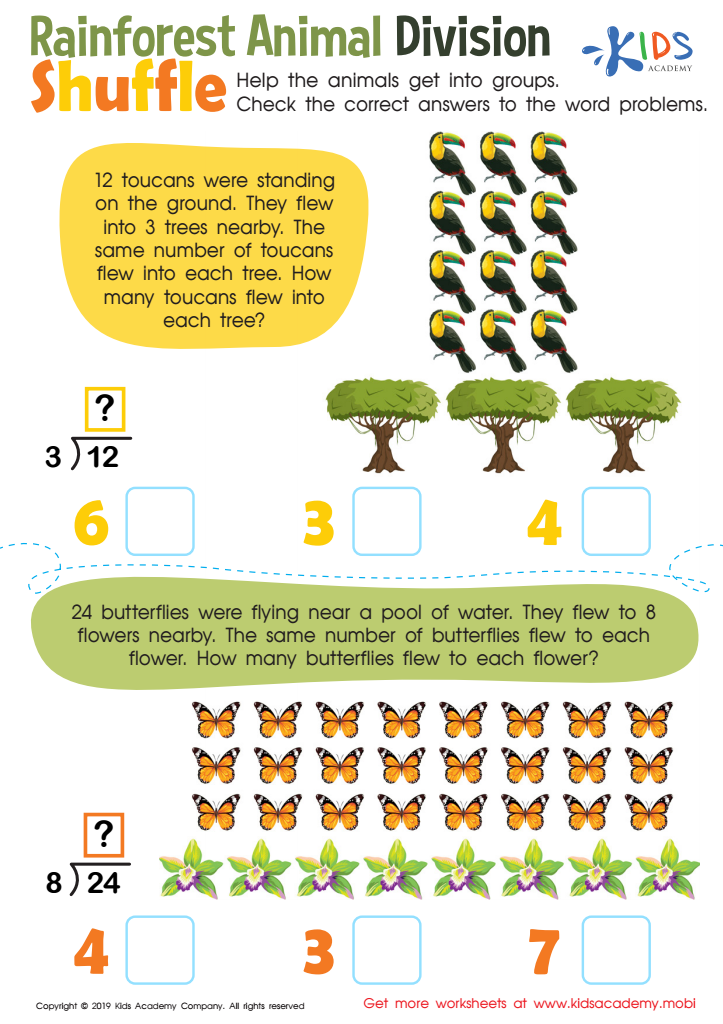
Rainforest Animal Division Worksheet
Children can save the rainforest and learn about division with this worksheet! It helps kids understand that division involves creating equal groups of specific numbers, and with its visual representation, they can grasp the concept more easily. They'll have fun learning about their place in the world and their role in protecting the environment.
 Assign to My Students
Rainforest Animal Division Worksheet
Worksheet
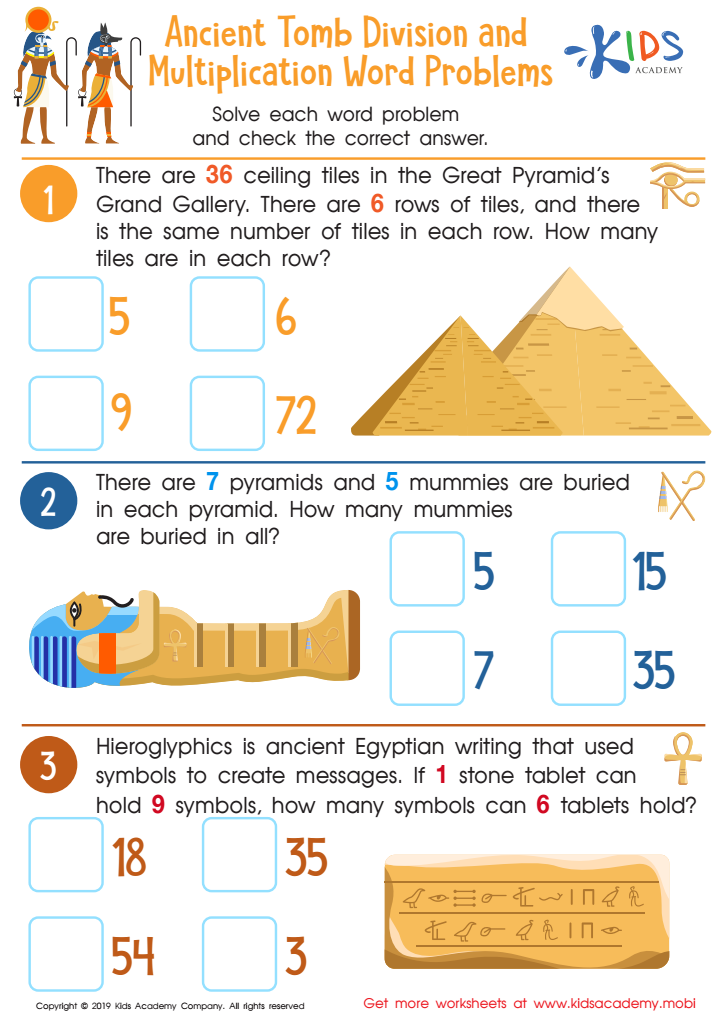
Ancient Tomb Division and Multiplication Word Problems Worksheet
This worksheet teaches kids math, plus a bit about ancient Egypt. Read the text and point to the pictures to explain them. There are three word problems - help kids interpret and solve each one, then find and check the answer. 80 words
Ancient Tomb Division and Multiplication Word Problems Worksheet
Worksheet
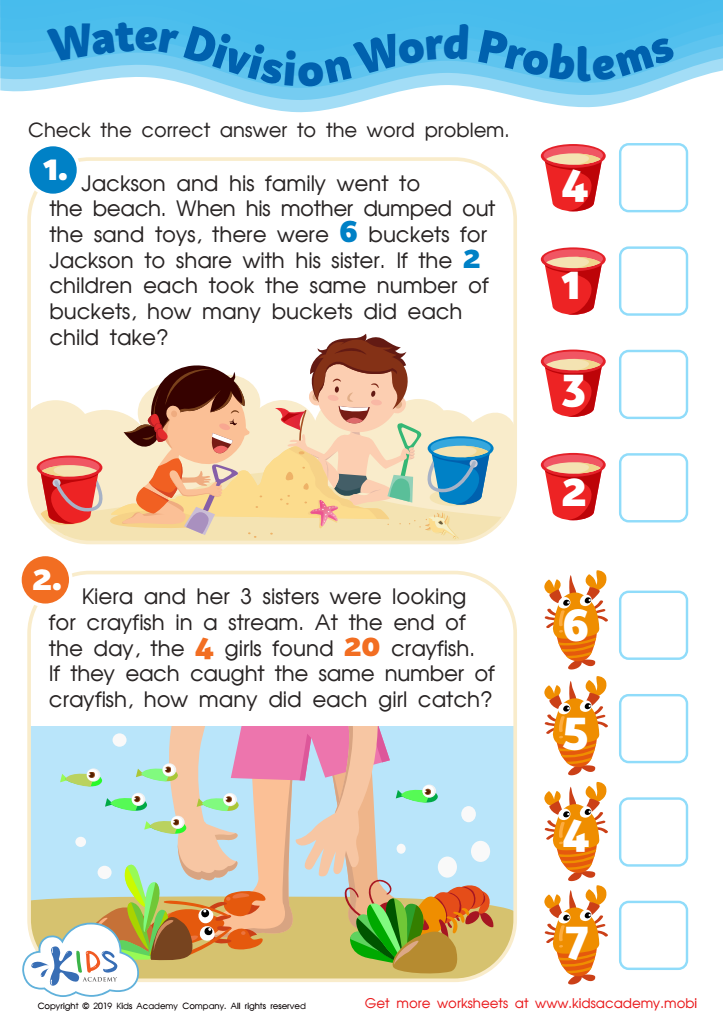
Water Division Word Problems Worksheet
Kids can sharpen their math skills with this fun PDF! They'll see pictures of friends at the beach, plus bold numbers and colorful pictures. All they need to do is read and understand the problem to find the answer - without even realizing they're doing division. A great way to make math enjoyable!
Water Division Word Problems Worksheet
Worksheet
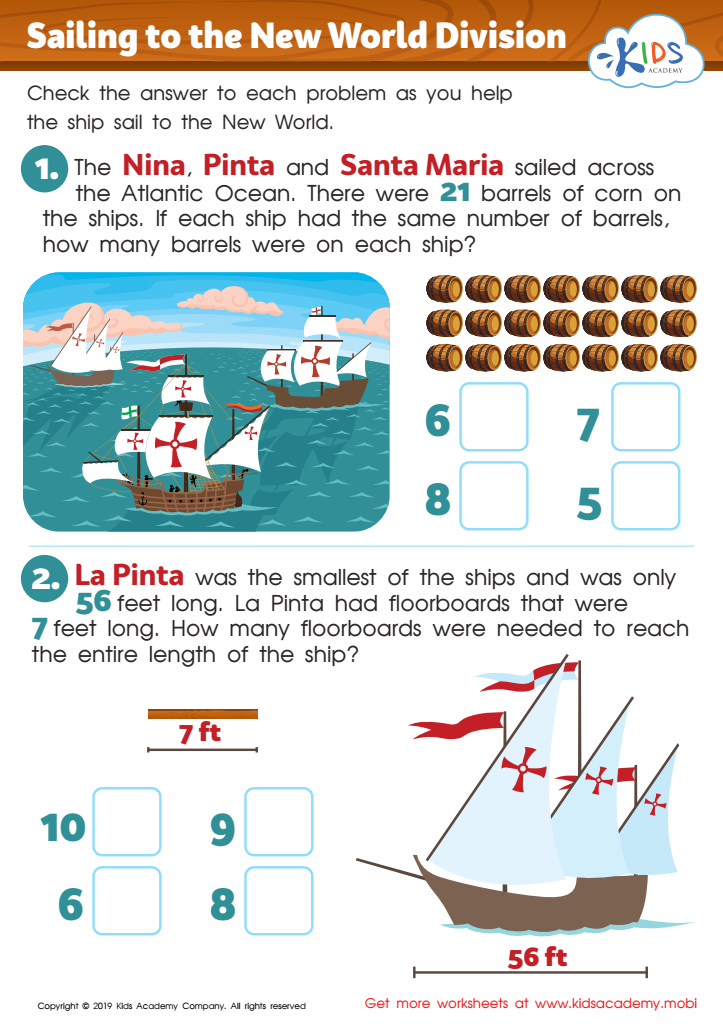
Sailing to the New World Division Worksheet
This worksheet combines history and math, helping kids make sense of problem-solving. Christopher Columbus sailing the ocean blue is combined with picture representations of division word problems in bold colors and highlighted numbers. Kids can learn while having fun figuring out the problems, regardless of whether it's math or history.
Sailing to the New World Division Worksheet
Worksheet
Join Kids Academy for Free
Who is primarily going to use this learning content?








Parents and teachers should prioritize Division and Multiplication word problem practices for children ages 5-9 for several compelling reasons. Firstly, foundational mathematics skills are crucial at this age, as they form the building blocks for more complex math concepts later on. Word problems specifically encourage students to translate real-life situations into mathematical expressions, enhancing their problem-solving skills and critical thinking.
Additionally, understanding multiplication and division through word problems helps children develop number sense. It enables them to grasp the concepts of grouping, sharing, and scaling—principles integral to both operations. Engaging with these problems promotes vocabulary growth and comprehension, as students learn to deconstruct the language of math.
Moreover, practicing division and multiplication word problems fosters perseverance and resilience. Children learn that making mistakes is a valuable part of the learning process, fostering a growth mindset. For parents, this practice offers a way to bond with their children over learning, reinforcing the idea that math is relevant to everyday life.
Overall, cultivating these skills provides a strong mathematical foundation, equips children to face future challenges, and enhances their confidence and enthusiasm for learning. This investment in early math literacy paves the way for lifelong academic success.