Understanding symmetry Building Vocabulary Worksheets for Ages 5-9
5 filtered results
-
From - To
Unlock the magic of symmetry with our "Understanding Symmetry Building Vocabulary Worksheets" designed for ages 5-9. These engaging and educational worksheets help young learners grasp the concept of symmetry while expanding their vocabulary. Through fun activities and visually appealing exercises, kids will learn to identify, create, and describe symmetrical objects and patterns. Our worksheets are perfect for both classroom and home use, fostering critical thinking, spatial awareness, and language skills. Let your child's journey into symmetry be an enjoyable adventure with our expertly crafted materials. Spark curiosity and build a strong foundation in mathematical concepts today!











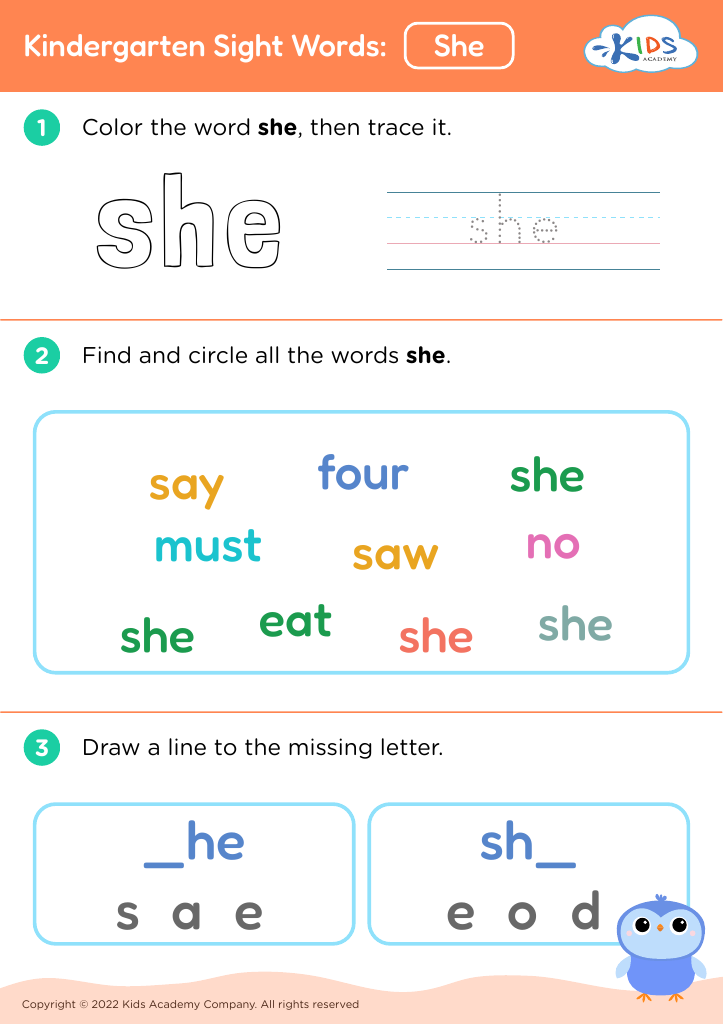







Understanding symmetry and building vocabulary are foundational skills for children ages 5-9, and they serve as crucial building blocks in a young learner's cognitive and academic development.
Symmetry helps children develop spatial awareness and visual skills, enabling them to understand how objects and shapes fit together. It cultivates pattern recognition, an essential aspect of mathematics and nature, sparking curiosity in various subjects such as art, biology, and physics. Engaging kids with symmetry activities fosters their ability to reason systematically, laying groundwork for more complex mathematical concepts like geometry and algebra.
Simultaneously, strong vocabulary skills are critical for effective communication and literacy. A broad vocabulary allows children to express themselves clearly, understand instructions, and participate in discussions. As students encounter new words, they enhance their reading comprehension skills, enabling them to understand stories and texts, vital for academic success across subjects. A robust vocabulary also boosts writing skills, aiding students in constructing clear and detailed sentences and narratives.
When parents and teachers prioritize symmetry and vocabulary development, they equip children with the tools needed to succeed in school and beyond. These dual focuses promote critical thinking, problem-solving skills, and nuanced communication, offering a well-rounded foundation that supports lifelong learning and intellectual curiosity.








