
Understanding punctuation Writing Worksheets for Ages 5-9
3 filtered results
Difficulty Level
Grade
Age
-
From - To
Subject
Activity
Standards
Our "Understanding Punctuation Writing Worksheets for Ages 5-9" offer engaging and educational exercises designed to help young learners master the fundamentals of punctuation. Tailored to children aged 5-9, these worksheets cover essential punctuation marks such as periods, commas, and question marks through fun activities and clear examples. Each worksheet is crafted to enhance writing skills, comprehension, and accuracy, making learning punctuation an enjoyable experience. Perfect for parents and teachers, these printable resources support the development of strong writing foundations, helping children communicate more effectively and confidently. Access our collection today and watch your child's writing improve!
Favorites
With answer key
Interactive
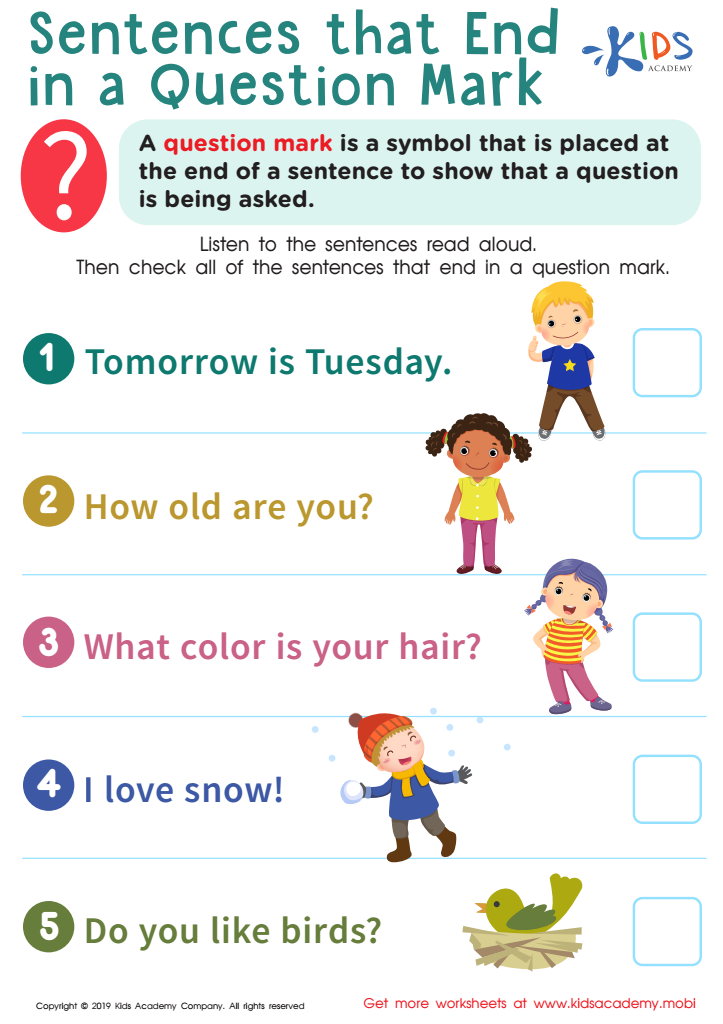
Sentences That End in an Question Mark Worksheet
Teach your students about the four most common punctuation marks - period, comma, question mark, and exclamation mark - with this worksheet. Show them how to use the question mark to indicate a sentence is a question. Then, have them check all sentences that end in a question mark.
 Assign to My Students
Sentences That End in an Question Mark Worksheet
Worksheet
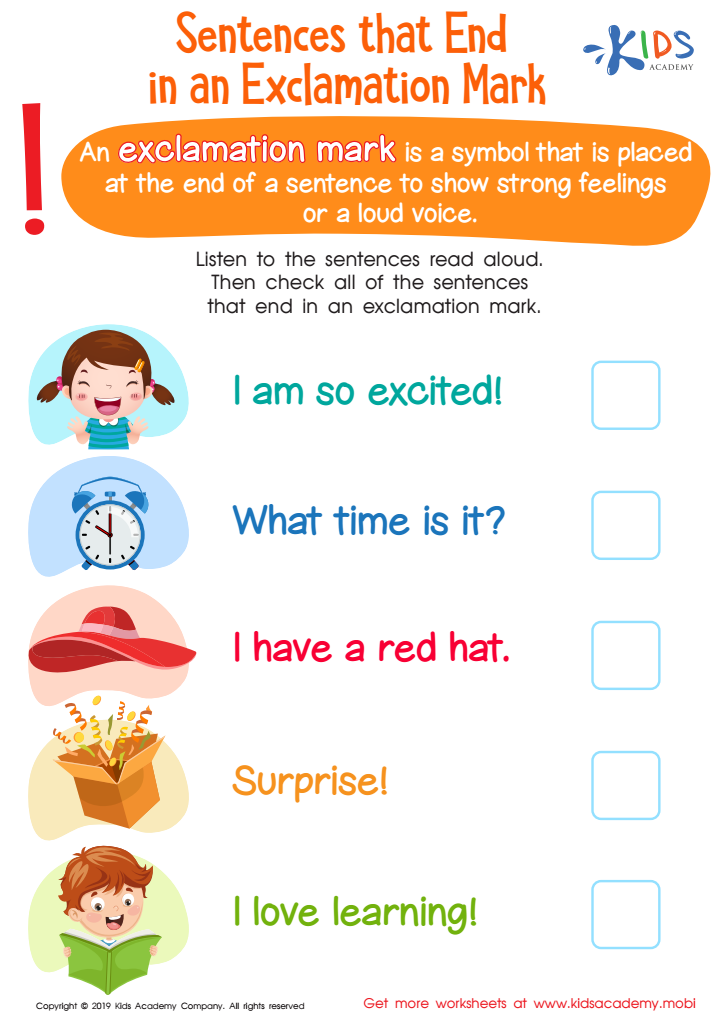
Sentences That End in an Exclamation Mark Worksheet
This worksheet is a great way to brush up kids' punctuation skills. Period, comma, question mark and exclamation mark are the first four punctuation marks they should learn. Exclamation marks show strong emotion or a noise. Use this printout to teach and test kids' understanding of exclamation marks.
Sentences That End in an Exclamation Mark Worksheet
Worksheet
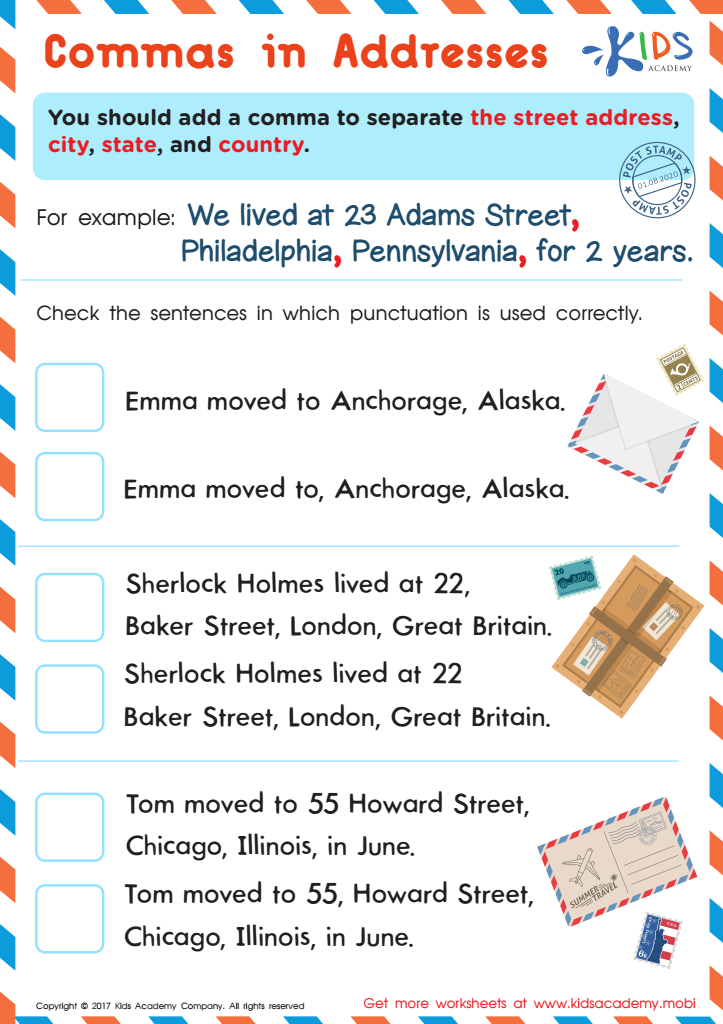
Commas in Addresses Worksheet
Learning comma rules can be tough for kids. Help make it easier with free worksheets, like this fun letter-themed exercise. It'll teach them the rules in isolation and keep them engaged.
Commas in Addresses Worksheet
Worksheet
Join Kids Academy for Free
Who is primarily going to use this learning content?




.jpg)



Understanding punctuation is crucial for young learners aged 5-9 as it forms the building blocks of effective communication. At this developmental stage, children are learning to read and write, skills that depend significantly on punctuation for clarity and meaning.
Firstly, punctuation marks such as periods, commas, question marks, and exclamation points help children comprehend how sentences are structured. This structuring aids in reading fluency, allowing children to recognize pauses and the intent behind a sentence, whether it is a statement, question, or exclamation. This improved comprehension can make reading more enjoyable and engaging.
Moreover, understanding punctuation can enhance a child's writing skills. Knowing where to place punctuation marks helps children write clearly and precisely, preventing misunderstandings. For instance, “Let’s eat, Grandma” is very different from “Let’s eat Grandma.”
Punctuation also plays a role in developing critical thinking. Children start to understand how different punctuation can change the meaning of a message, encouraging them to think about the sentences they construct and the ways in which they communicate ideas.
Parents and teachers should therefore prioritize teaching punctuation, not just as a technical skill, but as a vital part of fostering effective communication, literacy, and cognitive development in young children. This foundational knowledge sets the stage for future academic success and clear, confident self-expression.








