
Understanding directions Science Worksheets for 5-Year-Olds
3 filtered results
Difficulty Level
Grade
Age
-
From - To
Subject
Activity
Standards
Explore our engaging "Understanding Directions Science Worksheets for 5-Year-Olds" designed to develop your child's navigational skills in a fun way. These printable worksheets help young learners grasp essential concepts such as left, right, up, and down through interactive activities. Created by educational experts, this resource promotes spatial awareness, critical thinking, and early science skills. Perfect for home or classroom use, each worksheet captivates kids' interest with delightful illustrations and age-appropriate challenges. Empower your child with foundational navigation skills while fostering a love for learning. Download now for endless educational fun!
Favorites
With answer key
Interactive
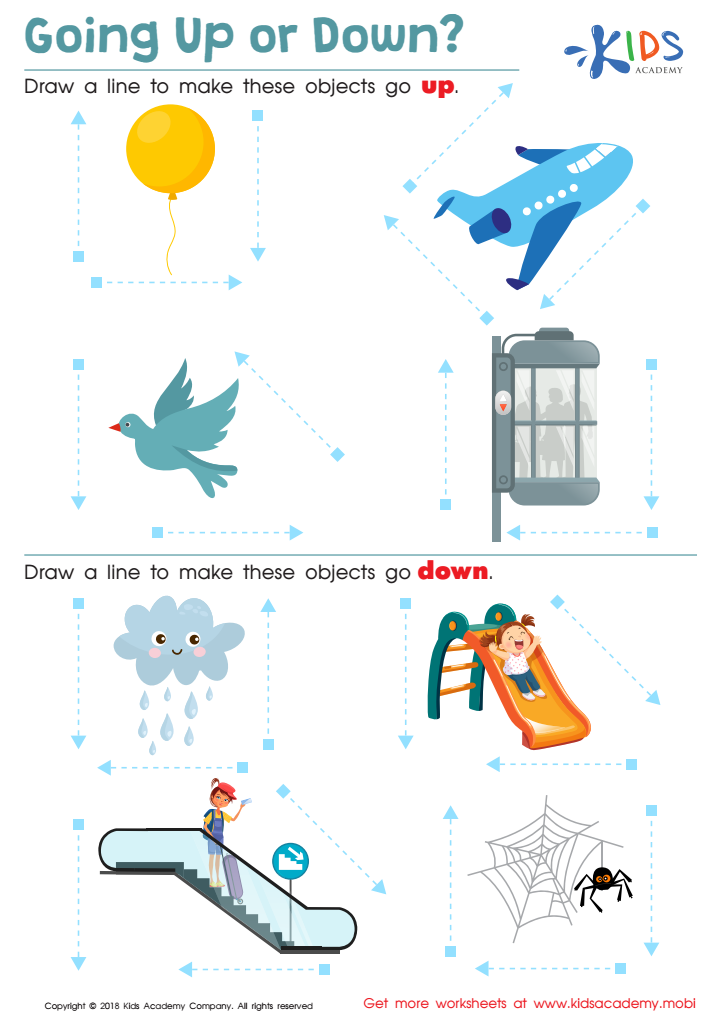
Going up or Down? Worksheet
Young students learn the concept of up and down with this geometry worksheet. They trace lines to identify relative positioning as an object travels. Kids can use position words to describe an object's movement, enhancing their spatial relationship skills - an important geometry foundation.
 Assign to My Students
Going up or Down? Worksheet
Worksheet
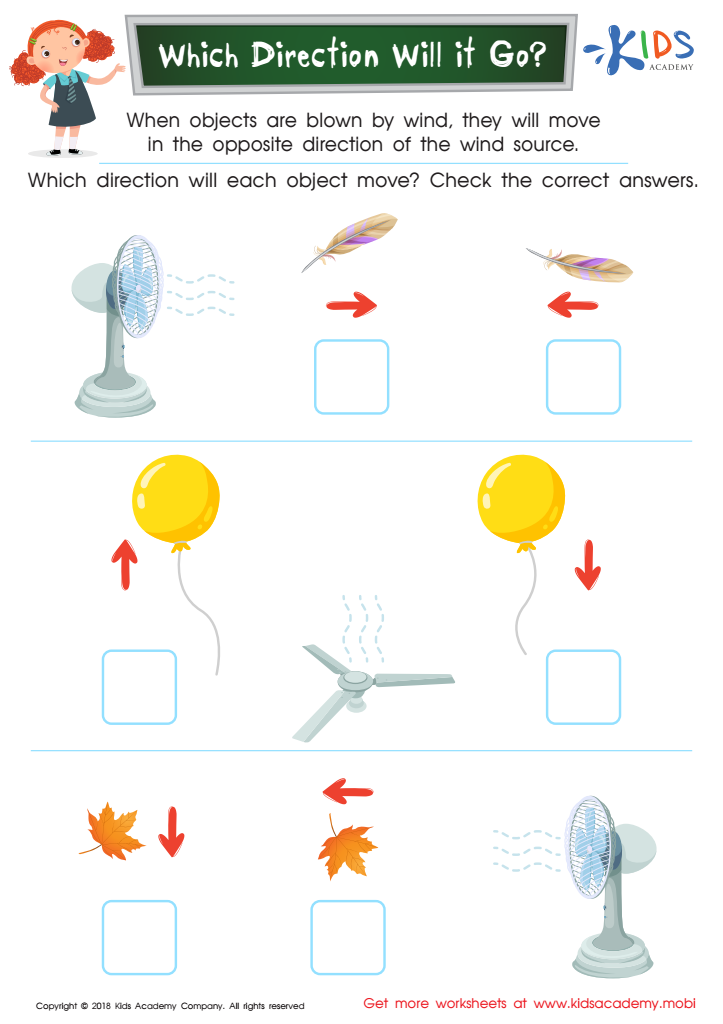
Which Direction Will it Go? Worksheet
Explain to your students: when objects are blown by wind, they will move in the opposite direction. In the worksheet, there are pictures of wind sources and objects being blown by the wind. Ask your child to identify and check the direction each object will move.
Which Direction Will it Go? Worksheet
Worksheet
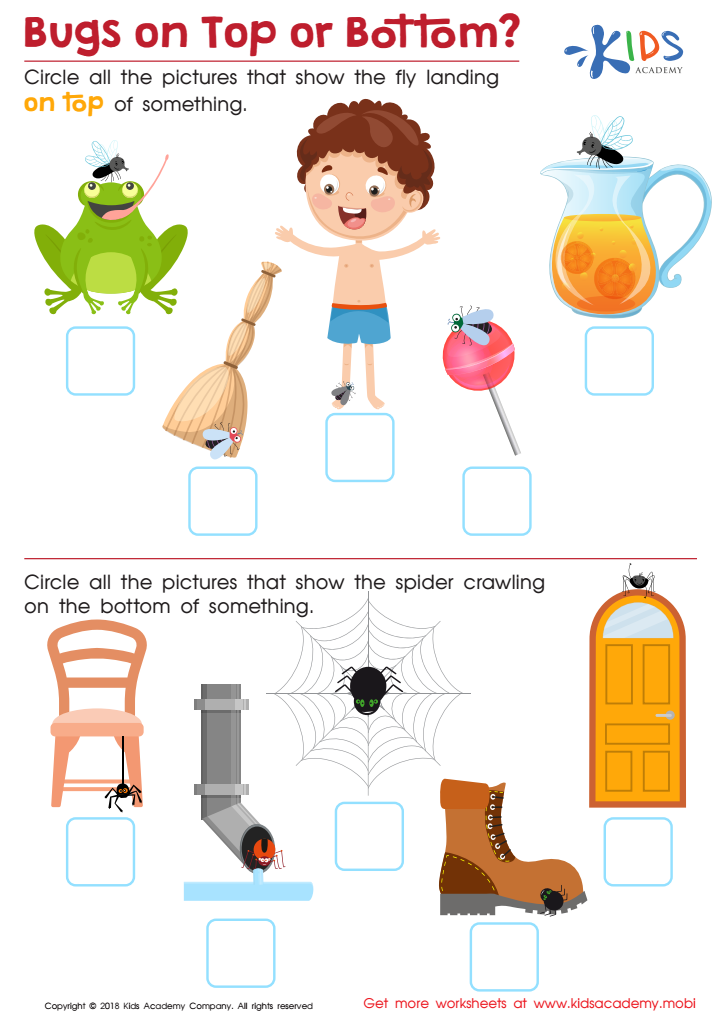
Bugs on Top or Bottom? Worksheet
Preschoolers need to learn directional skills such as top and bottom. This PDF worksheet helps them recognize bugs on the top or bottom using fun visuals. It builds their spatial reasoning while teaching prepositional words in an engaging way.
Bugs on Top or Bottom? Worksheet
Worksheet
Join Kids Academy for Free
Who is primarily going to use this learning content?







Understanding directions in science for 5-year-olds is essential because it lays the foundation for lifelong learning and cognitive development. At this age, children are naturally curious and eager to explore the world around them. By guiding them through simple scientific experiments and observations, parents and teachers can harness this curiosity, helping young learners to develop essential skills like critical thinking, problem-solving, and attention to detail.
When 5-year-olds learn to follow directions in science, they also improve their listening and comprehension skills. These are crucial for academic success across all subjects. For example, following steps to plant a seed helps them understand sequences, cause and effect, and the importance of following instructions.
Science activities often involve hands-on learning, which keeps young children engaged and makes abstract concepts more concrete. Moreover, by providing these early science experiences, adults can foster a positive attitude towards science and learning in general. This positive perception can make children more eager to learn new concepts as they grow older.
Furthermore, understanding directions and participating in science activities enhance fine motor skills, social skills, and vocabulary. Thus, parents and teachers have a unique opportunity to support the overall development of 5-year-olds by incorporating simple yet impactful science activities into their daily routines.







