
Spatial awareness Physical Science Worksheets for 5-Year-Olds
3 filtered results
Difficulty Level
Grade
Age
-
From - To
Subject
Activity
Standards
Boost your child's understanding of spatial concepts with our engaging Spatial Awareness Physical Science Worksheets designed specifically for 5-year-olds! These worksheets are filled with fun activities and exercises that help young learners grasp important ideas about direction, location, and movement. Your child will develop crucial skills like differentiating between left and right, understanding positions like under and over, and recognizing patterns. Perfect for enhancing early learning at home or in the classroom, our printable worksheets promote hands-on, interactive learning. Watch your little one grow in confidence and spatial understanding with these expertly crafted resources from Kids Academy!
Favorites
With answer key
Interactive
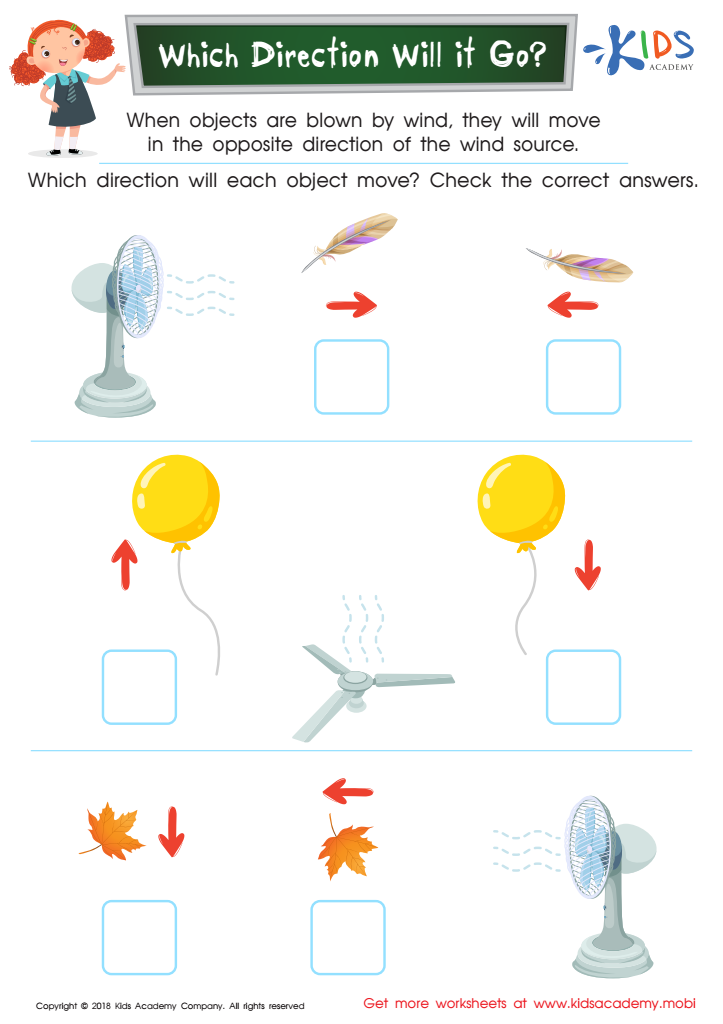
Which Direction Will it Go? Worksheet
Explain to your students: when objects are blown by wind, they will move in the opposite direction. In the worksheet, there are pictures of wind sources and objects being blown by the wind. Ask your child to identify and check the direction each object will move.
 Assign to My Students
Which Direction Will it Go? Worksheet
Worksheet
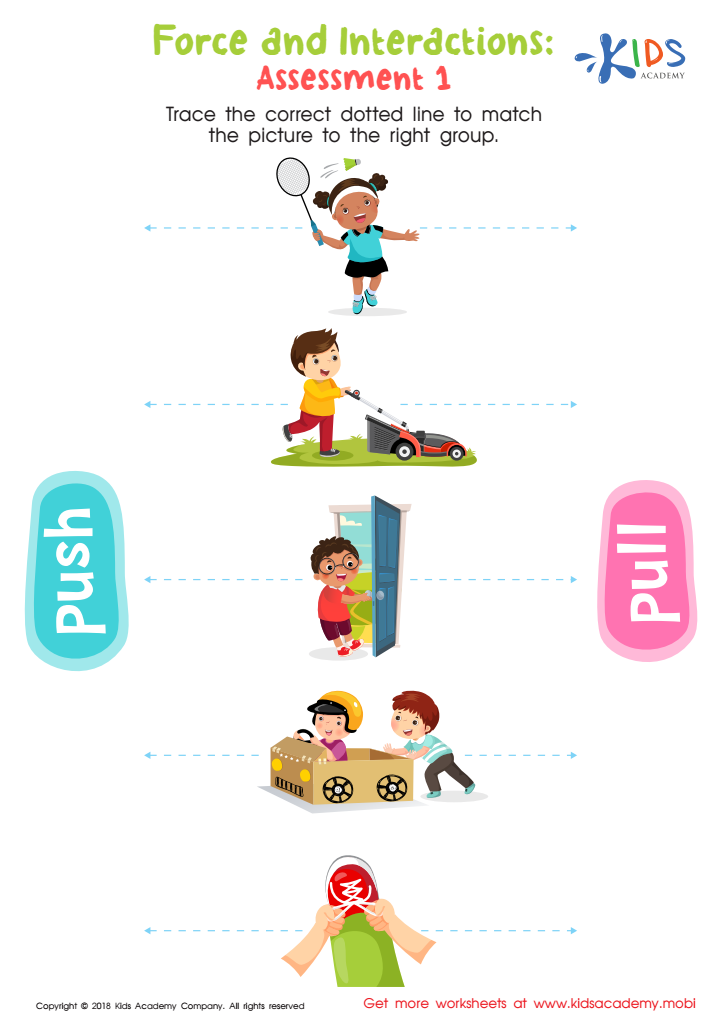
Force and Interactions: Assessment 2 Worksheet
Help your child see the difference between push and pull with this fun worksheet. Ask them to match each picture to the right group. The "push" is on the left and the "pull" is on the right. Assist them in tracing the activities and explain what it is the people are doing.
Force and Interactions: Assessment 2 Worksheet
Worksheet
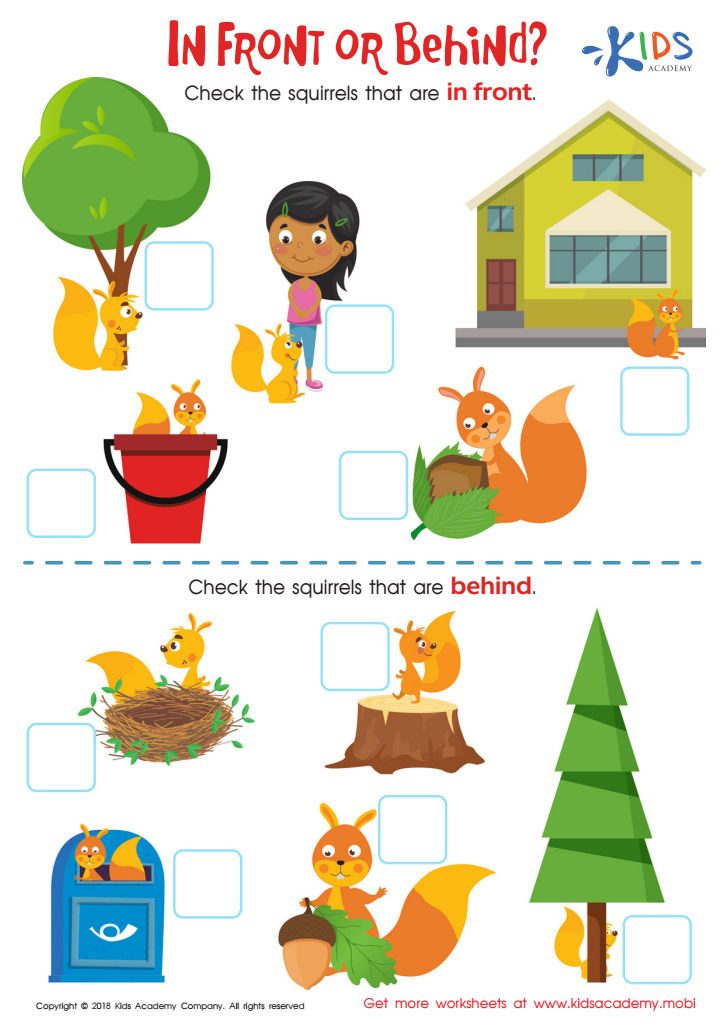
In Front or Behind: Part 2 Worksheet
Teach positional words "front" and "behind" with this fun worksheet! Students identify where the squirrel is in relation to the object - in front or behind. It's a great exercise to practice early geometry skills and understanding object movement.
In Front or Behind: Part 2 Worksheet
Worksheet
Join Kids Academy for Free
Who is primarily going to use this learning content?






.jpg)
Spatial awareness and physical science play crucial roles in the development of 5-year-olds, impacting their cognitive, physical, and social growth. Parents and teachers should invest in nurturing these skills for several compelling reasons:
-
Foundational Learning: Spatial awareness is a critical precursor to reading and math skills. Understanding shapes, sizes, directions, and distances enhances a child’s ability to recognize patterns, which is fundamental for decoding words and solving math problems.
-
Problem-Solving Skills: Physical science activities, like building with blocks or exploring simple machines, foster logical thinking and problem-solving. These experiences help children understand cause and effect, enabling them to approach challenges methodically.
-
Motor Skills Development: Engaging in spatial tasks improves both fine and gross motor skills. For example, navigating through a space or constructing an object enhances hand-eye coordination, balance, and muscle control, essential for everyday activities and sports.
-
Curiosity and Creativity: Early exposure to physical science stimulates curiosity and imagination. Exploring the natural world encourages questioning and creative thinking, laying the groundwork for lifelong learning and innovation.
-
Social Skills and Collaboration: Group activities involving spatial tasks or science experiments teach cooperation, communication, and sharing. Children learn to work together, listen to others’ ideas, and develop empathy and teamwork skills.
By emphasizing spatial awareness and physical science, parents and teachers equip children with the tools needed for academic success and holistic development.







