Vocabulary expansion Phonics Worksheets for Ages 6-7 - Page 3
49 filtered results
-
From - To
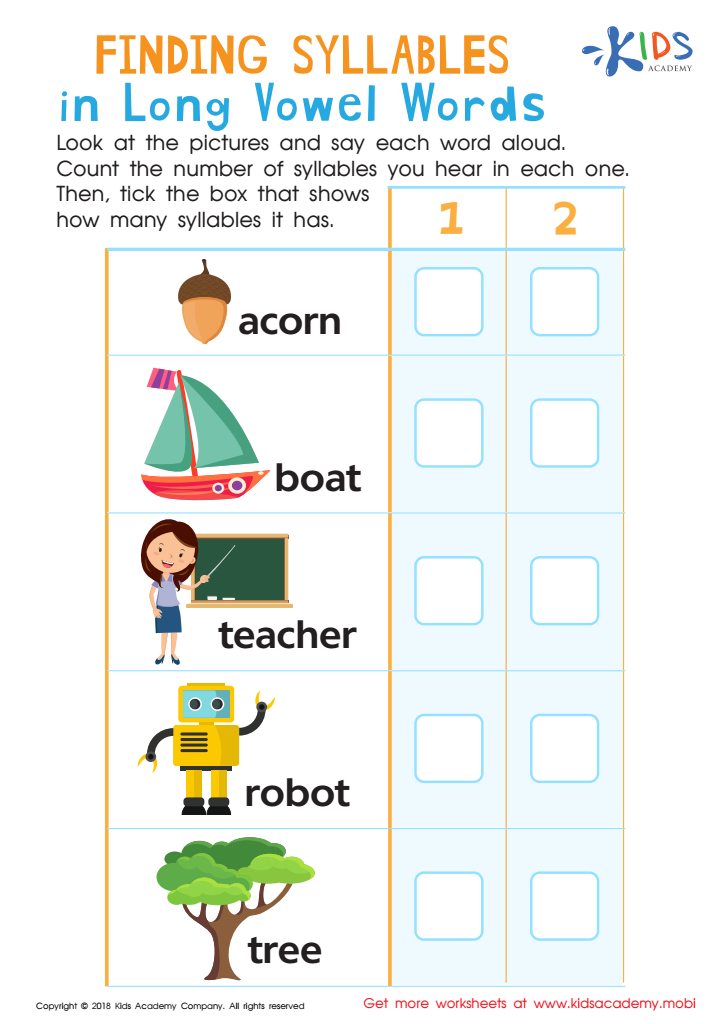
Finding Syllables in Long Vowel Words Worksheet
 Assign to My Students








Parents and teachers should prioritize vocabulary expansion and phonics for children aged 6-7 because these foundational skills are critical for reading proficiency and overall academic success. At this stage, children's brains are highly receptive to new information. A robust vocabulary enhances their ability to understand and communicate thoughts more effectively, allowing them to grasp new concepts and instructions swiftly.
Phonics instruction, which focuses on the relationship between sounds and their corresponding letters, is equally vital. It forms the building blocks of reading by helping children decode words, improving their reading fluency and accuracy. Early mastery of phonics can lead to increased confidence in reading, motivating children to explore new books and subjects.
Moreover, vocabulary enrichment and phonics are interlinked; knowing more words helps in recognizing and decoding them faster. This dual approach aids in comprehension, making reading a more enjoyable and less frustrating experience. Studies consistently show that early literacy skills are predictors of future academic achievement. Therefore, investing time in vocabulary expansion and phonics at this crucial developmental stage can set the trajectory for lifelong learning and success. Prioritizing these skills shows commitment to a child's educational foundation, preparing them not just for school, but for lifelong exploration and learning.







