
Alphabetical order practice Worksheets for Ages 6-7
3 filtered results
Difficulty Level
Grade
Age
-
From - To
Subject
Activity
Standards
Enhance your child's alphabet mastery with our "Alphabetical Order Practice Worksheets" tailored for ages 6-7. These engaging worksheets from Kids Academy are designed to strengthen learning skills by helping young learners arrange words in alphabetical order. Filled with colorful illustrations and fun activities, each worksheet promotes literacy and critical thinking. Perfect for at-home practice or classroom use, these worksheets will boost your child's confidence and pave the way to reading success. Encourage your child's progress by downloading our expertly crafted alphabetical order practice worksheets today and make learning enjoyable!
Favorites
With answer key
Interactive
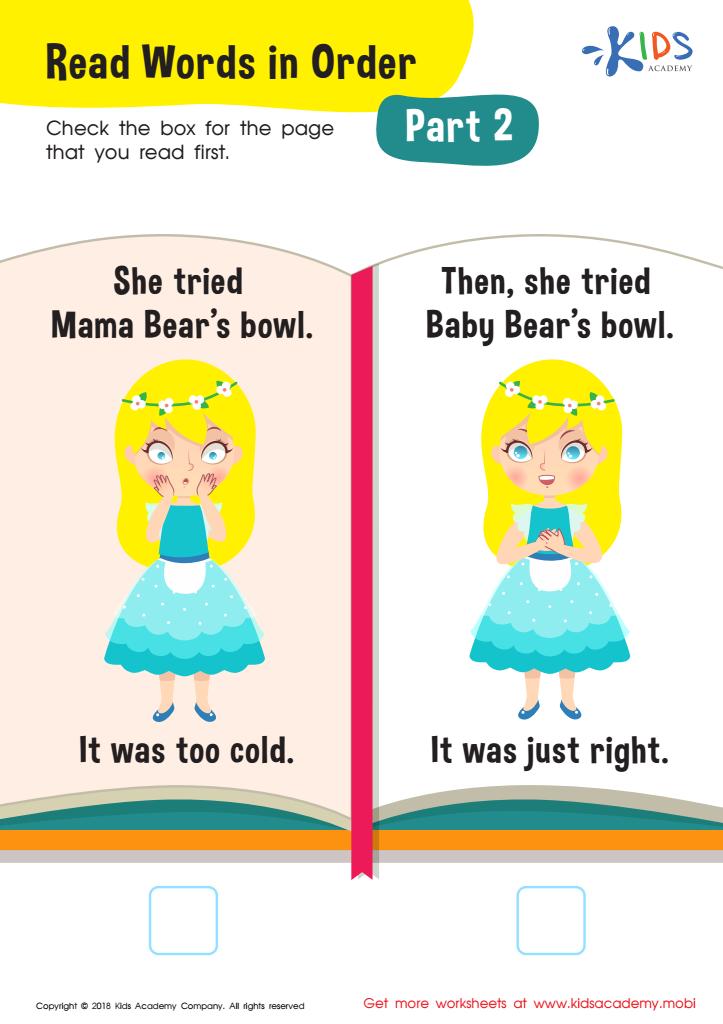
Read Words Order Part 2 Worksheet
Help your students make progress with reading by using this easy worksheet. It includes two pictures with short sentences your child should be able to read. Ask them to read these out loud, and if they're struggling, help them. Then, they should check the box that shows the page they'd read first.
 Assign to My Students
Read Words Order Part 2 Worksheet
Worksheet
Join Kids Academy for Free
Who is primarily going to use this learning content?








Alphabetical order practice is crucial for children aged 6-7 as it builds a foundation for essential literacy skills. At this developmental stage, students are honing their recognition of letters and their sequence, which is a stepping stone to more advanced reading and writing abilities. By familiarizing children with alphabetical order, parents and teachers help them understand the organizational structure of language, making future tasks like using dictionaries, indices, or directories much easier.
Moreover, this practice reinforces the relationship between letters and sounds, thus improving phonemic awareness. When students can quickly identify and order letters, their ability to decode new words strengthens, enhancing reading fluency and comprehension. For budding writers, knowing the alphabet order aids in proper spelling and can boost their confidence in written communication.
The discipline and attention to detail required for alphabetical sorting also support cognitive development. It encourages children to approach tasks methodically and systematically, skills that are invaluable across various academic subjects and in everyday problem-solving. Hence, investing time in alphabetical order practice is a meaningful way to foster both literacy and broader educational growth in young learners.








