
Learning number patterns Worksheets for Ages 6-7
4 filtered results
Difficulty Level
Grade
Age
-
From - To
Subject
Activity
Standards
Explore our engaging Learning Number Patterns Worksheets designed specifically for children ages 6-7. These interactive resources help young learners develop essential math skills by recognizing, creating, and completing number patterns. With a variety of fun exercises, children will enjoy practicing sequencing and addition, enhancing their understanding of numerical relationships. Perfect for at-home practice or classroom activities, our worksheets facilitate a strong foundation in mathematics while making learning enjoyable. Download and print them easily for instant access to creative and educational exercises that will boost your child's confidence and math proficiency. Help your child unlock the world of numbers today!
Favorites
With answer key
Interactive
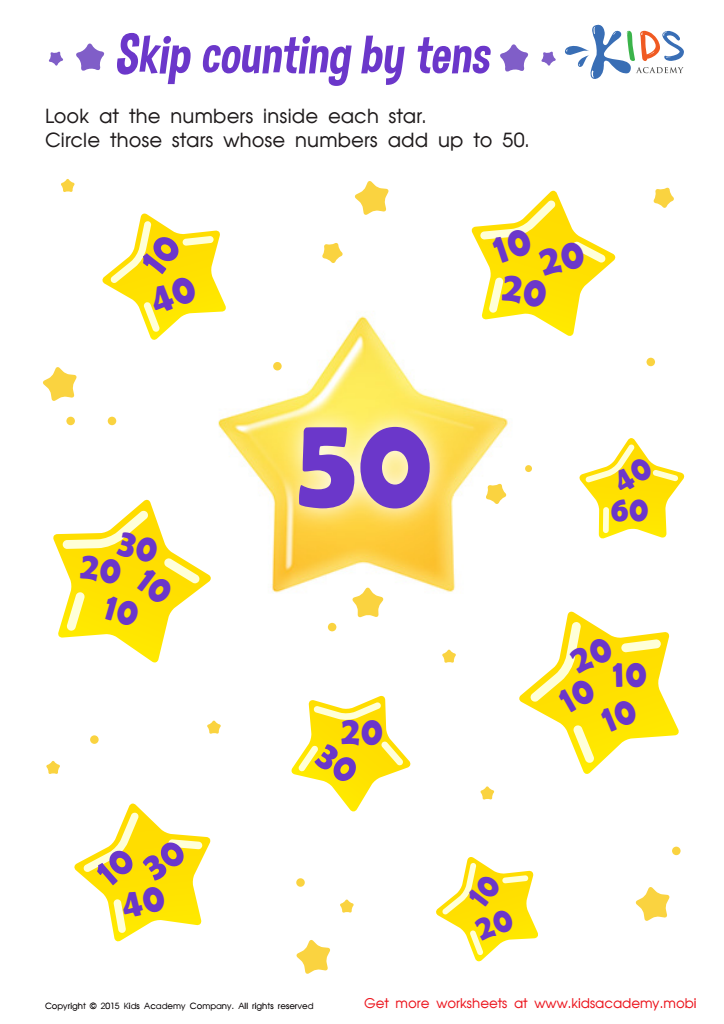
Learn Dozens: Skip Counting by Tens Printable
This skip counting by 10 worksheet helps kids strengthen fluency, practice addition & build number sense. They'll use problem-solving skills to find the correct answer, which is revealed by stars. This worksheet is a fun way to practice crucial foundational math skills.
 Assign to My Students
Learn Dozens: Skip Counting by Tens Printable
Worksheet
Join Kids Academy for Free
Who is primarily going to use this learning content?




.jpg)

Learning number patterns is crucial for children aged 6-7, laying a solid mathematical foundation for their future education. At this age, children are very receptive to learning new concepts, and number patterns help develop their critical thinking and problem-solving skills. Recognizing patterns enhances their ability to predict outcomes, a skill that applies not only in math but also in real-world situations.
Number patterns, such as sequences and skip counting, improve number sense and arithmetic skills, which are essential for more advanced mathematical concepts that will be introduced later, such as addition, subtraction, and multiplication. Understanding these concepts early can decrease anxiety in more complex mathematical tasks later on.
Parents and teachers should also recognize that learning patterns can be made engaging through games and hands-on activities, which often attract children’s interest and motivate them further. Moreover, this type of learning fosters a classroom environment where collaboration and discussion can thrive, enhancing social skills. Ultimately, that focus on patterns cultivates a deeper appreciation for math, setting children up for success as they continue their academic journeys and interact with the world around them.








