Number ordering Worksheets for Ages 6-7
3 filtered results
-
From - To
Discover our engaging number ordering worksheets, specifically designed for children aged 6-7! These interactive resources help young learners enhance their number sequencing and comparison skills through fun activities. With exercises ranging from arranging numbers in ascending or descending order to filling in missing values, these worksheets promote critical thinking and number sense in a playful manner. Each worksheet is crafted to align with early math standards, making them perfect for classroom use or at-home learning. Encourage your child's confidence and proficiency in mathematics with our thoughtfully created number ordering worksheets, ensuring a solid foundation for their mathematical journey!
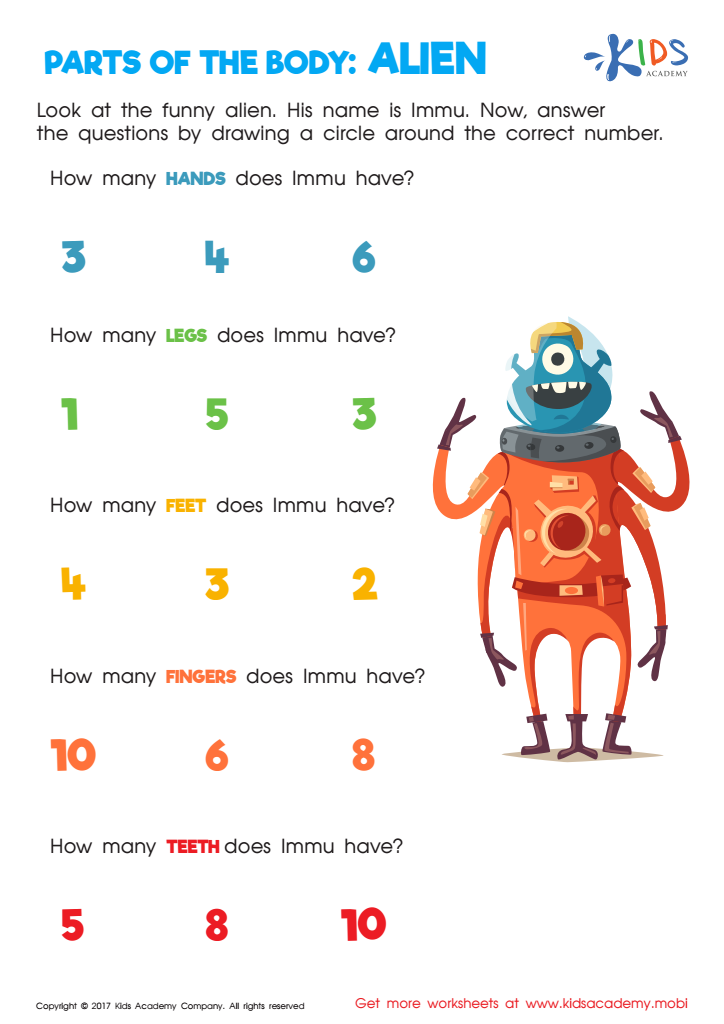
Alien Worksheet
 Assign to My Students







Number ordering is a fundamental skill that lays the groundwork for a child's mathematical understanding and overall cognitive development. For children aged 6-7, mastering number ordering offers them not only the ability to recognize the sequential nature of numbers but also fosters critical thinking and problem-solving skills.
Parents and teachers should care about this skill because it enhances a child's ability to perform basic arithmetic, such as addition and subtraction, since these operations often rely on understanding the order of numbers. Furthermore, strong number ordering abilities can boost a child's confidence and enthusiasm for math, which can profoundly influence their future academic pursuits.
Additionally, number ordering helps children grasp more complex concepts, such as place value, estimation, and number comparison, all vital for later mathematical learning. It also promotes organizational skills and logical reasoning.
Encouraging practices like number games, puzzles, and hands-on activities allows children to explore numbers in engaging ways, reinforcing their understanding of sequence.
Overall, emphasizing number ordering during the early grades cultivates a solid mathematical foundation, setting children on a path toward success in both math and other areas of learning.








