
Recognize shapes Worksheets for Ages 6-7
11 filtered results
Difficulty Level
Grade
Age
-
From - To
Subject
Activity
Standards
Explore our engaging "Recognize Shapes Worksheets for Ages 6-7" to help young learners master geometric concepts with fun, interactive activities. Designed specifically for children aged 6 to 7, these worksheets enhance shape identification, spatial awareness, and problem-solving skills. Each worksheet features vibrant visuals, easy-to-follow instructions, and playful exercises that keep kids motivated. From tracing and matching shapes to comparing and sorting, our materials foster critical thinking while supporting early math education. Ideal for use at home or in the classroom, these printable worksheets offer a dynamic approach to learning that will catch the interest of any young student.
Favorites
With answer key
Interactive
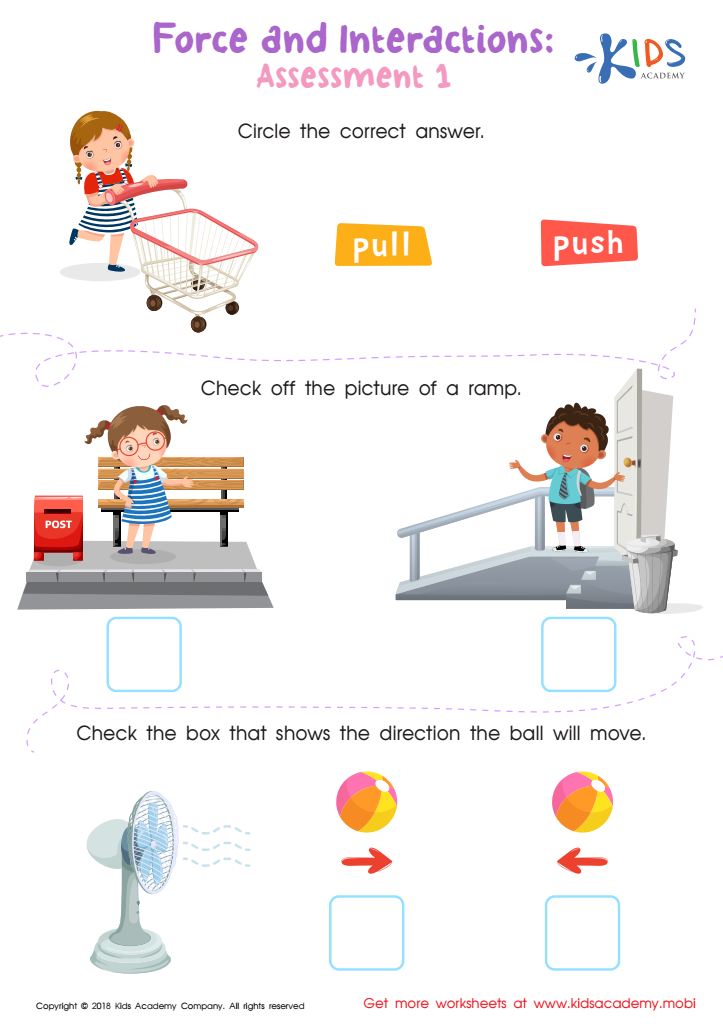
Force and Interactions: Assessment 1 Worksheet
Test your students' knowledge of pushing, pulling, ramps and wind with this worksheet. The first task requires them to identify push or pull pictures. The second asks them to identify a ramp and the third to explain which direction a ball will move when exposed to wind.
 Assign to My Students
Force and Interactions: Assessment 1 Worksheet
Worksheet
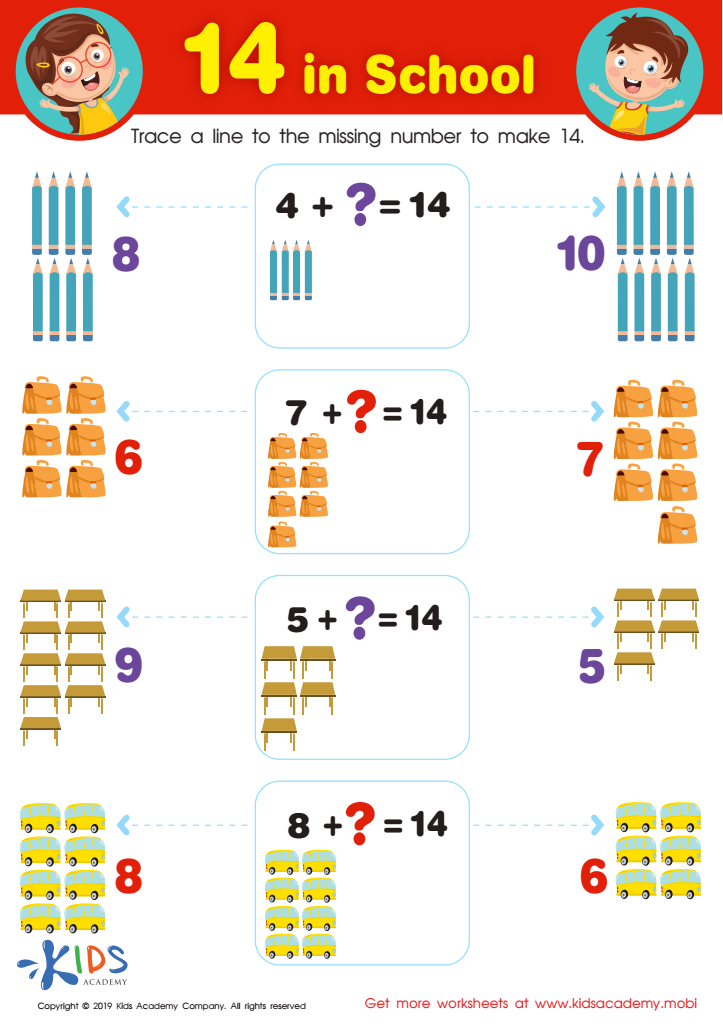
14 in School Worksheet
Remind your kids that adding different sets of numbers can give the same total (e.g. 2+3=5, 4+1=5). Ask them for more examples. Afterwards, work through the exercise. Help them count the objects and trace a line to the missing number that makes the total 14.
14 in School Worksheet
Worksheet
Join Kids Academy for Free
Who is primarily going to use this learning content?







Recognizing shapes is a fundamental cognitive skill for children aged 6-7 and lays the groundwork for more advanced mathematical thinking. Firstly, understanding shapes helps with spatial awareness. As children learn to identify and differentiate shapes, they also learn about their properties, such as the number of sides and corners, and develop the ability to visualize objects from different perspectives.
Developing these skills is not only crucial for geometry but a variety of real-world applications. Furthermore, recognizing shapes enhances early problem-solving skills. When kids are presented with pattern recognition activities or puzzles, the ability to discern different shapes aids in critical thinking and complex reasoning.
In addition to mathematical competency, shape recognition also promotes language development. By learning to describe and categorize shapes, children expand their vocabulary and improve communication skills. Engaging with shapes in interactive ways—such as sorting, drawing, and building with blocks—also enhances fine motor skills, which are essential for tasks such as writing.
Conclusively, an early grasp of shapes can foster a positive attitude towards learning more complex concepts. Parents and teachers play a crucial role in providing stimulating opportunities to engage with shapes, setting the stage for academic success and a well-rounded cognitive development.








