Understanding greater/less than Worksheets for Ages 6-7
3 filtered results
-
From - To
Explore our "Understanding Greater/Less Than Worksheets for Ages 6-7" to make learning fun and engaging for your child. These worksheets are designed to build crucial math skills by helping kids compare and identify numbers using greater than, less than, and equal to symbols. With a variety of colorful activities, worksheets promote logical thinking and boost confidence in mathematics. Perfect for young learners, these resources are aligned with school curricula to reinforce classroom learning. Introduce your child to the joy of numbers with exciting exercises that develop their understanding and pave the way for future math success.
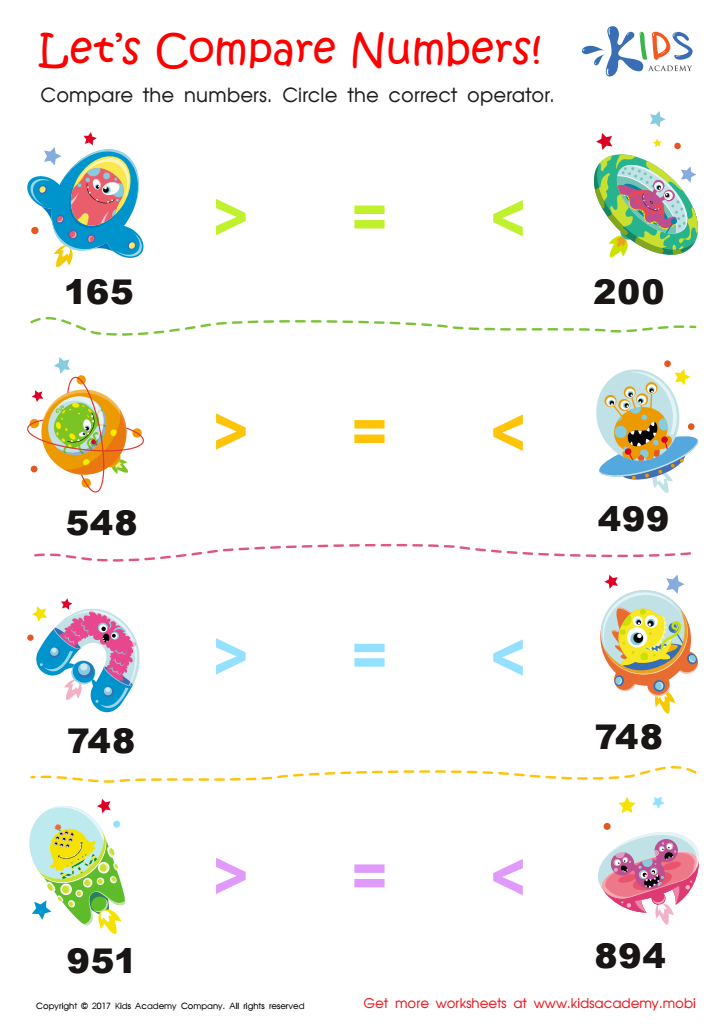
Comparing Numbers Worksheet for 2nd Grade
 Assign to My Students
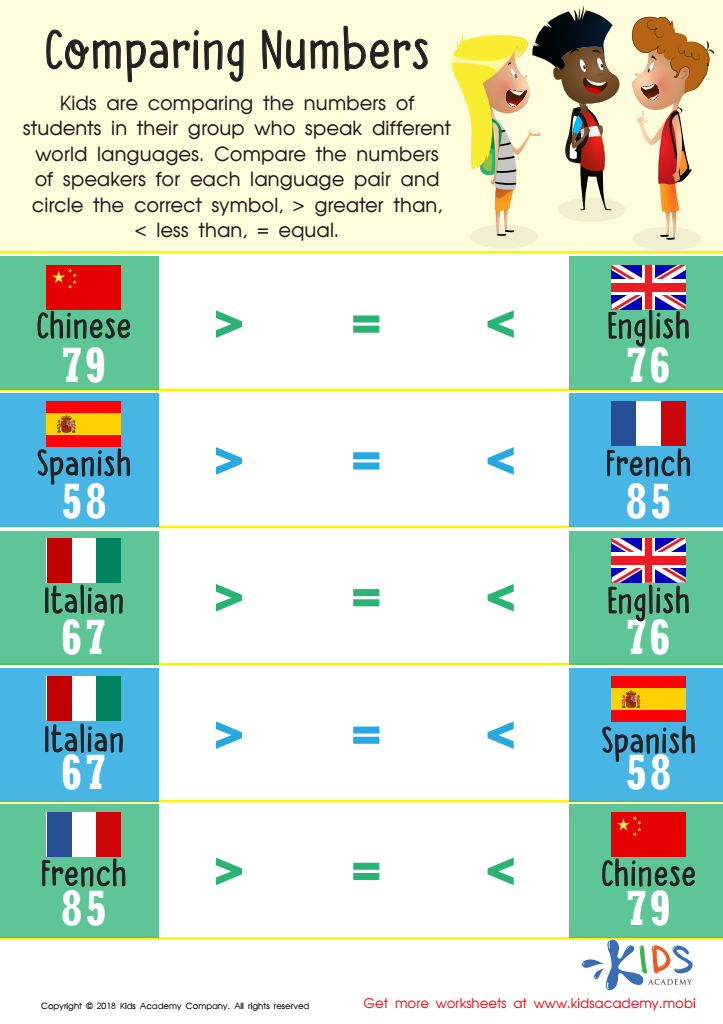
Comparing Numbers Worksheet for 1st Grade





Understanding the concepts of greater than and less than at the ages of 6 and 7 is foundational for a child’s mathematical development. At this age, children are in the early stages of grasping number sense, which is crucial for their ongoing education in mathematics. Knowing how to compare quantities helps children develop their number sense by understanding the relative size of numbers and sets. This skill is not just about mathematics; it supports logical thinking and problem-solving abilities, which are useful across all subjects and in daily life.
When children grasp these concepts early, they build a solid base for more complex arithmetic operations such as addition and subtraction, which frequently require comparing numbers. It also equips them to understand more abstract mathematical concepts later on, including fractions, decimals, and algebra. Moreover, proficiency in comparing numbers encourages confidence and enthusiasm for learning, reducing math anxiety, and fostering a positive mindset towards education as a whole.
For parents and teachers, emphasizing greater than and less than concepts aligns with curriculum standards and prepares children for academic assessments. It’s not just about meeting educational requirements; engaging children with these ideas through interactive activities, games, and real-life examples enhances their overall comprehension and supports their long-term academic success.








