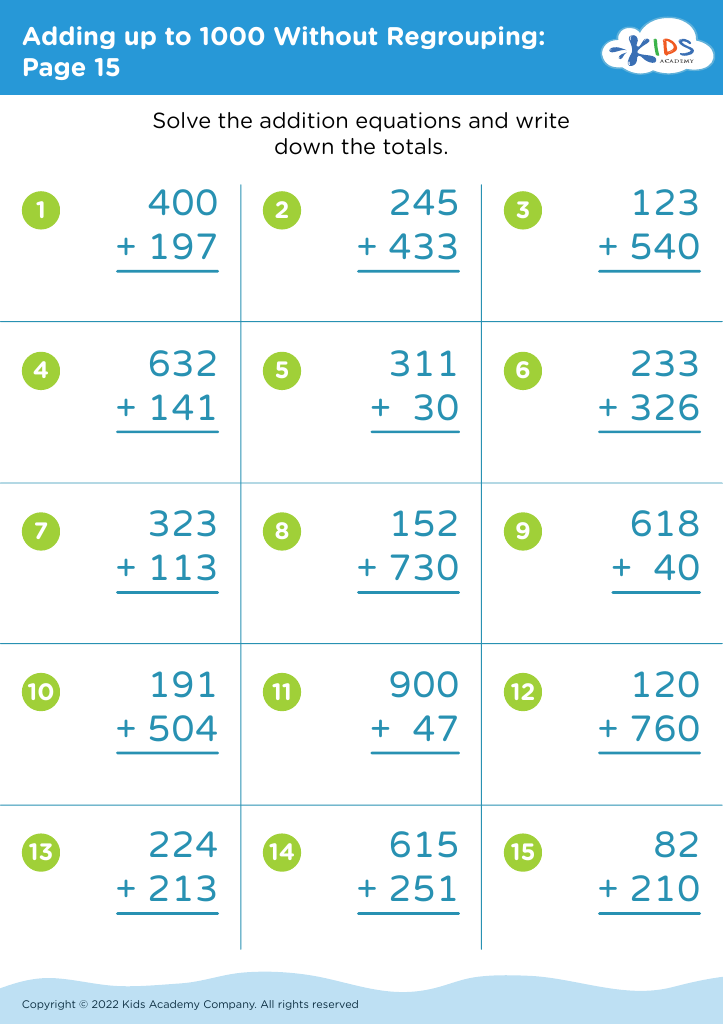




Parents and teachers should prioritize problem-solving skills for children aged 6 to 7, particularly through activities that involve adding up to 1000, as these competencies lay a foundation for lifelong learning and cognitive development. At this age, children are at a critical stage where they transition from concrete concepts to more abstract thinking. By engaging them in problem-solving exercises, they enhance their logical reasoning, critical thinking, and creativity.
Moreover, working with numbers, and understanding how to manipulate them through addition promotes numeracy skills essential for everyday life. Mastering these skills not only supports mathematical proficiency but also fosters persistence, confidence, and resilience. When children successfully solve problems, in turn, they develop a growth mindset, understanding that challenges can lead to learning and improvement.
Additionally, problem-solving in collaborative settings encourages teamwork, communication, and respect for different perspectives. Parents and teachers can guide students in applying their mathematical understanding in real-world scenarios, making them more engaged learners. These skills not only benefit academic success but also prepare children for tackling future obstacles with a positive outlook, setting them up for personal and professional achievements as they grow. Investing time and resources in developing these skills can significantly enrich a child's educational experience.








